A pair of newly released data reports is tracking the residential habits of the two demographic blocs that dominate the housing market.
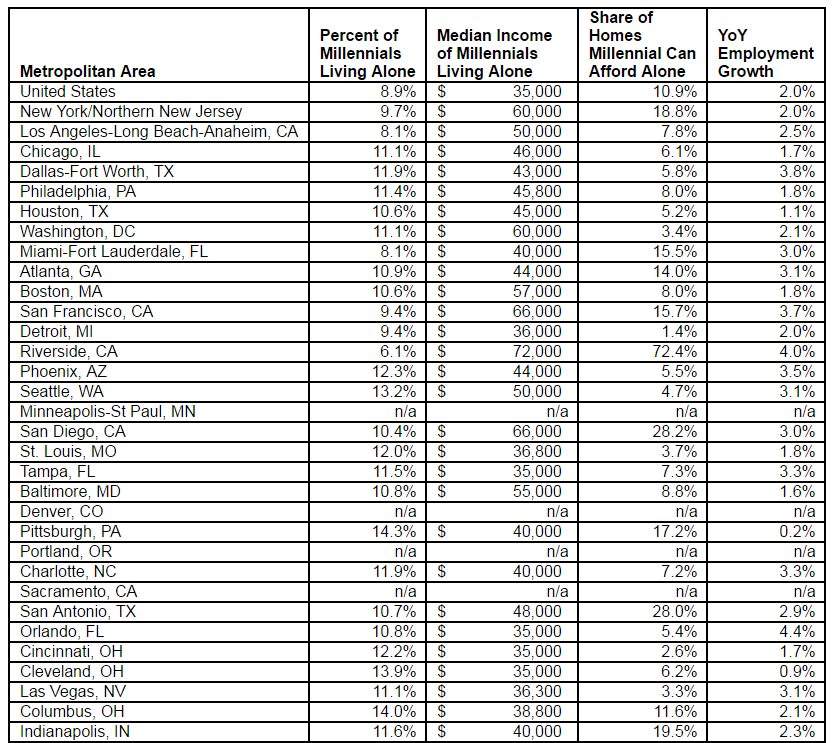
Zillow has studied the lives of solitary Millennials and has concluded that more Millennials live alone in Richmond, Va. than in any other major U.S. metro. The Virginia capital has a 15 percent rate of Millennials living alone, followed by 14 percent in Pittsburgh and Buffalo, N.Y. Other markets with high levels of independent Millennials include Columbus, Ohio (14 percent); Virginia Beach, Va., and Cleveland (tied at 13.9 percent); New Orleans, Austin and Kansas City (tied at 13.4 percent); and Oklahoma City (13.3 percent.) On a national average, almost nine percent of Millennials live alone.
"With home prices and rents rising as fast as they are, it's a common assumption that young adults in many cases cannot afford to live alone," said Zillow Chief Economist Svenja Gudell. "Though that may be true in some markets, there's still a large number of amazing places across the U.S. that are prime for Millennials to thrive independently. These are places where young adults can easily find jobs at a competitive salary, and where housing expenses won't eat up the majority of their income, enabling them to save more."
Separately, Freddie Mac placed its data analysis on Baby Boomers and others aged 55 or older, and the government-sponsored enterprise reached the conclusion that an estimated six million homeowners and nearly as many renters in this age range are considering to move again and rent at some point. The latter is especially unusual, with more than five million indicating they are likely to rent by 2020, with 51 percent of renters expressing a preference for a landlord over homeownership.
"When a population this large expects to move into less expensive rental housing, we have to expect it will create significant new pressure on both the supply and cost of existing affordable rental housing," said David Brickman, executive vice president of Freddie Mac Multifamily.