Less Than One-Third of Millennials Are Homeowners – NMP Skip to main content

Less Than One-Third of Millennials Are Homeowners

Jun 27, 2017
Less than one-third of Millennials are homeowners, but the homeownership rates among this youthful demographic are significantly lower in expensive coastal cities and pricey college towns

Less than one-third of Millennials are homeowners, but the homeownership rates among this youthful demographic are significantly lower in expensive coastal cities and pricey college towns, according to a new data analysis from ABODO.
 
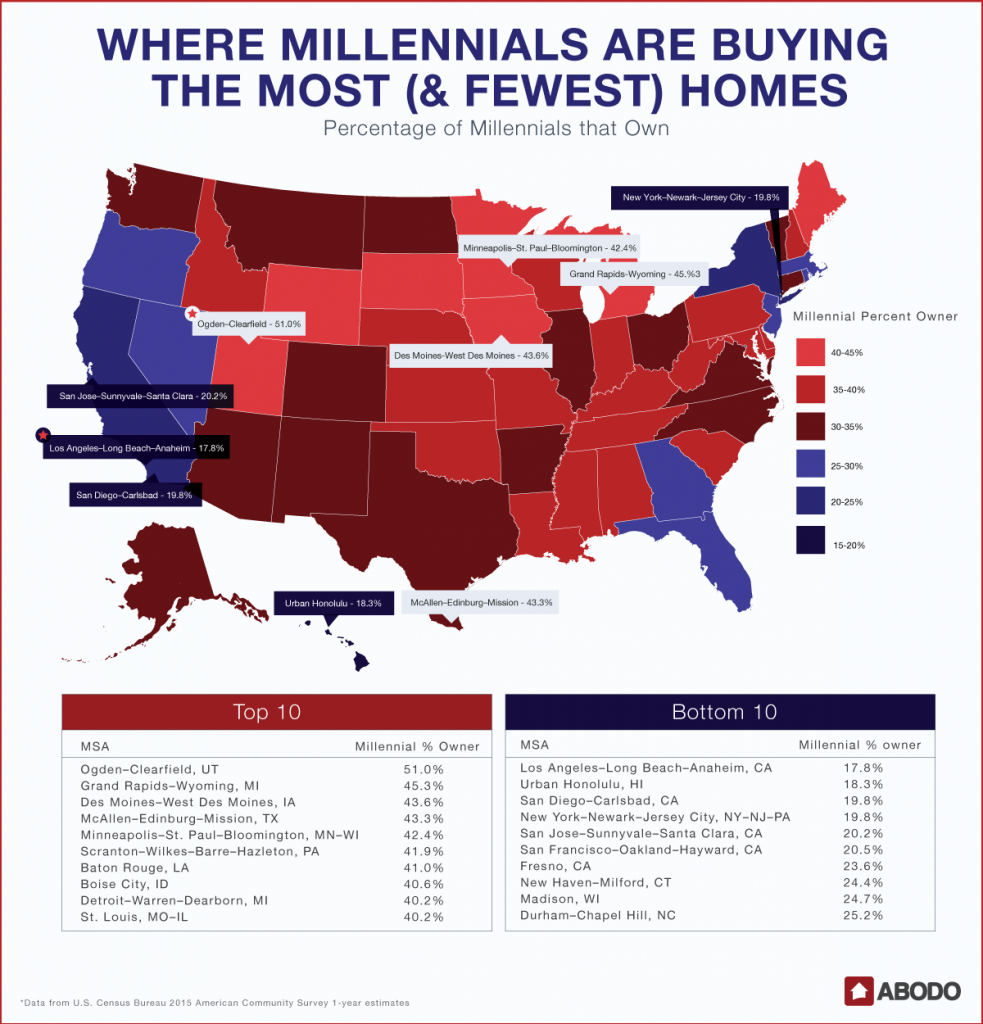
On a national level, 32.1 percent of Millennials are homeowners—back in 2005, the number was 39.5 percent—but those numbers vary among markets. Among the metro areas with higher-than-average Millennial homeownership rates are Ogden–Clearfield, Utah, where 51 percent of Millennials own homes, followed by the Grand Rapids, Mich., metro area (45.3 percent), Des Moines-West Des Moines, Iowa (43.6 percent), the McAllen, Texas, metro (43.3 percent) and Minneapolis-St. Paul (42 percent). ABODO noted that all of these markets are small to-midsize cities in the Midwest, South, and Southwest.
 
However, Millennial homeownership rates are much smaller in major coastal markets: California’s Los Angeles–Long Beach–Anaheim has a 17.8 percent Millennial homeownership rate, the lowest in the country. Other low percentages are in Urban Honolulu (18.3 percent), California’s San Diego–Carlsbad corridor and the New York–Newark–Jersey City metro area, both at a 19.8 percent level.
 
Metro areas with a large college student population are also lacking in Millennial homeowners: Connecticut’s New Haven–Milford metro (24.4 percent), Madison, Wis. (24.7 percent) and Durham–Chapel Hill, N.C. (25.2 percent) have disproportionately high percentages of college-age Millennials relying on renting or dorm life. 
Less than one-third of Millennials are homeowners, but the homeownership rates among this youthful demographic are significantly lower in expensive coastal cities and pricey college towns

 
About the author
Published
Jun 27, 2017
July CPI Eases Mortgage-Rate Risk, But Doesn’t Promise Relief

Consumer inflation rose just 0.1% in July, reducing pressure for a September Fed rate hike as mortgage rates remain near their highest levels of the year

Aug 13, 2026
The Fed Held. The Mortgage Market Got A Warning.

Three policymakers favored an immediate hike, while Warsh welcomed higher bond yields and offered no clear path toward mortgage-rate relief

Jul 30, 2026
New Study Finds UWM's 'All-In' Triggered Industrywide Pricing Spillovers

Research shows wholesale competitors responded to the 2021 Rocket ban by lowering mortgage rates,

Jul 15, 2026
First Major Housing Reform In Decades Becomes Law Without Trump's Signature

Bipartisan ROAD to Housing Act advances supply, construction, and mortgage reforms despite White House protest

Jul 10, 2026
Mortgage Star Conference Honors Women Shaping The Future Of Mortgage Leadership

MWLC honors leaders driving innovation, mentorship, and growth across the mortgage industry

Jul 09, 2026
June Jobs Report Improves Mortgage Rate Outlook

Slower hiring strengthens bonds and eases concerns over additional Fed tightening

Jul 02, 2026


