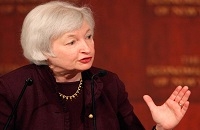
After Larry Summers withdrew his name from contention to succeed Ben Bernanke as chairman of the Federal Reserve, all eyes essentially fell on Janet Yellen, who was assumed to be the second choice for the gig. In his withdrawal letter, Summers stated to President Obama: “It has been a privilege to work with you since the beginning of your Administration as you led the nation through a severe recession into a sustained economic recovery built on policies to promote employment and strengthen the middle class.”
Obama, who backed Summers pretty aggressively, has now decided to back front-runner Yellen, stating that Yellen is "one of the nation's foremost economists and policymakers."
Some Senate Republicans are not likely to get behind the endorsement. “I voted against Vice Chairman Yellen’s original nomination to the Fed in 2010 because of her dovish views on monetary policy," Sen. Bob Corker, a member of the banking committee, told the Washington Examiner. "We will closely examine her record since that time, but I am not aware of anything that demonstrates her views have changed.”
There are, however; Republicans who support Yellen. John Taylor, the top Conservative economist from Stanford, stated back in September “I’ve been positive ... about Janet Yellen.” Taylor served as a member of President George W. Bush’s Treasury Department.
Should Yellen receive the nomination, she would become the first woman to head a major central bank in America. She has served as the Fed’s vice-chairman since 2010 and is known for promoting education and low unemployment. Before her time as vice-chairman of the Fed, Yellen was perhaps best-known for her headbutting with Alan Greenspan regarding inflation being reduced to zero. She argued, at the time, that inflation was good for employment, and would thus stimulate the job market.
"Janet Yellen's nomination signals the President's desire for continuity at the Federal Reserve during this pivotal economic time," said Financial Services Roundtable President and CEO Tim Pawlenty. "Dr. Yellen is a talented economist who will bring a wealth of experience to the job."
Yellen was also part of the Clinton-era group that brought about NAFTA, as well as market deregulation. She supported regulation that has since become wildly unpopular, similar to Larry Summers. Naked Capitalism does a good job in talking about Yellen’s unpopular decisions, especially during the years leading to the burst of the housing bubble. In 2005, Yellen stated “Another development, which may be making housing more like an investment vehicle in the U.S., is that it’s now easier and cheaper to get at the equity—either through refinancing, which has become a less costly process, or through an equity line of credit. These innovations in mortgage markets make the funds invested in houses more liquid. There are also constraints on the supply of housing in a number of markets, including the Bay Area. Probably the most obvious candidate for a fundamental factor is low mortgage interest rates. Even so, the consensus seems to be that the high price-to-rent ratio for housing cannot be fully accounted for by these factors.”
Gawker was quick to point out that Janet Yellen also has so much personal income, she makes Ben Bernanke look like a “pauper.” Here’s a list of her income, as lawfully obtained by Gawker:
►A salary of about $400K from the Federal Reserve
►A pension of about $3K monthly from the University of California
►Several million dollars in stock funds and bond funds.
►Hundreds of thousands of dollars worth of specific stocks, including Pfizer, Raytheon, DirecTV, and OfficeMax.
►A stamp collection valued at $15K-$50K
►And for pocket money, she keeps $15K-$50K in a Merrill Lynch banking cash account, a Wells Fargo checking account valued at $100k-$250K, and a Wells Fargo savings account valued at $250K-$500K.
It’s still not too late to consider Milton Friedman’s computer idea.