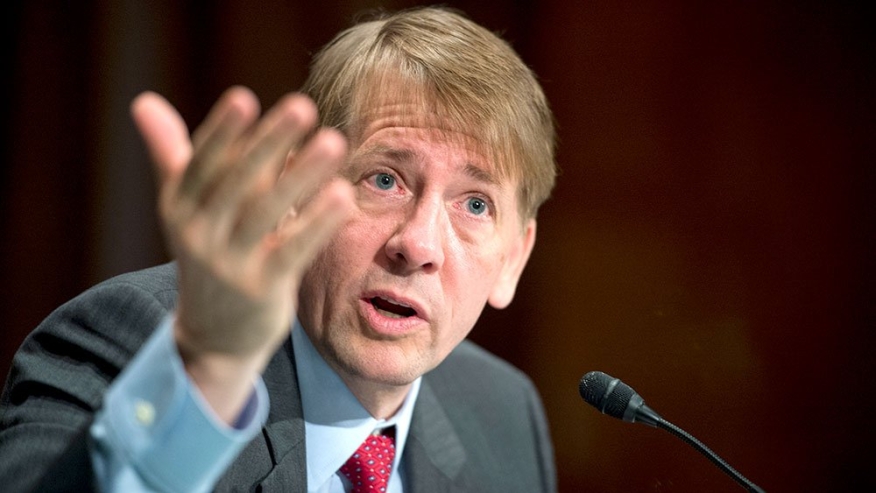
The battle over whether Richard Cordray should remain as director of the Consumer Financial Protection Bureau (CFPB) or whether he should be fired by the new Trump Administration has intensified, with Cordray’s supporters and detractors taking bold new steps to solidify their respective positions.
In the defense of Cordray, the Congressional Black Caucus led by Rep. Maxine Waters (D-CA) published an op-ed column in The Hill, an influential Washington, D.C.-based political journal, praising his work at the CFPB.
“Throughout his nearly four-year tenure, Director Cordray has amassed an impressive record of protecting consumers,” the op-ed stated. “For minority borrowers, the common targets of financial predation, the impact of his leadership has been especially significant. Under Director Cordray, the CFPB has brought nearly a dozen enforcement actions against financial service providers that overcharged or restricted access for minority borrowers. This led to nearly $30 million in civil monetary penalties and over $400 million in restitution for approximately 1.4 million affected minority consumers.”
The op-ed also stated that “Republicans are feigning concern for racial minorities as a justification for the removal of Director Cordray,” citing reports of workplace complaints within the CFPB from nonwhite employees who charged the agency with discrimination. The op-ed piece insisted that the matter was properly settled.
“When an internal report designed to evaluate the CFPB’s Performance Management Rating system revealed disparate treatment for certain categories of employees several years ago, Director Cordray directed changes to the CFPB’s performance rating system and proactively compensated all past and current employees who may have potentially been harmed,” the op-ed continued. “He also empowered a joint labor-management working group within the CFPB to monitor the performance rating system, identify any disparities and their causes, and recommend changes. We applaud Director Cordray’s recognition that racial discrimination has no place in the federal government. We encourage Congressional Republicans and the incoming administration to adopt that same zero-tolerance policy when considering all candidates for federal office.”
On the other side of the spectrum is a new report from Republican staff members of House Financial Services Committee that stated the CFPB potentially violated the Administrative Procedure Act through its promulgating of regulations impacting the auto lending industry. This could potentially be seen as a cue to enable President Trump to fire Cordray—under the Dodd-Frank Act, the CFPB director can only be dismissed for cause. However, a federal court ruling voided that language and stated the president has the authority to fire the director at will. That ruling is under appeal.
Rep. Jeb Hensarling (R-TX), chairman of the committee, has not gone on record to say whether the report should be used as the grounds for terminating Cordray’s position. The CFPB did not publicly comment on the report.