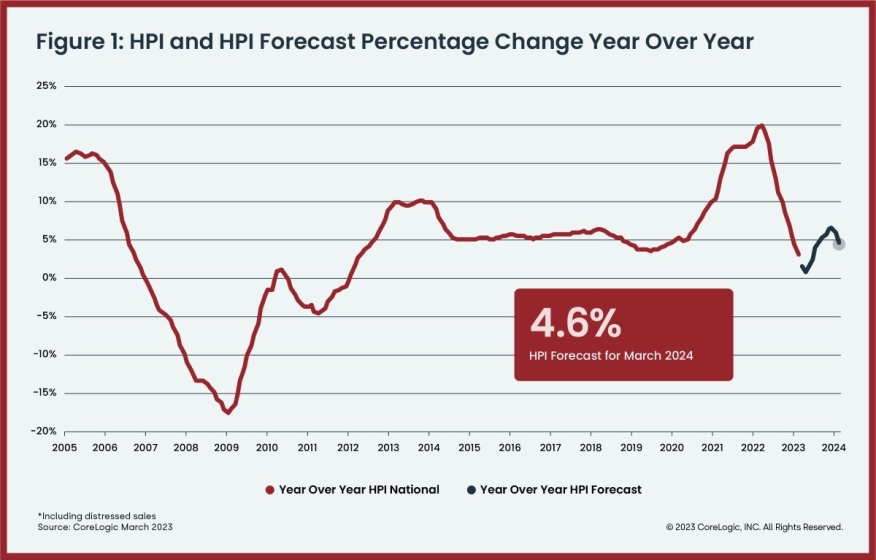
Home prices increased in March for the 134th consecutive month, but the pace of growth was the lowest since the spring of 2012, according to a report from CoreLogic.
U.S. home prices grew 3.1% in March from a year earlier, and grew 1.6% from April, according to the CoreLogic Home Price Index (HPI), released Tuesday.
Ten states saw home prices decline from one year ago, most of them in the western U.S., which partially reflects the region’s lack of affordability and continued inventory shortages, CoreLogic said. Also, demand for higher-priced homes is slowing compared with median-priced homes, pulling appreciation down in that region at a faster pace.
Some potential homebuyers remain hesitant due to economic factors including inflation; slowing job gains and wage growth; a potential recession; and interest rates that are still elevated above a mortgage rate of 5.5% that would likely attract more buyers to the market, the report states.
As a result of these conditions, CoreLogic said, it projects that U.S. annual home-price growth will continue to decline over the spring and early summer before picking back up later this year.
“While housing markets across the country continue to send mixed signals, prices in many large metros appeared to have turned the corner, with the U.S. recording a second month of consecutive monthly gains,” said Selma Hepp, chief economist at CoreLogic. “At 1.6%, the month-over-month increase was twice the average seen between 2015 and 2020.”
Hepp said the monthly rebound in home prices underscores the lack of inventory.
“In addition, while the lack of affordability generally weighs on home price growth, mobility resulting from remote working conditions appears to be a current driver of home prices in some areas of the country,” she said.
Other Key Highlights:
- In March, the annual appreciation of attached properties (4.6%) was 2.1 percentage points higher than that of detached properties (2.5%).
- CoreLogic forecasts show annual U.S. home price gains moving to 4.6% by March 2024.
- Miami posted the highest year-over-year home-price increase of the country's 20 tracked metro areas in March, at 14.8%, while Tampa, Fla., continued to rank second at 6.9%.
- Among states, Vermont and Indiana recorded the highest annual home-price gains, at 9.9% and 9.2%, respectively. Florida was third, with an 8.9% year-over-year increase.
- 10 states recorded annual losses: Washington (-7.4%); Idaho (-3.6%); Nevada (-3.5%); Utah (-3.4%); California (-3%); Montana (-2.3%); Oregon (-2%); Colorado (-1%); Arizona (-0.9%); and New York (-0.6%).