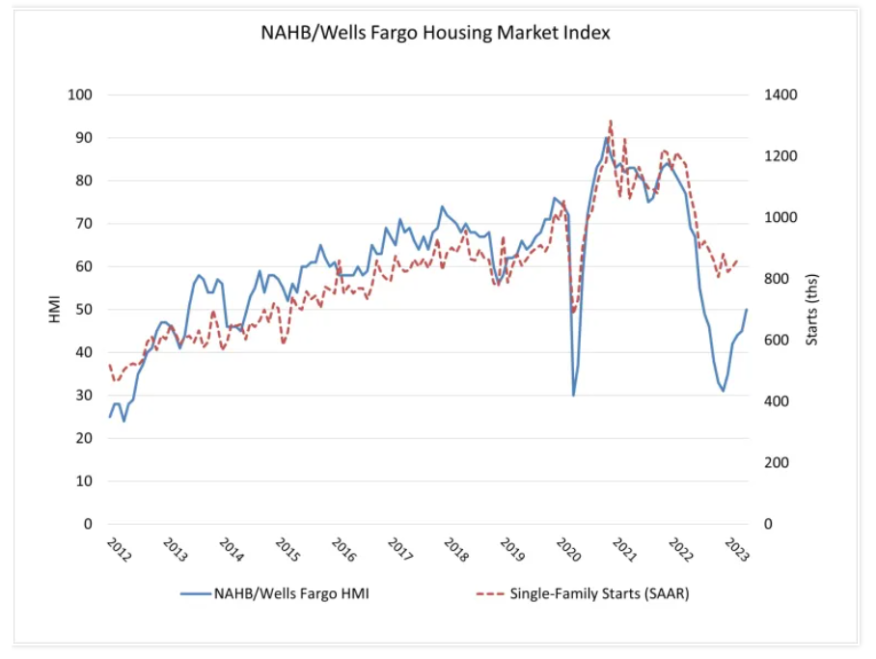
The lack of inventory of existing homes is causing frustration among home buyers, but it has brightened the outlook for home builders.
The low existing-home inventory has boosted new construction, which in turn boosted builder confidence in May, even as the industry continues to face several challenges — including supply-chain disruptions for building materials and tightening credit conditions for construction loans.
Builder confidence in the market for newly built single-family homes in May rose five points to 50, according to the latest survey from the National Association of Home Builders (NAHB)/Wells Fargo Housing Market Index (HMI). It was the fifth straight monthly increase in builder confidence, and is the first time that sentiment levels have reached the midpoint mark of 50 since July 2022.
Construction of new homes is increasing because many homeowners with loans well below current mortgage rates are choosing to stay put, keeping the supply of existing homes near historic lows.
In March, 33% of homes listed for sale were new homes in various stages of construction, up from the average share of 12.7% from 2000-19. With limited housing inventory available, new construction will continue to be a significant part of prospective buyers’ search in the quarters ahead, the NAHB said.
What that has helped to improve the outlook for builders, they continue to face challenges to meet the growing demand. These include shortages of transformers and other building materials, and tightening credit conditions for residential real estate development and construction brought on by the Federal Reserve’s interest rate hikes.
With interest rates more than double what they were in 2021, the HMI survey shows incentives continue to play a key role in attracting buyers, although the use of sales inducements are gradually slowing across the board:
- The share of builders reducing home prices dropped to 27% in May from 30% in April, 31% in February and March, and from 36% last November.
- The average price reduction remained at 6%, unchanged over the past four months.
- 54% of builders offered some type of incentive in May, down from 59% in April and 62% last December.
Derived from a monthly survey that NAHB has conduced for more than 35 years, the NAHB/Wells Fargo HMI gauges builder perceptions of current single-family home sales and sales expectations for the next six months as “good,” “fair” or “poor.”
The survey also asks builders to rate the traffic of prospective buyers as “high to very high,” “average” or “low to very low.” Scores for each component are then used to calculate a seasonally adjusted index, in which any number over 50 indicates that more builders view conditions as good than poor.
All three major HMI indices posted gains in May. The HMI index gauging current sales conditions rose five points to 56; the component charting sales expectations in the next six months increased seven points to 57; and the gauge measuring traffic of prospective buyers increased two points to 33.
Looking at the three-month moving averages for regional HMI scores, the Midwest edged up two points to 39, the South increased three points to 52, and the West moved three points higher to 41. The Northeast held steady at 45.