The gap between the nation’s homebuyers and sellers continues to widen.
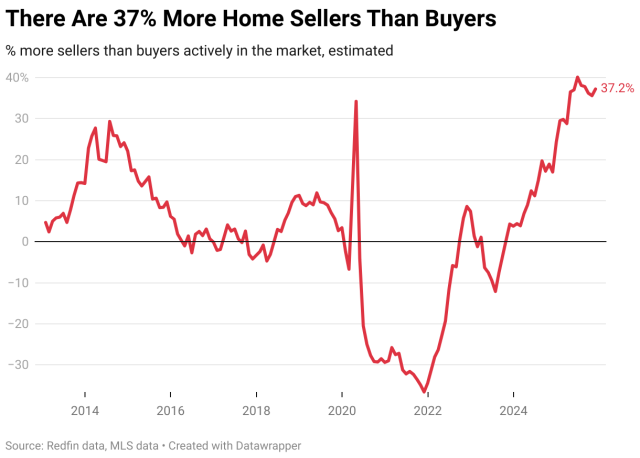
Save for this summer, sellers outnumbered buyers in November by the widest margin since 2013, according to a new Redfin report, which says there were an estimated 37.2% more sellers than buyers in the month.
The mismatch is wide enough that the brokerage firm now calls it “a buyer’s market,” with many buyers, the firm points out, able to negotiate lower prices and possibly other concessions from sellers.
In numerical terms, there were nearly 530,000 more sellers than buyers in November. The 37.2% spread compares to 35.6% in October and a mere 17% a year ago.
When sellers outnumber buyers, buyers typically hold the negotiating power because they have a lot of options to choose from, Redfin explained in its report. That’s why a market with a lot more sellers than buyers is considered a buyer’s market.
Of course, the report points out, “it’s only a buyer’s market for those who can afford to buy.” Unfortunately, it adds, many buyers have been priced out of the market.
Until affordability improves, says Redfin Economist Asad Khan, the market is “likely to remain in buyer’s market territory” with sellers trimming prices and offering concessions to lure buyers to their doors.
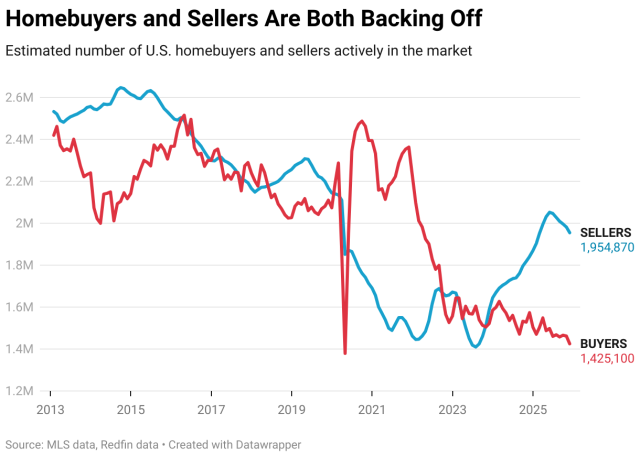
The market now favors buyers, even though the number of active buyers dipped by 2.5% month-to-month in November and 9.4% year-over-year. The estimated 1.43 million buyers currently shopping for a house is the fewest on record, aside from April 2020.
Sellers also have been retreating, but not as quickly. The number of sellers was up 6.2% from November 2024. But 1.4% dropped out on a month-to-month basis to roughly 1.95 million.
Buyers are backing off due to high housing costs and economic uncertainty. Sellers, many of whom are buyers themselves, are backing off in response to lackluster demand.
Overall, 36 of the 50 most populous metros were buyer’s markets in November, seven were in balance and seven were seller’s markets. The buyer’s markets are concentrated in the Sun Belt and on the West Coast, while balanced markets and seller’s markets skew more toward the Midwest and East Coast.
The largest unbalance was recorded In Austin, Texas, where there were 114% more sellers than buyers in November. Next were San Antonio, Texas (106%); Nashville, Tennessee (104%); Fort Lauderdale, Florida (102%); and West Palm Beach, Florida (93.6%).
On the flip side, Nassau County, New York was the strongest seller’s market, with an estimated 39.1% fewer sellers than buyers. The other six seller’s markets were Montgomery County, Pennsylvania (-34.8%); Newark, New Jersey (-31.8%); New Brunswick, New Jersey (-30.5%); Milwaukee, Wisconsin (-18%); San Francisco, California (-11.3%); and Cleveland (-10.5%).