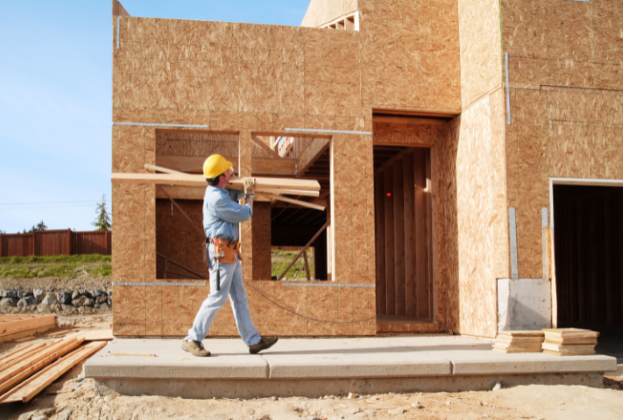
The spring home-building season got off to a slow start in March, as housing starts, completions, and permits all fell from a month earlier.
According to the joint monthly report from the U.S. Census Bureau and the U.S. Department of Housing and Urban Development, privately owned housing starts in March were at a seasonally adjusted annual rate of 1.42 million, down 0.8% from the revised February estimate of 1.43 million. The estimate was also 17.2% below the rate a year earlier.
The decline in starts was primarily due to a drop in multifamily units. The March rate for buildings with five units or more was 542,000, down 6.7% from the revised total of 581,000 in February, but up 6.1% from a year earlier.
Single‐family housing starts in March were at a rate of 861,000 up 2.7% from the revised February figure of 838,000, but down 27.7% from a year earlier.
Starts were mixed by region, increasing in the Northeast (+72.4%) and South (+6.8%) and falling in the West (-28.1%) and Midwest (-23.6%).
Privately owned housing completions in March were at a seasonally adjusted annual rate of 1.54 million, 0.6% below the revised February estimate of 1.55 million, but 12.9% above the March 2022 rate of 1.37 million.
The decline in completed houses was also led by multifamily units. The March rate for units in buildings with five units or more was 484,000, down 7.1% from 521,000 in February but up nearly 60% year over year.
Single‐family housing completions in March were at a rate of 1.05 million, up 2.4% from the revised February rate of 1.03 million, but down 0.2% from a year earlier.
Privately owned housing units authorized by building permits in March were at a seasonally adjusted annual rate of 1.4 million, 8.8% below the revised February rate of 1.55 million and 24.8% below rate a year earlier.
Authorizations of buildings with five units or more were at a rate of 543,000 in March, down 24.3% from the revised February rate of 717,000, and 17.7% below the rate a year earlier.
Single‐family authorizations in March were at a rate of 818,000, 4.1% above the revised February figure of 786,000, but down 29.7% from a year earlier.
First American Deputy Chief Economist Odeta Kushi said the results reflect builders responding to a dip in mortgage rates and the persistent lack of existing-home supply.
“Single-family housing permits, starts, and completions were all up on a month-over-month basis,” Kushi said. “This is consistent with the rise in homebuilder sentiment, which ticked up for the fourth consecutive month in April, with two of the three components — current single-family sales and single-family sales expectations — rising.”
Kushi said single-family permits are a leading indicator of future housing starts, “which leads to more groundbreaking on new homes and more single-family completions, ultimately adding net new supply to the housing stock. Good news for a supply-starved market.”
Even as builders still face several supply-side issues, in addition to volatile mortgage rates, she nonetheless said there is reason for cautious optimism.
“Notably, builders are responding to the recent decline in mortgage rates and the persistent lack of existing-home inventory,” Kushi said. “New-home inventory now makes up 27% of total inventory. Historically, that share was more like 11%. When existing homes for sale are nearly non-existent, a new home at the right price may be an attractive option.”
She noted that completions have outpaced starts since July 2022, and said that will continue to put downward pressure on the number of single-family homes under construction.
“As new, completed home inventory rises, it will provide some relief to a supply-starved market and put downward pressure on new-home prices,” Kushi said, adding that, “Plenty of headwinds remain for the new-home sector — mortgage-rate uncertainty, higher costs, and ongoing supply-side challenges. While there was some positive news for single-family homebuilding this month, it's not yet clear if a sustained recovery is on the horizon.”
Chief Economist George Ratiu of Keeping Current Matters said inflation and the Federal Reserve’s fight against it have influenced the housing market.
“With the Federal Reserve committed to bringing inflation to 2%, interest rates have made a significant impact on real estate markets over the past year, denting demand,” he said. “The sharp 2022 buyer pullback was reflected in the NAHB (National Association of Home Builders) Market Index, which hit a low of 31 in December 2022, a value not seen since mid-2012 at the tail-end of the previous housing bust.”
“However,” he continued, “winter proved that buyer demand remained resilient, as rates seemed to normalize in the 6%-7% range, giving home builders incentives to continue completing new homes. As we move through spring, rising foot traffic and sales are mirrored in rebounding values for the NAHB Market Index, with builders expecting better conditions into the summer.”