Single-family home price appreciation held steady from March to April at 5.3% annually, according to CoreLogic’s Home Price Index (HPI) and HPI Forecast for April, released Tuesday.
On a month-over-month basis, however, home prices increased by 1.1% compared with March 2024, below the seasonal monthly average.
Three states posted double-digit gains – New Hampshire, New Jersey, and South Dakota. Meanwhile, San Diego (+9.9%) overtook Miami (+9.7%) in the index's top 10 of major metros tracked. No state recorded year-over-year home price losses.
CoreLogic predicts that by next spring, national price gains are projected to slow to 3.4%, with only a few states putting up increases of higher than 6% – a reflection of the impact of higher interest rates and the increasing number of homes for sale in some parts of the country.
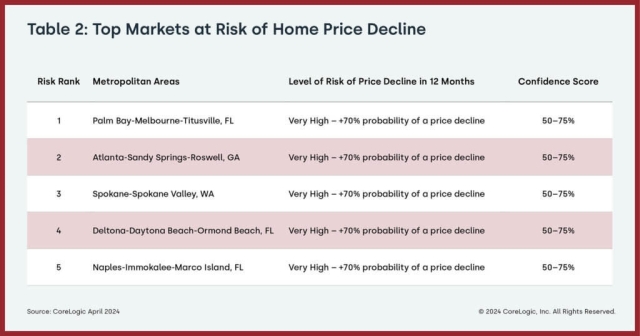
A softening in the market is already being seen in Texas and Florida where new listings are highest.
“Home price growth continues to slow, as a comparison with a strong 2023 spring is still impacting year-over-year differences,” said Dr. Selma Hepp, chief economist for CoreLogic. “Nevertheless, the April uptick in mortgage rates to this year’s high has cooled some of the typical spring homebuyer demand, which pulled monthly gains of 1.1% below the March-to-April average.”
In its HPI report, CoreLogic also noted which metropolitan areas may be at the highest risk of price declines within the next 12 months, as expressed in the graph below:
“The home price slowing also highlights buyers’ increased sensitivity to rising interest rates, as well as the anticipation that presumed lower rates down the road will help ease the affordability crunch,” Hepp continued. “Also, the price cooling is more pronounced in markets where there has been an influx of inventory and/or new construction, as well as those where additional homeownership costs (such as insurance, taxes and HOA fees) have risen relatively faster.”