Declining unemployment rates and rising housing prices have had a significant effect on a sector of homeowners that might come as a surprise.
According to CoreLogic’s just-released monthly Loan Performance Insights Report for December 2021, those two factors have led to a precipitous decline in mortgage delinquencies.
According to the report, the U.S. unemployment rate declined for the sixth straight month in December 2021 to the lowest since the beginning of the COVID-19 pandemic. Meanwhile, national home prices increased by 18.5% year over year, helping more owners regain equity. The combination of these dynamics pushed the overall mortgage delinquency and foreclosure rates to the lowest levels that CoreLogic has recorded in more than two decades.
Company officials said this is the lowest recorded overall delinquency rate in the U.S. since at least January 1999.
“Nonfarm employment grew by 6.7 million workers during 2021, the largest one-year increase, supporting income growth and keeping more families current on their loans,” said Frank Nothaft, chief economist at CoreLogic. “Nonetheless, places hit hard by natural disasters have experienced a spike in missed payments. Serious delinquency rates for December in the Houma-Thibodaux metro area were nearly two percentage points higher than immediately before Hurricane Ida.”
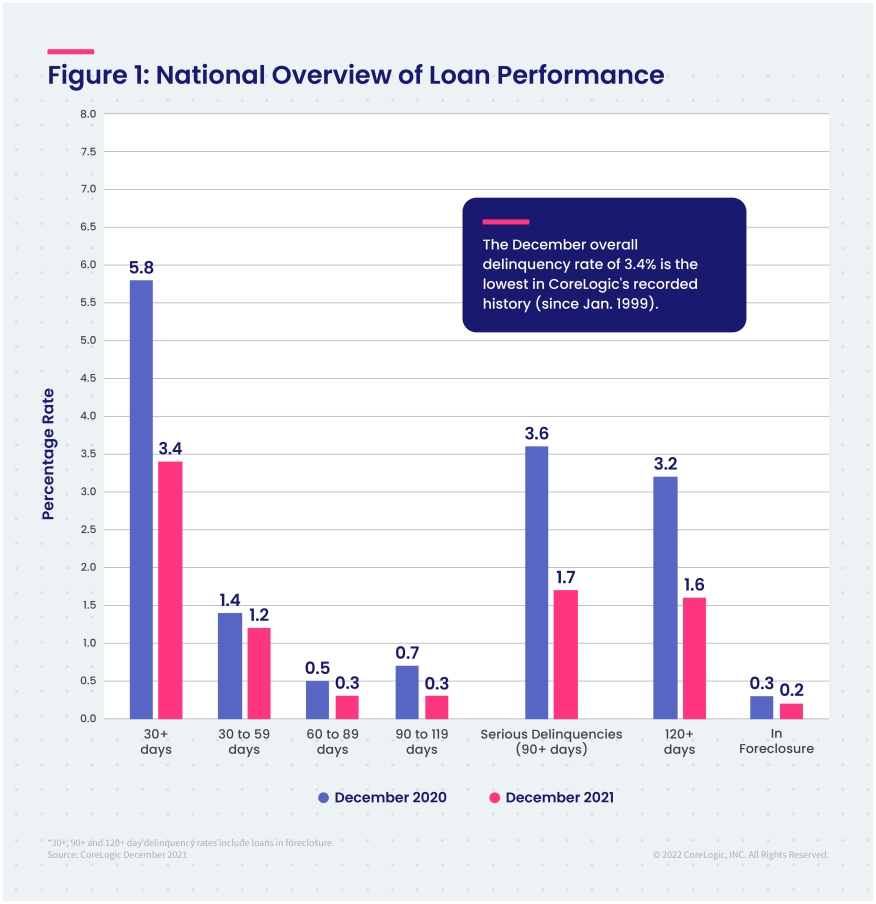
For the month of December, 3.4% of all mortgages in the U.S. were in some stage of delinquency (30 days or more past due, including those in foreclosure), representing a 2.4 percentage point decrease compared to December 2020, when it was 5.8%.
The company analyzed all sectors of the delinquency market and found that:
- early stage delinquencies (30 to 59 days past due) stood at 1.2%, down from 1.4% in December 2020;
- adverse delinquencies (60 to 89 days past due) were at 0.3%, down from 0.5% in December 2020;
- serious delinquencies (90 days or more past due, including loans in foreclosure) stood at 1.9%, down from 3.9% in December 2020 and a high of 4.3% in August 2020;
- the foreclosure inventory rate (the share of mortgages in some stage of the foreclosure process) was at 0.2%, down from 0.3% in December 2020, making it the lowest foreclosure rate recorded since at least January 1999, and
- the transition rate (the share of mortgages that transitioned from current to 30 days past due) stood at 0.6%, down from 0.8% in December 2020.
The report also noted that In December 2021 all states logged year-over-year declines in their overall delinquency rate. The states with the largest declines were: Nevada (down 3.7 percentage points), Hawaii (down 3.5 percentage points), Florida (down 3.4 percentage points), New Jersey (down 3.3 percentage points) and New York (down 3.2 percentage points).
Also, all but one U.S. metropolitan area posted at least a small annual decrease in the overall delinquency rate. The one area where delinquencies were unchanged in December 2021 was Houma-Thibodaux, La. Houma was impacted by Hurricane Ida in the fall, but its overall December delinquency rate improved from October and November, according to the report.