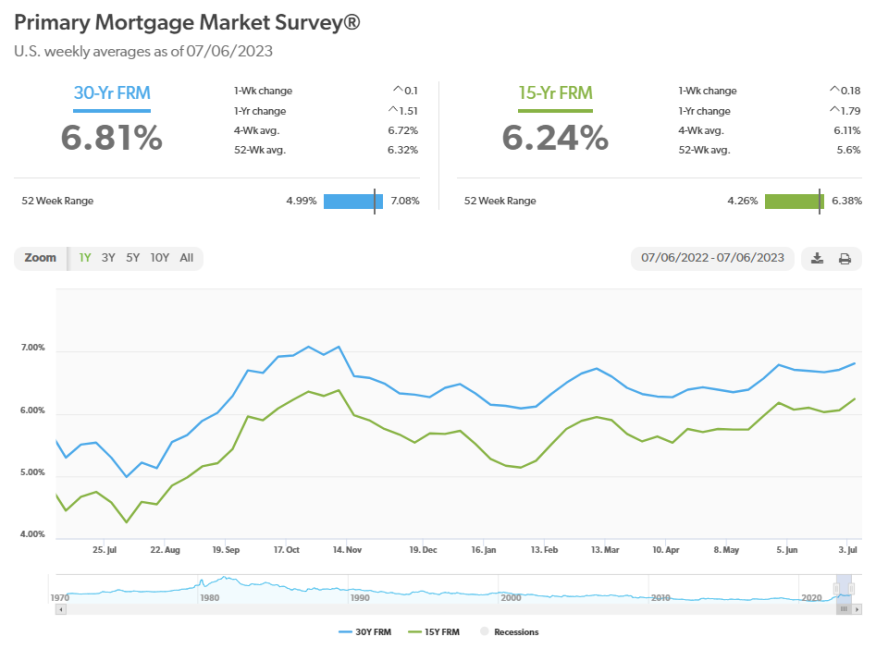
Mortgage rates increased for the second straight week, Freddie Mac said Thursday.
Rates rose for both 30-year and 15-year fixed mortgages, with each rising to a level not seen since the week of Nov. 10 last year.
According to Freddie Mac’s weekly Primary Mortgage Market Survey (PMMS):
- The 30-year fixed-rate mortgage averaged 6.81% as of July 6, up from 6.71% last week. A year ago it averaged 5.3%.
- The 15-year fixed-rate mortgage averaged 6.24%, up from 6.06% last week. A year ago it averaged 4.45%.
Until this week, the average for the 30-year fixed mortgage had moved within a narrow range between 6.39% and 6.79% since mid-April.
The PMMS is focused on conventional, conforming, fully amortizing home purchase loans for borrowers who put 20% down and have excellent credit.
“Mortgage rates continued their upward trajectory again this week, rising to the highest rate this year so far,” said Sam Khater, Freddie Mac’s chief economist. “This upward trend is being driven by a resilient economy, persistent inflation, and a more hawkish tone from the Federal Reserve. These high rates combined with low inventory continue to price many potential homebuyers out of the market.”
Realtor.com Economist Jiayi Xu said mortgage rates mirrored the trend of 10-year Treasury yields.
“The latest core Personal Consumption Expenditure (PCE) Price Index, a crucial indicator monitored by the Federal Reserve for monetary policy decisions, suggests that inflation remains sticky,” Xu said. “Although the headline PCE decreased from 4.3% in April to 3.8% in May, the core PCE — which excludes volatile food and energy prices — only retreated slightly on a year-over-year basis, down from 4.7% in April to 4.6% in May.”
“Meanwhile,” she continued, “the newly released Fed’s minutes reaffirms officials’ determinations to bring the inflation back to the target 2% range. While this may put near-term upward pressure on interest rates, including mortgage rates, we anticipate a gradual decrease that could bring rates close to 6.0% by the end of the year.”
Xu noted that rates for the 30-year-fixed mortgage were over 6.6% every week in June, “creating a challenging summer market for both home sellers and buyers.”
For sellers, she said, high mortgage rates have been compelling them to delay selling and moving, “despite the fact that home prices are still high and consumers generally agree that it’s a good time to sell. In fact, recent data indicated that nearly 82% of home shoppers reported feeling locked-in by their existing low-rate mortgage, while around 1 in 7 homeowners without a selling plan cited their current low rate as their reason for remaining on the sidelines.”
As a result, Xu said, the number of homes for sale remained lower than last year’s levels, with year-to-date new listings lagging 20% behind last year’s pace.
“In addition to the limited inventory for buyers,” Xu added, “the rising interest rates also pose a significant concern for those intending to purchase a home within the next year. About 78% of home shoppers planning to buy in the near future anticipate being priced out of the market if both home prices and mortgage rates continue to rise.”