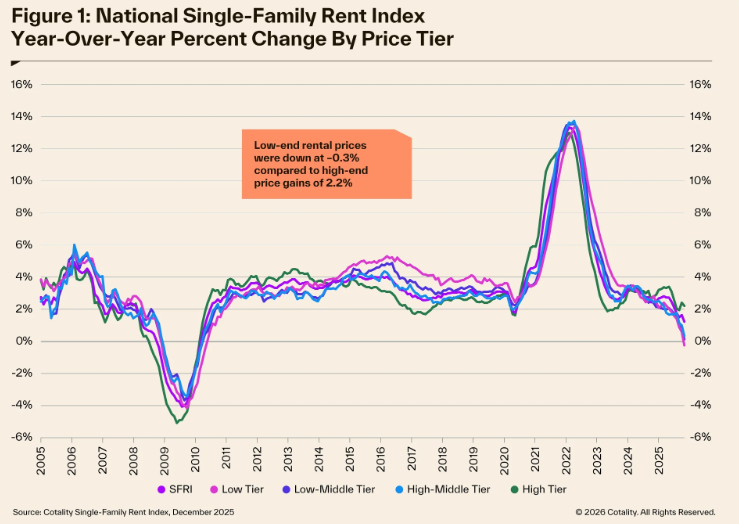
Annual rent growth for single‑family homes across the U.S. weakened substantially by the end of 2025, according to the latest Single‑Family Rent Index (SFRI) released by Cotality, a property data and analytics provider.
The national index showed rents rose just 1.2% year‑over‑year in December 2025, a marked deceleration from the 2.5% annual gain recorded between December 2023 and December 2024, signaling a broad cooling trend in the rental market.
Cotality’s data revealed that 35 of the 50 largest U.S. metropolitan areas posted slower annual rent growth in December 2025 than a year earlier, while 18 metros registered outright year‑over‑year declines in single‑family rents. This included several markets in Florida, Texas, and Arizona where rent growth turned negative, reflecting shifting demand dynamics and increasing vacancies in some regions.
“The single-family rental market ended 2025 on a notably softer trajectory. 35 of the 50 largest metros posted slower annual rent growth in December 2025 than in December 2024, and 18 recorded outright annual declines — including eight in Florida, three in Texas, and two in Arizona. In several of these markets, persistently high multifamily vacancy rates are giving renters meaningful leverage, softening rents, even in the single family segment,” said Molly Boesel, senior principal economist at Cotality, “Overall rent growth remains near 15 year lows, yet the high priced tier continues to track close to its long run trend, underscoring the K-shaped dynamics shaping today’s housing market. Affordability pressures remain front of mind for budget-constrained renters as these conditions persist.”
Renters are gaining leverage as multifamily vacancy pressures spill over into the single‑family segment, softening price increases even for detached homes traditionally seen as more resilient. In December, high‑end single‑family rents increased 2.2%, down from 2.8% a year earlier, while low‑end rental prices actually declined by 0.3%, a stark contrast to the 2.8% annual gain seen in the same period of 2024.
By property type, detached rentals saw rent growth of just 0.8%, with attached rentals posting a slightly higher 0.9% gain — both figures reflecting reduced upward pressure on rents.
Regionally, Chicago continued to stand out with the highest rent growth at 4.8%, followed by Philadelphia (3.3%), Detroit (3.1%), New York‑Jersey City‑White Plains (2.5%), and Los Angeles (2.4%). Conversely, Dallas posted a ‑1.2% year‑over‑year decline, while Miami and Houston also experienced negative rent trends.