California economist says COVID-19 stimulus payments caused problems.
KEY TAKEAWAYS
Economist says the Fed's interest rate hikes are causing economic woes.
He says the best way to fight inflation is with inflation.
A recession isn't on the horizon, and the country's economic woes are due to the government's response to COVID-19, a California economics professor insists.
Christopher Thornberg, director of the UC Riverside School of Business Center for Economic Forecasting and Development, also says the housing market is not going to collapse.
Thornberg made his comments to local business and government leaders during his presentation at the Financial Partners Credit Union's 6th Annual Economic Forum last week in Costa Mesa, Calif.
He was adamant that the root of inflation was the government’s COVID-19 stimulus package.
“The chaos starts with this overstimulation,” he said, talking about legislation that passed during the pandemic to provide financial assistance to Americans. “Households suffered $820 billion in economic harm, and, for the trouble, they (Congress) gave back $2.1 trillion.
Get the NMP Daily
Essential stories, every weekday.
Christopher Thornberg
“What the economy is experiencing right now is a stimulus hangover, not a recession,” he said.
A recession, he said, is very different.
“The very simplistic definition of a recession is two quarters of negative growth,” Thornberg said. “This is nonsensical."
“No true economist would define a business cycle so tritely,” he added.
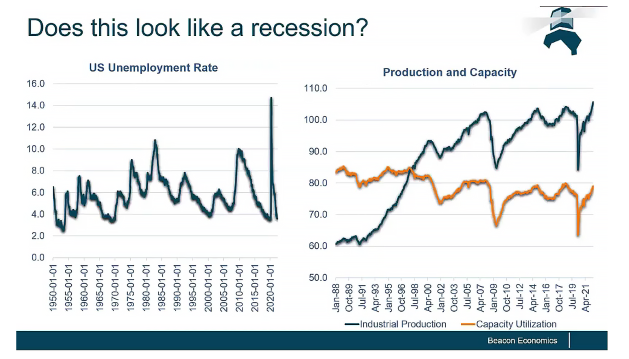
Thornberg cited statistics suggesting the economy is far from being in a recession. “We’re seeing some of the most bizarre paring of statistics I could possibly show you,” he said. “How often have we had two quarters of negative growth when we’ve had less than 4% unemployment?”
At one point during his presentation he asked, “Are we heading into a recession?"
"Not a chance,” he answered.
He defined a recession as a period when the economy "is performing below what it could perform at."
“It’s a period of time defined by excess capacity,” he added. “People want jobs but can’t find them, (thus) unemployment is high. Factories have the ability to produce goods, but no one wants to buy them (because) capacity utilization is low.”
He said the gross domestic product (GDP) is going down, but not because “it’s a problem of excess capacity driven by some broad market failure.”
He blamed the GDP’s downward swing on the Federal Reserve, saying its tactics — raising interest rates to combat inflation — is causing more problems.
“What should the Fed be doing?” he asked. “The answer is they should be doing absolutely nothing. What’s the best way to get rid of all this excess cash in the economy — inflation!"
“Inflation is its own cure, and the money will get absorbed,” he continued. “Instead, they just keep cranking it up, and they’re creating a lot of pains in small portions of the economy and the pain is only going to get worse.”
Housing, he said, is the largest recipient. “There’s no more rate-sensitive sector in the economy than real estate.”
Despite higher interest rates, Thornberg said, the housing market is not about to collapse.
“The cost of housing is going through the roof,” he said. “There’s big sticker shock going on and how that shakes it out remains to be seen.”
The increase in housing prices, he said, has also been beneficial: It brought about an increase in the equity people have in their homes.
“We have $9 trillion in new equity,” he said. “There’s $28 trillion in housing equity today.”
The dispute over publicly marketed homes comes amid a Compass–Rocket alliance linking home search, buyer inquiries, and financing offers
Six multiple listing services have sued Compass over its demands that they stop penalizing agents who publicly market homes without sharing the listings through the MLS, escalating a dispute over who gets access to for-sale inventory and when.The lawsuit, filed Oct. 21 in th...
Veterans United’s survey finds less willingness to hold out for lower rates, but little change in purchase timelines
Prospective homebuyers are growing more pessimistic about interest rates, and less inclined to wait for relief.In Veterans United Home Loans’ latest survey, 57% expect interest rates to rise over the next year, up from 45% a year earlier. Yet the share who would consider wai...
September’s decline leaves originators competing for fewer purchases, while rising borrowing costs and limited new listings keep affordability under pressure
Realtor.com finds 66 of 99 metros favor buyers or are moving that way, while rising financing costs have cut borrowing capacity 7.2% since late August for a fixed monthly payment