Even in a market where overall home prices are rising, individual homes can lose value.
And so it is that Zillow reports that as of October, 53% of all houses lost value. That doesn’t mean that they sold for less than what their owners paid, but rather, they were worth more a year ago than they are now.
At the same time, though, Zillow says 4.1% of all houses are worth less than their previous sale price. And 1.6% are down “substantially” — more than 5% — from the last selling price.
Moreover, the listing site found that 3.4% of October’s listings are being offered at less than what their seller’s paid, with 2% of those listed for substantially less.
As measured by Zillow’s Zestimates, the share of homes that are not worth as much today as they were a year ago is the largest share of homes with declining values recorded since April 2012, when the housing crash was just starting to bottom out.
Since July of 2022, the site also reports, most homes have fallen from their peak value. The average drawdown of all homes is 9.1%, but that hasn’t worsened substantially over the past three years.
It’s a larger setback than the 3.5% drop measured in the spring of 2022, but still slightly lower than pre-pandemic rates, and a far cry from the 27% average drawdown in early 2012.
Zillow says it is “important to consider that the peak for most homes was fairly recent.”
Most peak Zestimates were hit within the past few years. But most homes were purchased well before then and for quite a bit less.
That means the majority of owners are still sitting on sizable gains.
Among homes with sales records in Zillow’s database, the median home was last purchased 8.6 years ago and has experienced a 67.2% increase in value since.
Of course, “losses” are not realized until a house sells. The 3.4% of new listings that are priced below their last sale price is under the 4.1% share of all homes with Zestmates below previous price. Still, that’s up from 2.1% a year ago.
The share of homes down substantially has grown from 0.8% to 1.7% over the past year. Historically, that’s not a high percentage. But in areas where there were an outsized number of homes sold during the pandemic-era boom, the share is much higher.
In Austin, Texas, for example, 17% of all properties are estimated to be valued substantially lower than their last sale price.
Lost values have been most widespread in the West and South. All told, 49 of the 64 major metros in the two regions have the most homes that have fallen in value.
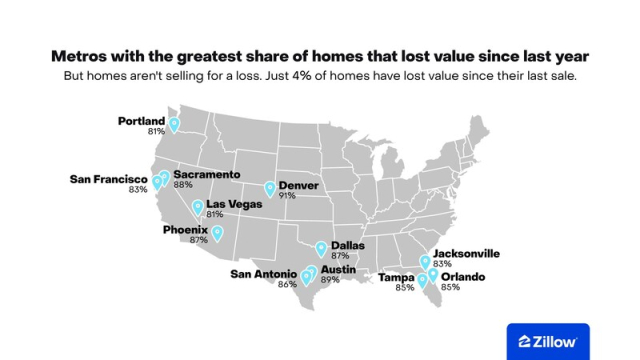
More homes have slid in Denver, Colorado than in any other metro at 91%, followed by Austin, Texas (89%); Sacramento, California (88%); Phoenix, Arizona; and Dallas, Texas (both at 87%).
In sharp contrast, only three of the 36 major metros in the Northeast and Midwest have had major declines over the past year – Minneapolis, Minnesota, down 55%; Des Moines, Iowa, off 54% and Scranton, Pennsylvania, down 52%.
While the losses have largely missed the Northeast and Midwest so far, Zillow adds, declines are spreading to more homes in all metros.