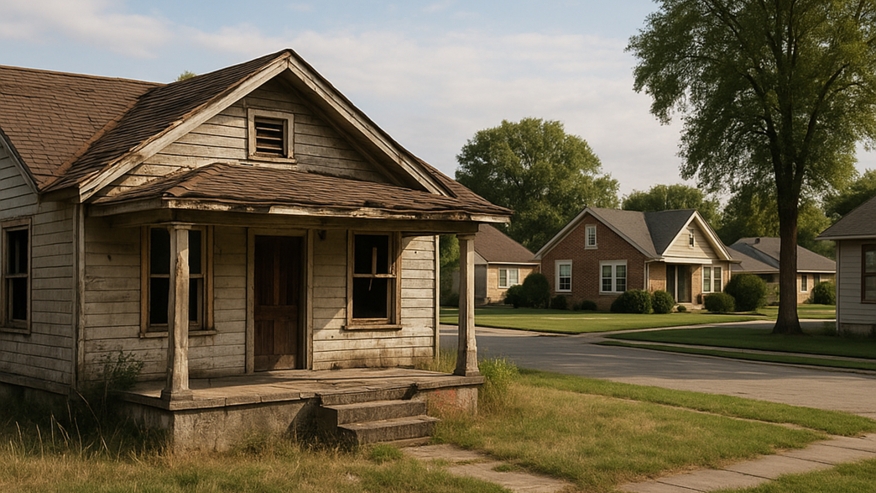
The share of vacant residential properties across the U.S. remained steady for the 13th consecutive quarter, according to ATTOM’s Q2 2025 Vacant Property and Zombie Foreclosure Report. Roughly 1.3% of all homes — about 1.4 million properties — were vacant during the quarter, signaling continued strength in post-pandemic housing stability.
However, the report also notes a modest year-over-year rise in so-called “zombie properties” — homes vacated by owners as they enter the foreclosure process and left sitting empty, potentially dragging down neighborhood property values.
Among large metro areas, the worst zombie property concentrations were found in Wichita, Kan., Peoria, Ill., and Toledo, Ohio.
“Thankfully, we’re not seeing a lot of homes sitting vacant due to pending foreclosures, which is good for families, neighborhoods, and the market,” stated Rob Barber, CEO of ATTOM, which is a curator of land and property data and real estate analytics. “However, foreclosure filings have shown a recent uptick — with April seeing a 14% increase compared to the same month last year.”
Zombie properties accounted for 3.3% of all homes in the foreclosure process during the second quarter, totaling 7,329 homes. That’s essentially unchanged from Q1 2025, but up slightly from 2.9% in the same period in 2024. Overall, one in every 14,207 homes in the U.S. was a zombie property — still a low figure, according to ATTOM.
“Nobody wants to see a return to the days of the 2008 housing crisis when vacant, blighted homes were common in many parts of the country,” Barber added. “So far, buyers seem to be scooping up these repossessed homes relatively quickly, so they aren’t sitting empty.”
The number of homes in foreclosure rose 4.8% from Q1 to Q2 2025, following five consecutive quarters of decline, but is still down 6.3% from this time last year.
On a state level, the number of zombie properties increased quarter-over-quarter in 30 states and Washington, D.C., though mostly by small amounts.
The largest year-over-year increases were in:
- North Carolina (up 52.5%);
- Iowa (52.1%);
- Texas (51.9%);
- South Carolina (43.8%); and
- Kansas (29%).
Meanwhile, the biggest decreases were seen in:
- Massachusetts (down 48.7%);
- Maryland (22.1%);
- New Jersey (17.6%);
- California (8.9%); and
- Illinois (8.8%).
Among large metro areas, the worst zombie property concentrations were found in Wichita, Kan. (12.1%), Peoria, Ill. (11.8%), and Toledo, Ohio (10.2%). On the other end of the spectrum, cities like Barnstable, Mass. (0%) and Atlantic City, N.J. (0.2%) showed negligible zombie property presence.
Vacancy rates overall remain highest in the South, with Oklahoma (2.4%), Kansas (2.3%), and Alabama (2.2%) leading the way. In contrast, Northeastern states such as New Hampshire (0.3%), Vermont (0.4%), and New Jersey (0.5%) had the lowest vacancy rates.
ATTOM’s report serves as a sort of barometer for housing health. While the vacancy rate’s long-term consistency is encouraging, the slight rise in zombie properties offers a reminder that economic pressures continue to ripple through some parts of the housing market.