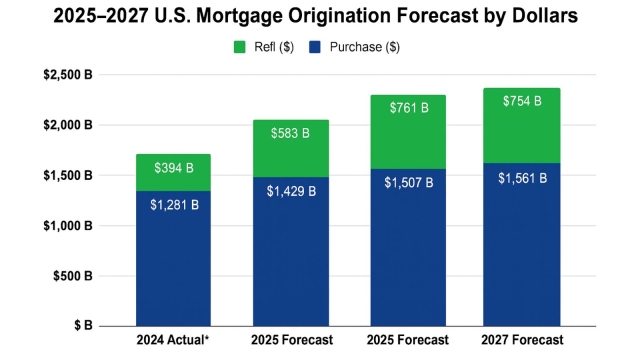
Total mortgage originations will jump 13% next year to $2.27 trillion, according to a new forecast from iEmergent.
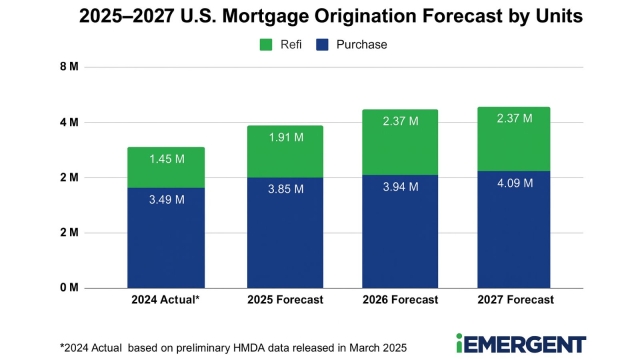
Slowing economic growth and easing interest rates will fuel a refinancing rebound as well as a “modest” gain in purchase money mortgages, the advisory service firm projected. Refinance lending is expected to grow 24% as lower rates boost activity, while a 2.3% increase in purchase loans will help push total loan count up nearly 10% year-over-year, the company said.
Total originations for this year are forecasted to surpass $2 trillion for the first time since 2022, driven by a 48% jump in refinance dollars and 12% in purchase dollar gains, increasing an overall 20% from 2024.
For 2027, the company is looking for purchase activity to hit 4.09 million loans totaling $1.56 trillion, while refinance units are expected to hold steady at 2.37 million, with dollars dipping slightly at $754 billion.
iEmergent’s projections are the second so far in this forecasting season to suggest a big jump in lending activity in 2026. Earlier, Cotality weighed in with a similar projection. The Mortgage Bankers Association (MBA) will offer its estimates at its annual convention later this month in Las Vegas.
The firm’s outlook reflects a shifting economic landscape, said Chief of Forecasting Mark Watson.
As tariffs impact spreads, Watson explained, consumer confidence will wane and the labor market will cool. At the same time, he expects that GDP growth to slow further, setting the stage for lower interest rates and a modest housing recovery.
Long-term interest rates are expected to rise slightly by the end of 2025 but fall again in 2026 as growth weakens. That drop should spur a rebound in refinances and lift overall mortgage originations.
“Crossing back above $2 trillion in 2025 signals renewed strength in the mortgage market,” Watson said. “By 2026, lower rates and moderating home prices should support activity, though affordability challenges will persist, especially for first-time buyers.”
In dollar terms, purchase money lending should hit $1.507 billion next year, the company projected, while refinance lending should add $761 billion to the pot. For 2027, purchase loans will rise slightly to $5.561 billion but refinancing will dip to $754 billion.