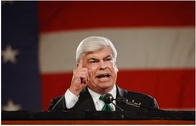
Senate Banking Committee Chairman Chris Dodd (D-CT) was joined by fellow committee members Jack Reed (D-RI), Charles E. Schumer (D-NY), Robert Menendez (D-NJ), Daniel Akaka (D-HI), Jon Tester (D-MT), Mark Warner (D-VA), Jeff Merkley (D-OR) and Michael Bennet (D-CO) to unveil a tough, bold bill to reform the way that our financial system is regulated. “It is the job of this Congress to restore responsibility and accountability in our financial system to give Americans confidence that there is a system in place that works for and protects them,” Dodd said at the press conference. “We must create a sound foundation to grow the economy and create jobs.”
“The financial crisis exposed a financial regulatory structure that was the product of historic accident, created piece by piece over decades with little thought given to how it would function as a whole, and unable to prevent threats to our economic security.”
“This is a thorough and carefully constructed plan. It will promote innovation and job creation while protecting consumers and our economy as a whole from another crisis like the one we are now in. I look forward to the continued input and cooperation of my colleagues from both sides of the aisle.”
When questioned about his bill Dodd told reporters “This is not a time for timidity.”
“The American people have been through a lot over the past year. They deserve an economy in which Americans can find jobs, manage their money, and build better futures for their families. They deserve the real and meaningful change in this bill.”
► Click here for a summary of the discussion draft.
► Click here for the full text of the discussion draft.
Below is Dodd’s statement and prepared for delivery.
“Thank you all for coming, and I would like to thank my Banking Committee colleagues for joining me and for all of the hard work they have put into this endeavor.”
“Over the past year, Americans have faced the worst financial crisis since the Great Depression. Millions of Americans have lost their homes, their jobs, and their savings – and yet, they’ve watched some of the people and institutions that caused this mess collect million dollar bonuses and receive billion dollar bailouts.”
“Those hard working Americans are asking, what is the government doing to ensure their economic security?”
“It is the job of this Congress to restore responsibility and accountability in our financial system to give Americans confidence that there is a system in place that works for and protects them.”
“We must create a sound foundation to grow the economy and create jobs.”
“And so today, after months of thoughtful consideration – the Banking Committee has held more than 50 hearings on these issues in the last year alone - I am unveiling sweeping and long overdue comprehensive financial reform legislation.”
“The financial crisis exposed a financial regulatory structure that was the product of historic accident, created piece by piece over decades with little thought given to how it would function as a whole, and unable to prevent threats to our economic security.”
“This proposal will create a new architecture to make our financial institutions more transparent, more responsible, and more accountable to the American people. It will address the problems of the past, and look forward to the needs of the future.”
“For decades, Washington has failed to deliver the substantial reform we need. If we fail again this time, our economy will be vulnerable to another crisis.”
“Our plan will stop abusive practices by creating an independent Consumer Financial Protection Agency with one mission: standing up for consumers. Whether taking out a mortgage, getting a credit card, or investing for retirement, Americans deserve to receive clear and accurate information, to be protected from hidden fees and abusive terms, and to know that the financial products they’re being offered are safe.”
“We will end “too big to fail.” We cannot allow the collapse of a few firms to threaten our entire economy. Our plan will create an independent council of regulators to identify risks, so that government can act to prevent a crisis. We will have a mechanism in place to safely shut down large failing companies without destabilizing the financial system. No longer will the Federal Reserve’s emergency lending authority be used to prop up a failed institution.”
“Our proposal will replace the myriad government agencies that failed to rein in risky schemes with a single, accountable federal banking regulator. We will do this while preserving the dual banking system with a separate division for community banks that have never posed, and do not now pose, the same risks as these huge financial institutions. For firms that play by the rules, this single prudential regulator will provide clarity, cut red tape, and make it easier to compete. But those institutions that would undermine the security of our economy will no longer be able to shop for the weakest regulator.”
“We will eliminate regulatory gaps that allow risky practices to fly beneath the radar – including over-the-counter derivatives, hedge funds, asset-backed securities, and payday lending.”
“And on derivatives, I would like to recognize the work of the Agriculture Committee, and I look forward to working with Chairman Lincoln and Ranking Member Chambliss as we move forward on these very complicated matters.”
“And we will demand transparency from credit rating agencies and hold them accountable for the quality of their ratings.”
“To restore confidence in our markets and encourage investment, we will require companies that sell products such as mortgage-backed securities to keep “skin in the game” so that they won’t sell worthless securities to investors.”
“And, because public companies are owned by their shareholders, we will give those shareholders a greater say in how those companies are run, including how executives are compensated.”
“This is a thorough and carefully constructed plan. It will promote innovation and job creation while protecting consumers and our economy as a whole from another crisis like the one we are now in. I look forward to the continued input and cooperation of my colleagues from both sides of the aisle.”
“I will not stand for attempts to protect a broken status quo, particularly when those attempts are made by some of the same special interests who caused this mess in the first place.”
“The American people have been through a lot over the past year. I hear from them every day. They are business owners forced to shutter their doors and lay off workers because their credit dried up. They are senior citizens who have delayed their retirement because their 401(k) vanished. They are ordinary Americans who did nothing wrong, but are paying a steep price. They deserve an economy in which Americans can find jobs, manage their money, and build better futures for their families. They deserve the real and meaningful change in this bill.”