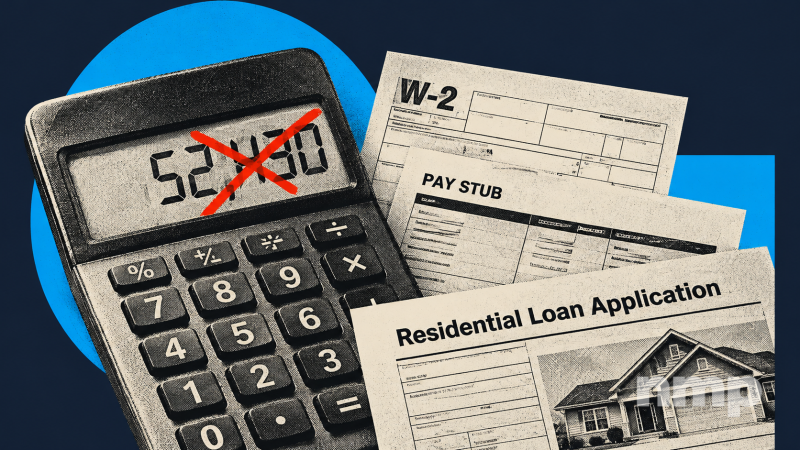
Last April, the Community Home Lenders of America (CHLA) released its Gen Z Homeownership White Paper. The paper painted a somewhat alarming picture of the unprecedented challenges families and individuals in their 20s and 30s face in achieving the American dream of homeownership.
Six months later, how is Gen Z faring when it comes to these challenges? The answer: Not so good.
In that short period, 30-year mortgage rates rose almost a full percentage point, from 6.30% to 7.18% as of Nov. 5. At the same time, home prices continued their upward trajectory. It doesn't take a Ph.D. to do the math that skyrocketing mortgage rates + modestly rising home prices = worsening homeownership affordability.
Meanwhile, consumers are stressed. The latest New York Federal Reserve Report on Household Debt and Credit showed that household debt reached a record $19.1 trillion in the third quarter of 2026. Inflation is heating up, with the October CPI rising 0.4%. Wages are not keeping up with inflation, with CNBC reporting in August that year-over-year inflation exceeded wage growth. Gen Zers struggling to make ends meet increasingly have to stretch to take on a mortgage on a new home.
Other factors also continue to work against first-time homebuyers, like increasing competition for home purchases from all-cash buyers and a reluctance among many home sellers to accept offers from buyers using low-down-payment FHA mortgages.
It is clear that bold action is needed to address our first-time homeownership affordability challenges. Partisanship, sloganeering, and tinkering around the edges just won't cut it. In its Gen Z White Paper, CHLA argues that we need nothing less than a modern-day version of a Moon Shot Commitment to restore the American dream of homeownership as a reality for the next generation.
It is a difficult business environment for mortgage lenders and servicers, and for mortgage professionals. CHLA understands and participates in advocacy for policies that improve industry profitability, like bringing down credit score costs through more competition and exploring how AI can improve efficiencies.
But mortgage lenders and mortgage professionals will not thrive unless we meet home purchase affordability challenges and restore a robust purchase mortgage market, focusing on new homebuyers.
So, what policies should we focus on? When asked why he targeted banks, Willie Sutton (sorry, not Jesse James) said, "Because that's where the money is." When it comes to getting Gen Zers into homeownership, our mortgage policies should focus like a laser on entry-level, affordable homes, because that's where first-time homeownership is.
Expanding Condo Financing
In more urban areas, entry-level housing often means condos. Condos are more affordable than site-built homes. But the mortgage approval process is more challenging for condos than for site-built homes because FHA, Fannie, and Freddie must approve not just the individual mortgage application, but also the underlying condo project itself.
So, CHLA is asking FHFA, Fannie, and Freddie to take a step back from recent changes to tighten condo project requirements. We think a sound compromise is possible to restore some form of limited-review approval while meeting legitimate safety and soundness concerns about condo projects. We also think Fannie and Freddie should delay increases in condo reserve requirements scheduled to take effect at year-end while they study the impact more fully.
This is not to criticize the GSEs. In fact, more condos qualify for GSE loans than for FHA loans. So, CHLA has called on FHA to accept condo projects approved by Fannie or Freddie, which no one is accusing of being lax in approving condo projects.
Opening Up Manufactured Housing Financing
In less urban areas, entry-level housing often means manufactured homes. Congress recently took an important action, eliminating the outdated chassis requirement to boost manufactured home production. But these homes need to be financed.
Federal mortgage programs (FHA, RHS, VA, GSE) are responsible for two-thirds of all mortgage loans but are not financing any personal property (chattel) manufactured homes, even though a majority of manufactured home buyers use chattel loans. We need these federal mortgage loan programs in this market.
Addressing High-Balance Loan Pricing
In high-cost areas, entry-level housing means homes that are typically priced above the conventional loan limit. Yet Fannie Mae and Freddie Mac charge significantly higher fees (LLPAs) for these so-called "high-balance" loans, even though these loans are no riskier than lower-balance loans and these homes are just starter homes in these areas.
Put simply, Fannie and Freddie should end the practice of overcharging for high-balance loans.
Making Down Payments More Accessible
And everywhere, this means programs and funds to help first-time homebuyers surmount the number one impediment to homeownership: the down payment requirement.
All across America, younger Americans are making sacrifices to accumulate enough money for a down payment on a home, whether by living with their parents, forgoing personal spending, or getting financial help from their parents.
Study after study confirms that the down payment requirement is the biggest impediment to first-time home purchases.
Yet, despite the fact that states and localities receive almost $5 billion each year through the HUD HOME and CDBG programs, only a tiny fraction of these funds is used for down payment assistance. We should explore ways to get states to use more of these block grant funds for down payment assistance for Gen Zers.
Rethinking Tax Incentives for Homeownership
But perhaps the greatest opportunity for bold action lies with tax policy. Why are existing tax code incentives for stock investments five times the level of incentives for home purchases? This is true even while the nationwide asset value of homes is roughly the same as the asset value of stock investments, and a home is the most important investment a majority of families make.
There are tens of trillions of dollars in assets that could be redeployed to help first-time homebuyers make a down payment on a home. But tax disincentives or tax rules stand in the way.
For example, young workers starting their first job are encouraged to start saving by socking away funds in a 401(k). Five or 10 years later, they decide they want to buy a home but discover they would pay significant income taxes to take money out of their 401(k) for a down payment.
Tweaking rules that apply to 401(k) loans to buy a home could resolve impediments to this approach, like requiring companies to maintain a 401(k) home purchase loan when an employee shifts jobs, extending the permissible loan term, and allowing loan rates as low as the underlying mortgage loan rate.
CHLA has also proposed a kind of homeownership Starker exchange, in which parents with capital gains could sell stock and gift the funds to a child or grandchild for a down payment, transferring and deferring the capital gain to the child.
Targeted and properly structured, the tax cost would be relatively limited, since the majority of these capital gains will never be taxed due to step-up treatment at death.
CHLA doesn't have all the answers to the challenges of homeownership affordability. But millions of young people, and their parents, across this country are struggling with this challenge and still consider owning a home a priority. We owe it to them to make it our priority.