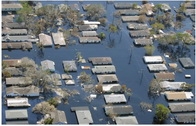
In the five years since Hurricane Katrina struck the Gulf coast, the New Orleans metropolitan area lost 75,000 housing units or nearly 13 percent of its housing stock. In addition, the median monthly cost of housing rose by nearly 33 percent, from $662 in 2004 to $882 in 2009. These are among the key findings of a new housing survey presented by the U.S. Department of Housing & Urban Development (HUD).
HUD’s "2009 New Orleans Metropolitan Area Housing Survey" is the most comprehensive analysis of the area’s housing stock since HUD's last substantive assessment in 2004 (prior to Hurricane Katrina) and includes data from Jefferson, Orleans, Plaquemines, St. Bernard, St. Charles, St. James, St. John the Baptist, and St. Tammany Parishes. The 2009 survey also provides a critical point of comparison since Hurricane Katrina and offers an in-depth progress report of the redevelopment of the metro area following the storm. HUD plans another housing survey in 2011 to further gauge progress in the restoration of the area’s housing stock.
“This survey presents a startling picture of just how disruptive Hurricane Katrina was to the lives of tens of thousands of families throughout the New Orleans area,” said HUD Secretary Shaun Donovan. “The numbers also offer clear evidence of where things stood in 2009, providing a benchmark for the Obama Administration’s work to help New Orleans recover and rebuild.”
Dr. Raphael Bostic, HUD’s Assistant Secretary for Policy Development and Research, said, “The New Orleans metro area suffered a great deal from Katrina, and that suffering extended beyond just the housing stock to include the generations of families who called that area their home. While fewer families remain in transition, we’re seeing significant increases in the cost of housing, especially for lower and middle-income renters.”
Based on in-depth interviews with residents of approximately 3,000 housing units, HUD estimates that more than 80 percent of the area’s households were forced to move because of Hurricane Katrina and approximately 12 percent still consider themselves in flux. HUD also found that approximately 298,000 households were forced from their homes for at least two weeks after the storm; most families moved twice or three times and some moved as many as 10 times.
Meanwhile, the Obama Administration is taking important steps to help remaining displaced families find long-term housing solutions. Since President Obama took office, HUD worked aggressively with nearly 350 local housing authorities around the country to extend housing assistance for more than 30,000 families who were on the verge of losing their temporary assistance. In addition, HUD provided permanent housing support for more than 12,000 of the most vulnerable households.
HUD has also helped stimulate privately owned affordable housing developments, creating 8,400 new affordable homes in New Orleans since 2009. In total, this means there is more federally assisted housing in New Orleans today than there was before Hurricane Katrina.
“It’s clear that this Administration is focused on the long-term recovery of the New Orleans area and the restoration of its affordable housing stock in particular," said Donovan. "But we will not rest until every displaced family has a permanent place to call home.”
Key findings in the 2009 New Orleans Metropolitan Area Housing Survey include:
►Composition of the Housing Stock: HUD estimates that in 2009 there were 511,000 residential housing units in the New Orleans metro area compared to 587,000 units in 2004. This 13 percent decline is largely explained by demolition activity, particularly among older single-family attached homes built prior to 1979. In addition, approximately 24,700 new homes were constructed in the New Orleans metro area between 2004 and 2009. Considering the loss of many older homes and the addition of newly built units, the median year of construction of the area’s housing stock is currently 1972 compared to 1960 prior to Hurricane Katrina. HUD’s 2009 survey also indicates there are an estimated 72,500 vacant housing units in the New Orleans metro area.
►Monthly Housing Costs: The median monthly cost of housing in the New Orleans metro area was $882 in 2009 compared to $662 in 2004, a jump of 33.2 percent. While this significant increase is true for both owner- and renter-occupied units, the trend is largely attributed to the decline of “mid-priced” rental units ($300-$600/month) from 66,300 in 2004 to just 19,300 in 2009. The median rent charged to New Orleans-area tenants was $689 in 2004 compared to $876 in 2009, an increase of 27 percent. The 2004 housing cost data noted above have been adjusted for inflation to reflect “2009 dollars” to provide a true comparison. HUD’s survey also calculated “worst case housing needs” in the New Orleans metro area. These are very low-income, unassisted renter households who either paid more than half their income on rent, lived in severely inadequate housing or both. HUD found that while the total number of renter households declined by 32,000 from 2004 and 2009, the number of worst case renter households grew by nearly 6,500 or 22 percent.
►Forced to Move: Because of Hurricane Katrina, more than 307,000 households were forced to move from their homes and share housing with others, primarily family and friends. Since Katrina, almost 59,000 families (19 percent) moved once; 95,000 families moved twice (32 percent); 77,000 families moved three times; and more than 68,000 households moved as many as 10 times. In 2009, more than 38,000 families still consider themselves in transition.
►Damaged Housing: Of the 252,000 owner-occupied housing units that sustained damage during Hurricane Katrina, 90 percent have undergone repair through private insurance payouts, federal flood insurance and/or homeowner assistance grants provided through Louisiana’s HUD-funded Road Home Program. More than 52 percent of owners of damaged units reoccupied their homes while only 25 percent of homeowners reoccupied their severely damaged units. More than 18,000 area homeowners either have or intend to elevate their homes. In addition, almost than 11,000 homes were razed or condemned due to Katrina damage, but nearly 10,000 of these were rebuilt.
HUD’s data files are intended for use by economists, housing analysts and others in the research community. The Census Bureau expects to release a more comprehensive narrative report on these data later this fall. In addition, HUD and Census intend to conduct yet another survey in the New Orleans metropolitan area next year to gain further insight into the area’s housing recovery since 2009.
For more information, visit www.hud.gov.