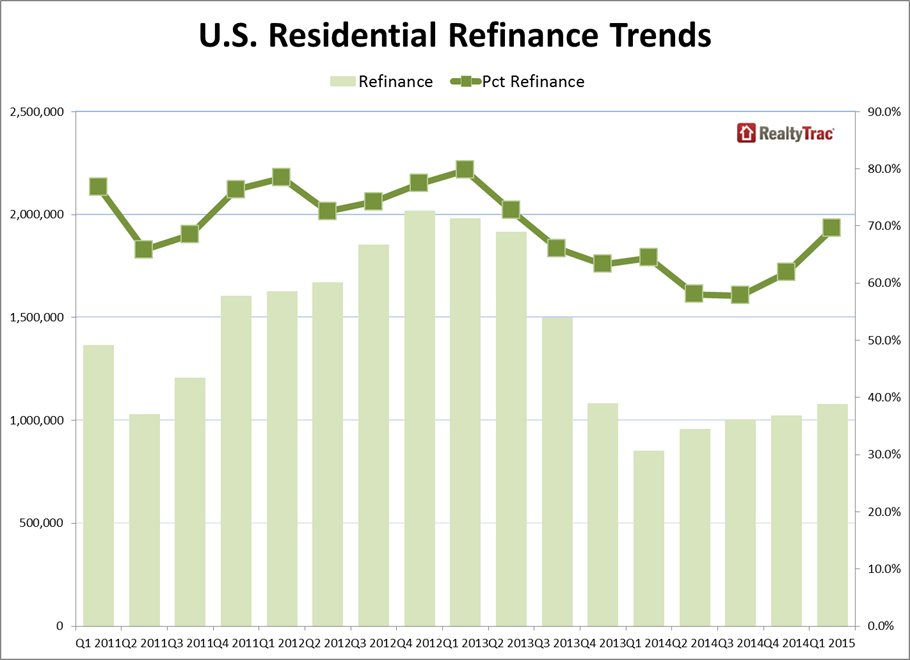
RealtyTrac has released its Q1 2015 U.S. Residential Loan Origination Report, which shows that 1,551,865 loans were originated on single family homes and condos in the first quarter, down six percent from the previous quarter but up 17 percent from a year ago. Total dollar volume of loans originated in the first quarter was $377 billion, down one percent from the previous quarter, but up 32 percent from a year ago. Refinance originations represented nearly $256 billion in the first quarter, 67.8 percent of total loan origination dollar volume, and purchase loan originations represented $121 billion, 32.2 percent of total origination dollar volume. As a share of total loan origination dollar volume, purchase originations reached a recent peak of 49.2 percent in the second quarter of 2014 followed by three consecutive quarters of decreasing share.
Of the nearly 1.6 million loan originations in the first quarter, 471,822 were purchase loan originations, down 25 percent from the previous quarter and up less than one percent from a year ago. There were 1,080,043 refinance originations in the first quarter, an increase of six percent from the previous quarter and an increase of 27 percent from a year ago.
“A dip in interest rates early in the year combined with lowered mortgage insurance premiums for FHA loans breathed some life back into the refinancing market in the first quarter,” said Daren Blomquist, vice president at RealtyTrac. “Meanwhile the purchase loan market remained largely missing in action despite tepid growth from a year ago. The prime buying season still remains ahead, providing some hope that first-time homebuyers and other traditional buyers relying on traditional financing will come out in the woodwork in greater numbers in the coming months.”
Metro areas with a population of at least 500,000 and the biggest increase in loan originations from a year ago were San Jose (up 72 percent), San Diego (up 64 percent), Oxnard-Thousand Oaks-Ventura, Calif. (up 64 percent), Palm Bay-Melbourne-Titusville, Fla. (up 61 percent), and Boston (up 54 percent).
Other major markets among the top 20 for biggest year-over-year increase in loan originations included Salt Lake City (up 53 percent), San Francisco (up 49 percent), Los Angeles (up 48 percent), Denver (up 44 percent), Seattle (up 40 percent), Portland (up 39 percent), Bridgeport, Conn. (up 38 percent), and Richmond, Va. (up 35 percent).
Metro areas with a population of at least 500,000 and the biggest increase in purchase loan originations from a year ago were Palm Bay-Melbourne-Titusville, Fla. (up 72 percent), Dayton, Ohio (up 62 percent), Toledo, Ohio (up 36 percent), Tampa (up 32 percent), and Kansas City (up 32 percent).
Other major markets among the top 20 for biggest year-over-year increase in purchase loan originations from a year ago included Salt Lake City (up 18 percent), Orlando (up 17 percent), Atlanta (up 15 percent), Jacksonville, Fla. (up 14 percent), St. Louis (up 13 percent), Miami (up 13 percent) and Phoenix (up 13 percent).
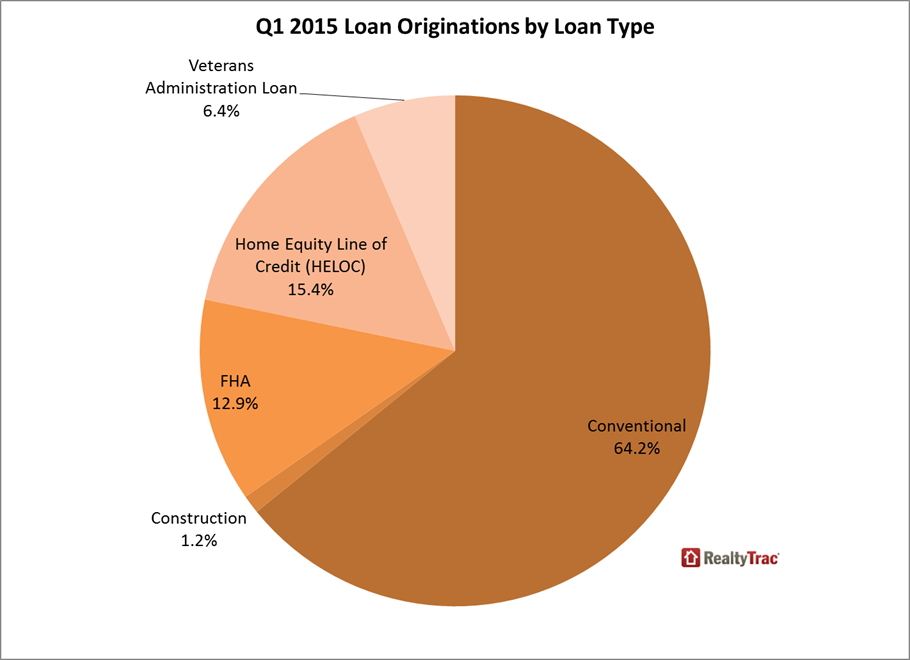
There were a total of 995,968 conventional loan originations (backed by Fannie and Freddie) in the first quarter, representing 64.2 percent of all loan originations. Conventional loan originations decreased five percent from the previous quarter but were up 13 percent from a year ago. Conventional purchase loan originations in the first quarter decreased 27 percent from the previous quarter and were down two percent from a year ago, while conventional refinance originations increased 10 percent from the previous quarter and were up 21 percent from a year ago.
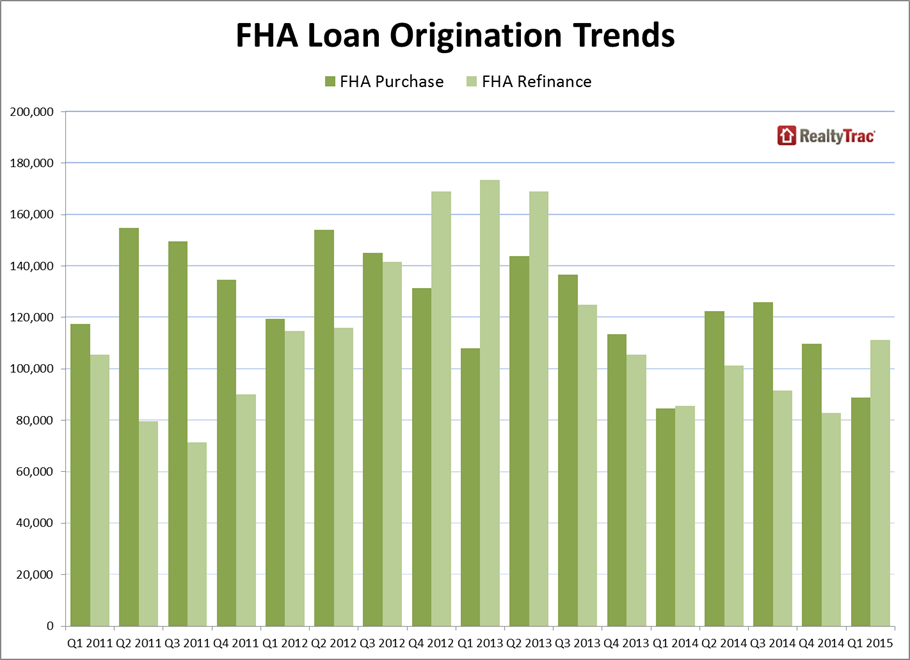
There were a total of 200,178 FHA loan originations in the first quarter, representing 12.9 percent of all loan originations. FHA loan originations increased four percent from the previous quarter and were up 18 percent from a year ago. FHA purchase loan originations in the first quarter decreased 19 percent from the previous quarter but were still up five percent from a year ago, while FHA refinance loan originations jumped 34 percent from the previous quarter and were up 30 percent from a year ago.
There were a total of 99,555 Veterans Administration loans originated in the first quarter, representing 6.4 percent of all loan originations. VA loan originations in the first quarter were down 5 percent from the previous quarter but up 57 percent from a year ago. VA purchase loan originations in the first quarter decreased 25 percent from the previous quarter but were still up four percent from a year ago, while VA refinance originations increased 12 percent from the previous quarter and were up 119 percent from a year ago.
There were a total of 238,359 Home Equity Lines of Credit (HELOC) originated in the first quarter, representing 15.4 percent of all loan originations. HELOC originations were down 17 percent from the previous quarter but still increased 32 percent from a year ago.