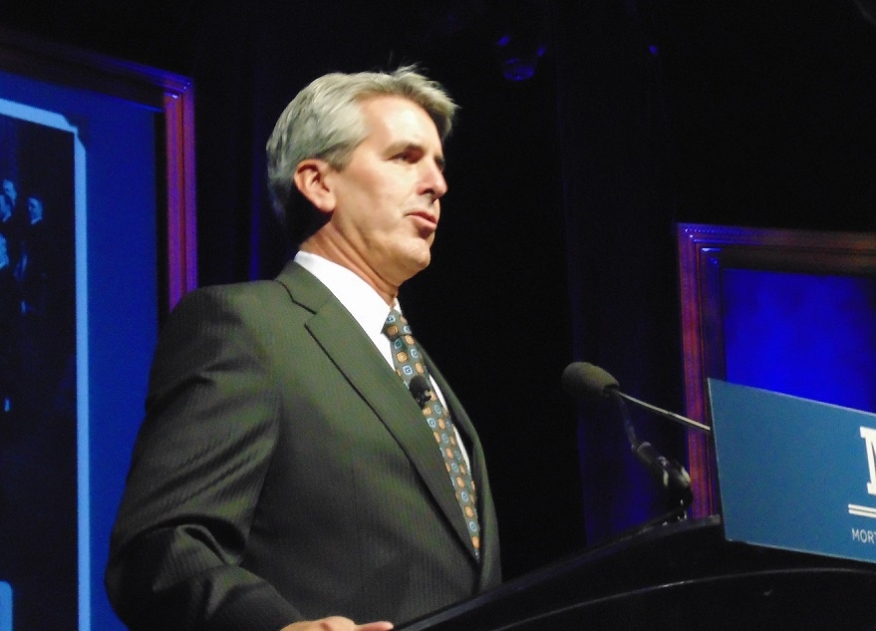
The head of the nation’s leading mortgage profession trade group struck a decidedly political tone in his opening address to his association’s annual gathering, citing continued pressures from regulators and a need for greater White House participation in housing—as well as a not-subtle swipe at the Democratic presidential nominee’s much-criticized comments on Millennials.
In the prepared text delivered ahead of his speech, Mortgage Bankers Association (MBA) President and CEO David H. Stevens offered a harsh consideration of the relationship between lenders and their regulatory authorities.
“Today, you are being discouraged from lending to some first-time homebuyers,” Stevens stated. “Why? Because the fear of a mistake, even if irrelevant to the credit decision, exposes each of you to unacceptable risk. Because of overly aggressive and sometimes inappropriate enforcement actions by some key government agencies. Because the regulatory framework is too often redundant—state regulations piled on top of federal regulations, piled on top of international rules, often conflicting with each other. No wonder you have no choice, but the most conservative lending posture in order to meet the lowest common regulatory denominator.
“I don’t have to tell you that the progress we’ve made doesn’t always correspond to the trust we earn,” Stevens continued. “But if compliance doesn’t lead to confidence, then maybe we need to do something about the morass of conflicting, and sometimes competing, bureaucracy we face. So, let’s work to find the right balance between necessary enforcement, appropriate regulation, consumer protection, and lender risk. Rules should be clear. Accountability should be rational. Credit, including private capital, must be accessible.”
Stevens also noted pointed to the so-called “Millennial gap” and the lack of participation in the housing market as either homeowners or rents. Stevens dropped the hint of a new MBA marketing campaign to be unveiled in January that will “highlight the benefits of housing” to Millennials, but he noted there was plenty of work in getting this demographic into the market.
“Homeownership rates among Americans between 18 and 35 are only 34 percent, or just over half the national rate,” he said. “But it’s more than the fact that they’re not buying. It’s that they’re not renting either. One in three 18 to 34-year-olds still live with their parents. According to Pew Research, this marks the first time since 1880—since 1880—more people in this age group live with Mom and Dad than in other living arrangements. It’s not all about the sharing economy. Or that their parents’ basement is a good place to hang a Bernie Sanders poster.”
The Sanders reference was a rare partisan moment in Stevens’ speech, calling up comments made by Hillary Clinton that depicted the Vermont senator’s young supporters as dwelling in their parents’ basement. Stevens, who served as the Federal Housing Administration (FHA) in President Obama’s first term, recently used Twitter to criticize Republican nominee Donald Trump prior to the second presidential debate, although in this speech he made no direct mention of Clinton and Trump by name.
However, Stevens repeated his previous proposal for a White House-based housing czar, adding to his call that this new position would supersede the authority of the Secretary of the Department of Housing & Urban Development (HUD).
“The issues are complex, so we need a clearly articulated policy,” he said. “There is a large inter-regulatory aspect of the challenge, so we need to encourage coordination across the spectrum of federal and state regulators. We have to work across private and public sectors to encourage lending to qualified borrowers, so we need a powerful presence to help drive housing’s role in the economy beyond just HUD. This is a multi-regulator, multi-agency effort that can only be successful with a key position working under the authority of the President. That’s what we need. And that’s what we’re calling for—expanding credit, more affordable housing, a new dialogue, a Housing Policy Director with authority. This is not just a dream, it’s the only option. It’s the only way to untangle the confusion and imbalances. It’s the only way to avoid the housing crisis to come.”