Supreme Court to Consider CFPB Constitutionality – NMP Skip to main content

Supreme Court to Consider CFPB Constitutionality

Oct 21, 2019
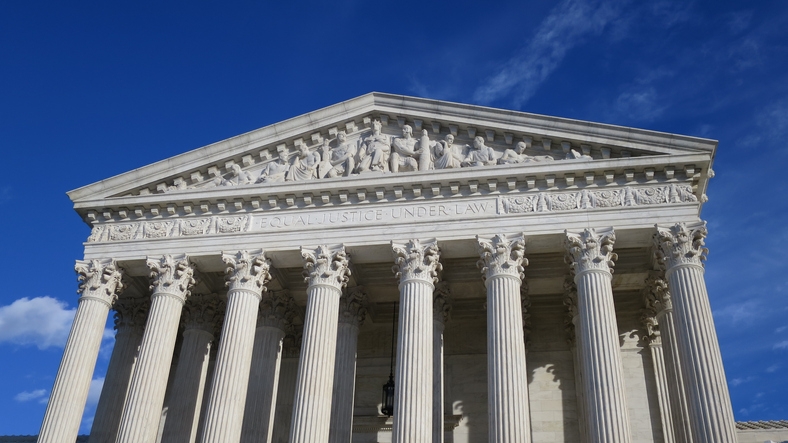
Photo credit: Getty Images/Phillip Nelson

The U.S. Supreme Court has agreed to hear a case that challenges the constitutionality of the Consumer Financial Protection Bureau (CFPB).
 
This court challenge follows the efforts by the California debt relief firm Seila Law, which filed a petition asking the Supreme Court to decide whether the CFPB’s structure is constitutional. Seila lost its case before the 9th Circuit, but on Sept. 17 the CFPB and the Department of Justice joined its cause by asking the high court justices to review Seila Law’s argument that the CFPB’s single-Director structure was unconstitutional.
 
In an order posted Friday, the Supreme Court’s justices asked both sides in this case to address whether the CFPB should remain operational even if its leadership structure is determined to be unconstitutional. A decision in the case could come by the end of June, in the middle of the presidential campaign. Sen. Elizabeth Warren (D-MA), who is widely credited as being the CFPB’s architect, is among the leading candidates for the Democratic Party’s presidential nomination.
 
Earlier this year, the Supreme Court has refused to hear a case brought by the State National Bank of Big Spring, Texas, the Competitive Enterprise Institute (CEI) and the 60 Plus Association that challenged that challenged the CFPB’s constitutionality.  CEI General Counsel Sam Kazman welcomed the news of the Seila case by stating, “As a party in the first major challenge to the constitutionality of this agency, we are glad to see that this issue has now been taken up by the Supreme Court.”

 
About the author
Published
Oct 21, 2019
UAD 3.6 Deadline Nears; First American Earns Verification

First American's ACI Sky Workbench gains verification ahead of the Nov. 2 implementation date for the GSEs' updated appraisal reporting requirements

MISMO Introduces New Loan Boarding Standard

Wrapper Files support standardized data transfers between origination and servicing systems, with potential savings of $60 to $160 per loan

The GLBA Compliance Gap Your AI Deployment Just Opened

Old statutes, new models, and the vendor contract you signed before machine learning became operational

FHA Keeps Tri-Merge Credit Reports While Expanding Approved Scoring Models

HUD says FHA lenders will continue using three-bureau credit reports even as the agency adopts newer scoring models aimed at increasing competition and modernizing mortgage underwriting

House Passes Amended 21st Century Road To Housing Act

The House version softens a controversial provision aimed at large institutional investors

New York Cash-Home Tax Proposal Could Push Wealthy Buyers Back Into Mortgages

As all-cash deals surge nationwide, a proposed 1% levy on $1M+ purchases in NY may reshape jumbo lending, borrower strategy, and origination opportunities