CoreLogic’s
Home Equity Report for the first quarter of 2020 shows that U.S. homeowners with mortgages (which account for roughly 63% of all properties) have seen their equity increase by 6.5% year-over-year, representing a
gain of $590 billion since the first quarter of 2019.
In the latter half of the first quarter of 2020, COVID-19 began to spread across the country, with immediate economic impact not fully realized until the end of March. As the pandemic continued to unfold and shelter-in-place orders were extended, unemployment reached double digits within a few short weeks and left many homeowners scrambling to cover mortgage payments. However, home prices continued to rise, which added to borrower equity through March.
Negative equity, also referred to as underwater or upside down, applies to borrowers who owe more on their mortgages than their homes are worth. From the fourth quarter of 2019 to the first quarter of 2020, the total number of mortgaged homes in negative equity decreased by 3.1% to 1.8 million homes or 3.4% of all mortgaged properties. The number of mortgaged properties in negative equity in the first quarter of 2020 fell by 16%, compared to the first quarter of 2019, when 2.2 million homes, or 4.1% of all mortgaged properties, were in negative equity. Because home equity is affected by home price changes, the number of borrowers with equity positions near (+/-5%) the negative equity cutoff is most likely to move out of or into negative equity as prices change. Looking at the first quarter of 2020 book of mortgages, if home prices increase by 5%, 310,000 homes would regain equity, and if home prices decline by 5%, 420,000 would fall underwater.
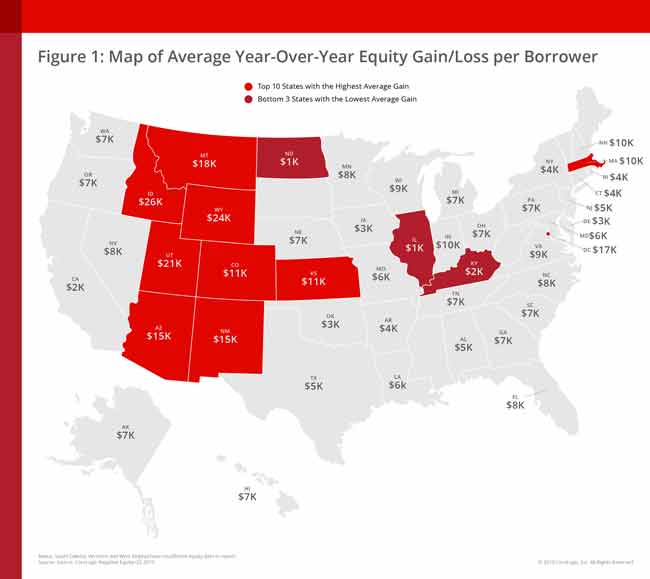
Homeowners gained an average of $9,300 in home equity between the first quarter of 2019 and the first quarter of 2020. States with the largest gains include Idaho, where homeowners gained an average of $24,400, Washington, where homeowners gained an average of $20,800 and Arizona, where homeowners gained an average of $19,900.
“The pandemic recession will likely lead to price declines in many areas during the next year and weaken home equity gains,” said Dr. Frank Nothaft, chief economist for CoreLogic. “However, price declines will be far less than those experienced during the Great Recession, when the national CoreLogic Home Price Index fell 33% peak-to-trough. Our latest forecast shows the national index to have a peak-to-trough decline of 1.5%.”