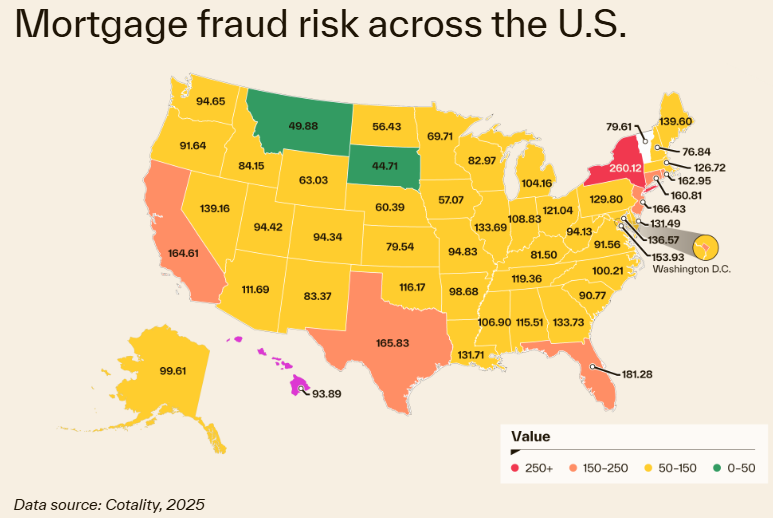
Mortgage fraud risk continued a gradual climb through the end of 2025, according to the latest Cotality National Mortgage Application Fraud Risk Index. The quarterly index for Q4 2025 registered 133, a modest increase from the prior quarter and a 1.5% year-over-year rise compared with Q4 2024. That level translates to an estimated one in every 118 mortgage applications showing indications of potential fraud.
Industry analysis from Cotality, a global property data and analytics provider, suggests that investment and multifamily mortgage segments remain the highest-risk categories. In Q4 2025, fraud indicators appeared in roughly one in 43 investment property applications and one in 27 multifamily applications — well above the broader market average.
Analysts point to shifts in refinancing and loan types as contributing factors. Although refinance applications historically pose lower fraud risk than purchase loans, their share in Cotality’s data set increased 19% year-over-year, coinciding with the broader uptick in overall fraud risk. According to Matt Seguin, senior principal for Cotality Mortgage Fraud Solutions, the surge in debt-service-coverage-ratio (DSCR) loans and heightened investor activity are influencing the risk profile.
“The percentage of refinances in the Cotality data set has increased year-over-year by 19%, yet the Fraud Index is up 1.5% over that time. This is significant because historically, refis bring a much lower risk of fraud than purchases,” said Seguin. “The two riskiest segments of the Fraud Index, investment properties (+34%) and multiunit properties (50%), have jumped significantly over the last year as a portion of the overall application volume seen by Cotality. The increase in volume in these two segments has led to a slight increase in the Fraud Risk Index. This change seems to have been driven, at least partially, by the surge in popularity of the DSCR loans.”
Among fraud types, undisclosed real estate fraud risk saw the largest annual jump, rising 8.6% in Q4. This category encompasses undisclosed debt, occupancy misrepresentation, and concealing adverse credit events — issues that appear significantly more common in non-owner-occupied transactions. Cotality’s data show these non-occupant properties triggered undisclosed real estate alerts at more than 2.5 times the rate seen for owner-occupied homes.
While most other fraud risk subcategories, such as identity and transaction alerts, showed year-over-year declines, Cotality observed increasing signals in income, property and occupancy risk areas. Property and occupancy alerts include reported signs of rapid flipping, inflated valuations, and discrepancies in claimed dwelling use.
Total mortgage applications edged down slightly (less than 1%) from Q3 to Q4, with purchase transactions falling to about 62% of total applications and government-backed loans steady at 24%.