There’s luxury … and then there’s “luxury,” both of which are doing quite well, thank you very much.
In the “ultra-luxury” category, which Compass defines as places selling for $10 million-plus, 2,261 transactions took place in 2025 totaling $38.6 billion in sales as the market for super expensive houses spread beyond the normal wealth centers such as New York and Los Angeles.
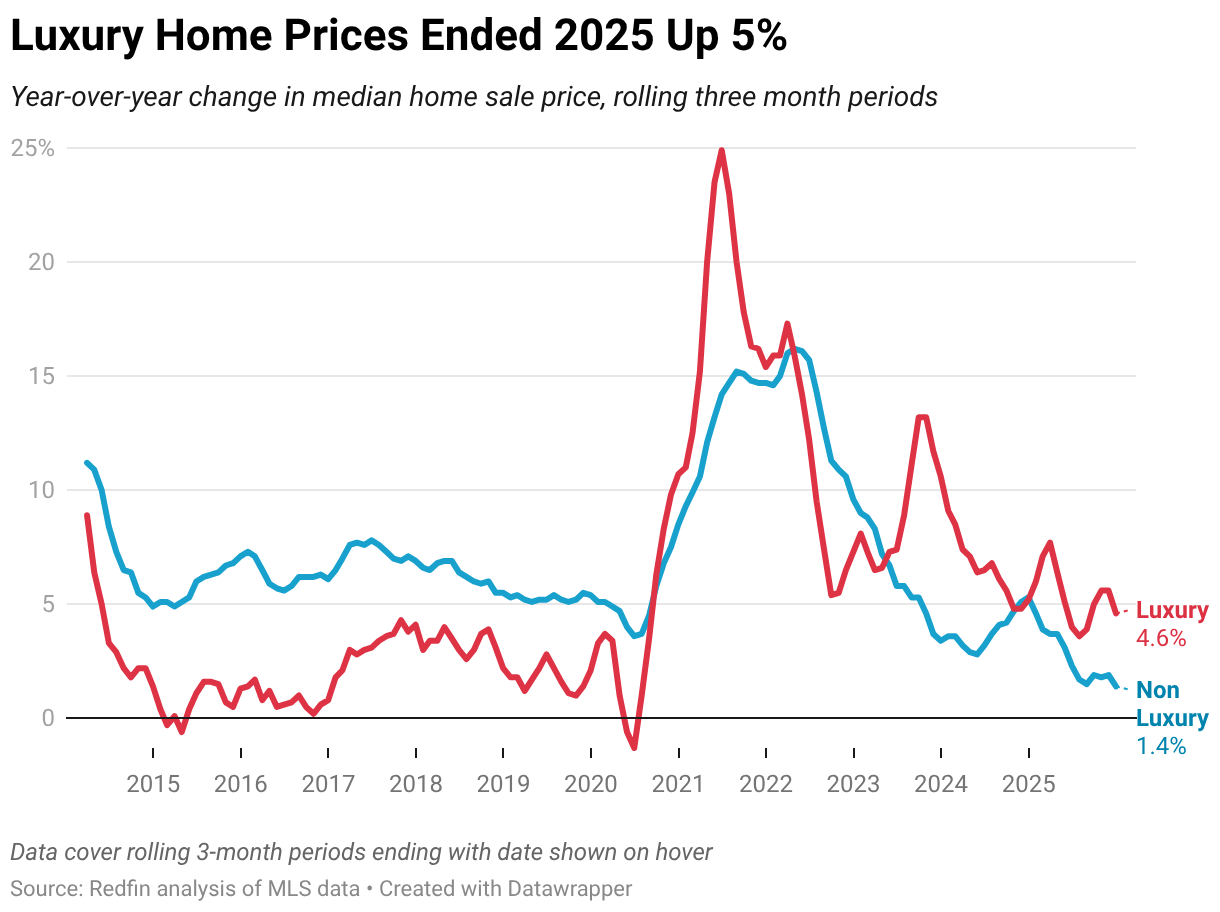
In the lowly luxury sector, defined by Redfin as sales in the top 5% of their respective areas based on the prices of homes sold over a rolling 12-month period, prices rose 4.6% in December, more than three times the gain for the rest of the market.
Compass reports that metros that historically saw little to no sales at or above the $10 million benchmark prior to COVID have now recorded ultra-luxury sales in consecutive years, as wealthy buyers look beyond supply-constrained hubs toward more development-friendly areas such as San Diego, Scottsdale and Dallas.
At the same time, strong wealth creation has driven outsized gains in markets where ultra-luxury sales had previously declined, including the San Francisco Bay Area and Greenwich, Connecticut.
Together, the top 10 ultra-luxury markets recorded 1,601 transactions totaling $28.62 billion, with every market achieving unit growth that represented a 31% year-over-year increase over last year’s Top 10. Total sales volume in the top 10 also increased by $5.47 billion year over year from $23.14 billion, a 23.67% gain.
Manhattan, Greater Los Angeles and South Florida continue to lead the nation as the top ultra-luxury hubs. But what was once a category of a handful of coastal cities has evolved into a far broader national landscape.
Houston is a case in point. After recording just one sale of $10 million or more in 2019, the market has posted double-digit ultra-luxury transactions for the second consecutive year and now leads all emerging markets, with 900% more sales in 2025 than in 2019.
"I’m seeing a clear trend toward turnkey modern estates with comprehensive wellness spaces and backup power,” said Laura Sweeney of Compass Houston. “Buyers prioritize privacy, making gated streets and advanced security desirable amenities.”
A slowdown in this market segment doesn’t seem to be in the cards, at least not for now.
“Demographically,” Compass reported, “the early stages of a generational wealth transfer and real estate’s appeal as a tangible asset indicate the ultra-luxury buyer pool may continue to broaden, with demand focusing on standout luxury and trophy properties that offer exceptional lifestyle, amenities, privacy and long-term value.”
Meanwhile, in the less expensive luxury sector, Redfin says prices rose 4.6% in December — more than triple the gain in non-luxury prices. The median luxury price increased to $1.31 million. By comparison, non-luxury prices rose 1.4% to $375,000, the slowest growth since 2013.
The supply of luxury houses fell 1.1% in December, the biggest dip since April, and Redfin agents report a lack of quality inventory is propping up prices.
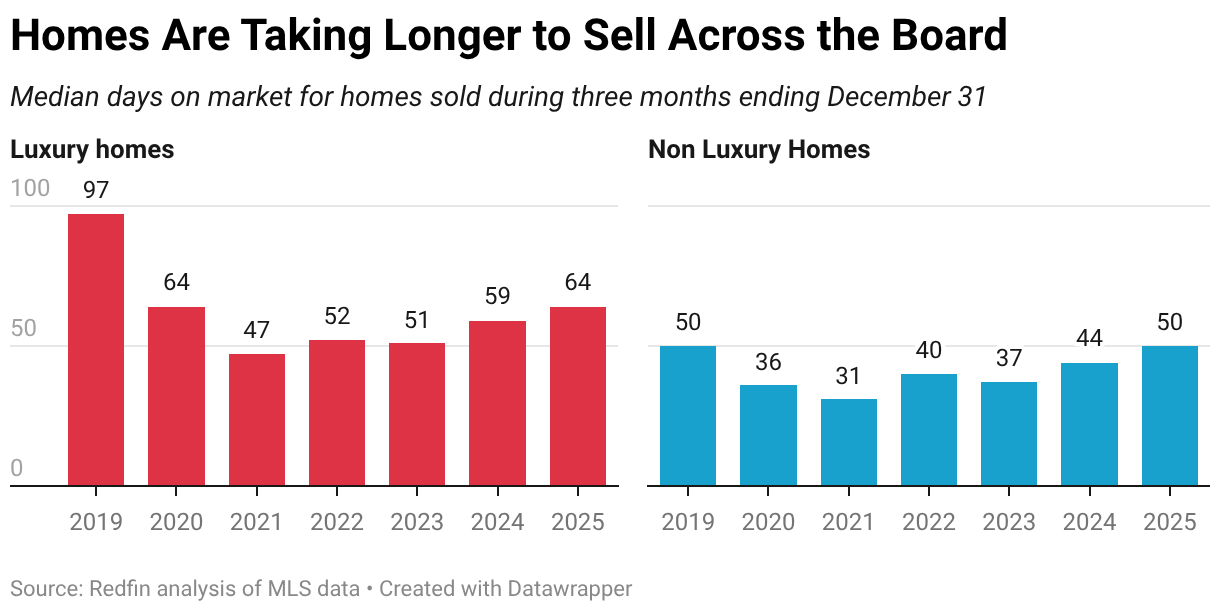
As in all price ranges, luxury homes took longer to sell in the month. Actually, December registered the slowest December since 2020, taking 64 days to go under contract, five days slower than a year earlier.
Luxury prices rose most in:
- Milwaukee, Wisconsin (20.6%)
- Orlando, Florida (16.8%)
- Nashville, Tennessee (13.6%)
They fell in just two metros:
- Fort Worth, Texas (-1.9%)
- Portland, Oregon (-0.7%)
“Homebuyers are very selective because prices and mortgage rates are high — they want a house that has everything. Even super wealthy buyers are hesitant to pull the trigger because there’s not a lot of great inventory and they don’t want to settle,” said Alin Glogovicean, a Redfin Premier real estate agent in Los Angeles. “We’re seeing bidding wars on the few homes that are desirable, which is driving up prices. If you list your house for $2.9 million and it’s in really good shape and in a desirable location, you might sell it for $3.3 million and get a buyer who pays cash and waives contingencies.”