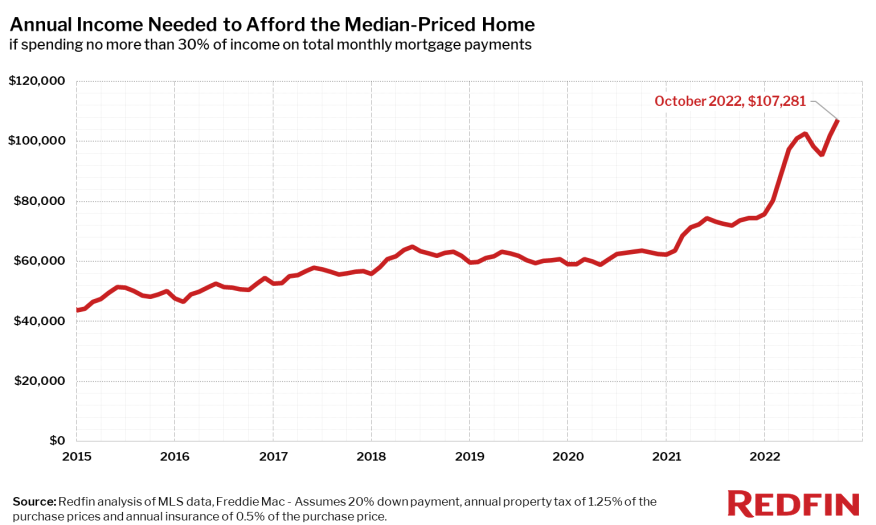
A homebuyer must earn $107,281 annually to afford the $2,682 monthly mortgage payment on the typical U.S. home. That’s up 45.6% from $73,668 a year ago, according to a new report from Redfin, and is attributed to high mortgage rates and home prices.
While that nearly 46% seems record high, Redfin noted that from February 2020 to October 2022, the monthly payment for an American family buying a median-priced home increased by roughly 70%.
“High rates are making buyers rethink their priorities, as many of them can no longer afford the home they want in the location they want,” said Chelsea Traylor, a Redfin agent in Washington, D.C. “If you had a $900,000 budget a few months ago, rising rates mean it’s now around $700,000 — and sellers aren’t dropping their prices enough to make up for the change. So buyers are searching further away from the city in more affordable areas, or waiting for prices and/or rates to come down before making a move.”
“I’m encouraging buyers to think long-term,” Traylor continued. “Prices are unlikely to fall drastically in the long run, so buying a home now — if you can afford the monthly payment — will still help you build wealth over time, especially if you plan to live in it for several years. Even though rates are high, another advantage of buying now is the lack of competition and opportunity to negotiate with sellers.”
Redfin reported that buyers in Florida are seeing the highest increases in income needed to afford homes. Buyers in North Port need to earn $131,535 annually to afford the metro area’s typical monthly mortgage payment of $3,288. That’s up about 74% from $75,659 a year earlier, and was the biggest percentage increase of any major U.S. metro. It’s followed by Miami, where homebuyers need to earn $128,892, up nearly 64% year over year.
Redfin’s report also noted that 16 of the 20 metros where the income necessary to afford a home has increased the most are in the Sun Belt. Hurricane Ian also had an impact, with homes in North Port and Cape Coral, Fla., hit with sharp drops in pending sales and new listings.
Overall, buyers need to earn at least 50% more income to afford a home than they did a year ago in 39 of the 93 metros included in this analysis. They need to earn at least 30% more in all 93. Lake County, Ill. had the smallest gain in income necessary to afford the median-priced home, though buyers still need 33.5% more than a year ago.
While California's Bay Area also had smaller-than-average increases, buyers still need to earn $402,821 to pay San Francisco’s typical $10,071 monthly mortgage payment, up 33.6% from a year ago.
The incomes buyers need to purchase a home in San Francisco and San Jose are the highest in the country, followed by Anaheim, where the typical buyer must earn $254,286 to afford the typical monthly mortgage payment of $6,357.
To put this in perspective, homebuyers must earn at least $100,000 annually to buy a home in roughly half (45) of the metros in this analysis — up from 16 metros a year ago.