As the U.S. House of Representatives convenes this week to consider advancements and regulation of artificial intelligence and cryptocurrencies, more than 150 industry and governmental officials gathered just days before to address the need for a stable regulatory framework, and what the evolution of digital money and AI means for economic progress.
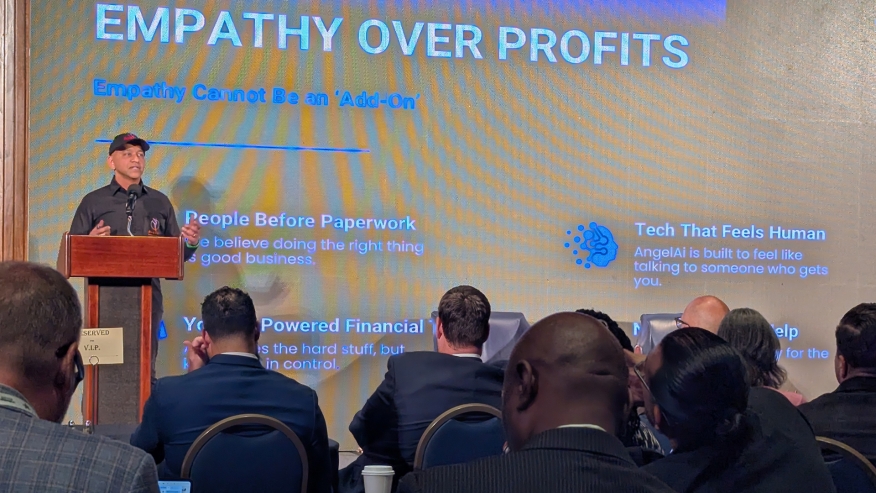
Leading that conversation was Pavan Agarwal, the CEO of Sun West Mortgage Co. and the founder of Celligence, a tech company that has developed AngelAi, which powers much of Sun West’s mortgage origination and underwriting.
"This summit wasn't just a conference — it was a call to action," said Agarwal. "We're entering an era where the synergy of AI and blockchain can restore fairness, transparency, and access. Angel Ai is proud to lead the conversation and build the tools that make this future possible."
Agarwal detailed how AngelAi, for instance, has streamlined the underwriting process and made it fairer for minorities seeking homes, because an AI system can more efficiently and quickly comb through thousands of programs that can qualify borrowers. He pointed to studies that have shown that more minorities qualify for mortgages when underwritten by AI than by human underwriters. And the same results hold true when borrowers find themselves in financial trouble.
The Sun West leader showed a video of a borrower, a U.S. veteran, who twice fell into fiscal peril and was close to losing his home, but was twice saved when an AI system found government programs that could rescue troubled borrowers.
“You can use AI to get you into a home,” said Agarwal. “But life is not a straight line. AI can also help find programs that give people a ‘hand up.’ It can save homes and financial lives.”
Adoption Increasing
Gary Acosta, co-founder and CEO of the National Association of Hispanic Real Estate Professionals, concurred. “There is sometimes an assumption that Latino communities are slow to adopt new technologies,” but that’s not true, he asserted. When technologies are wireless based – meaning not tied to desktop computers – “Latino adoption out indexes traditional users. And since Latino culture is concentrated on the home, homeownership and affordability are central to this marketplace.”
Acosta added that what AI can do is bring access to more home buying communities, and will play an even bigger role in the mortgage process as it brings to play “more adaptive and predictive models to assess capacity to repay.”
"It was a call to action. We're entering an era where the synergy of AI and blockchain can restore fairness, transparency, and access." —Pavan Agarwal, CEO, Sun West Mortgage Company and Founder, Celligence, speaking of the US Strategy For AI & Crypto summit in Washington, D.C.
Acosta was one of more than a dozen speakers and luminaries who took part in the inaugural U.S. Strategy for AI & Crypto (USSAIC) Congressional Exchange. The conference was produced by Celligence and the AI Innovation Alliance.
Beyond AI, the development of cryptocurrencies and digital tokenization will have far-reaching effects on the economy in general.
In real estate, for example, investors who own a commercial building have to take on the risks and duties of being a landlord, pointed out Alex Cartwright, founder and principal of HotelShift, a real estate tokenization company. But using tokenization, investors can buy into fractional shares – or digital tokens representing a building – and collect the benefits of commercial real estate investment without the liabilities and duties of physical ownership.
Agarwal pointed out that the nature of work, of payments, and of commerce are rapidly changing. “This is the gig economy,” he told the audience. “And most bankers are still thinking like it’s the 1960s.”
Agarwal was joined by the US Ambassador to El Salvador, Milena Mayorga, who talked about the progressive approach El Salvador takes. She told the audience, "We are a Bitcoin country, as you know. Almost four years ago, we created a Bitcoin law which made it legal tender for the seller, and gave incentives to the population so we were early adopters."
That approach was shared by Ambassador of the African nation Lesotho, Tumisang Mosotho, who commented, "previously unbanked, communities that were looked down upon by your traditional banking system, they can now have access to financial services because of AI and Blockchain."
The conference participants, including Patrick McHenry, the past chairman of the House Financial Service Committee, said that the U.S. House will start the process of putting the nation at the head of cryptocurrency adoption and regulation when it votes this week on the bipartisan Genius Act, which creates a regulatory framework for stablecoins. Those are crypto currencies whose value is pegged to a “stable” source, such as the U.S. dollar.
McHenry said the various pieces of legislation making their way through the House this week don’t seem exciting on their face. But they are critical stepping stones to ensuring U.S. dominance of digital asset regulation.
“We want to use a very boring thing to do a very interesting thing,” he said.