On the heels of Zillow’s somewhat controversial decision to drop a feature from its site that allowed people to view a property’s exposure to climate risk comes a survey that found would-be home buyers' interest in the topic is fleeting.
Redfin reports that house hunters on its listing site are most likely to click onto the climate risk section on its site after a major disaster, but interest fades rather quickly.
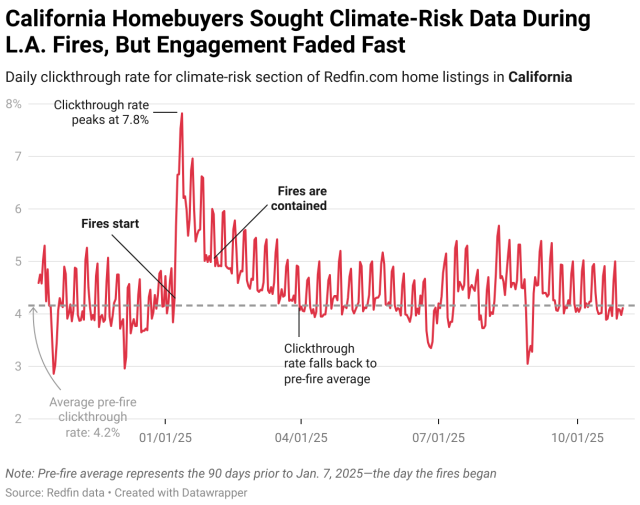
In the 90 days leading up to the Los Angeles wildfires earlier this year, for example, Redfin users clicked onto the climate risk section 4.2% of the time when perusing California listings. The day after the fires began, that percentage jumped to 5.7%. And a few days later, it peaked at 7.8%.
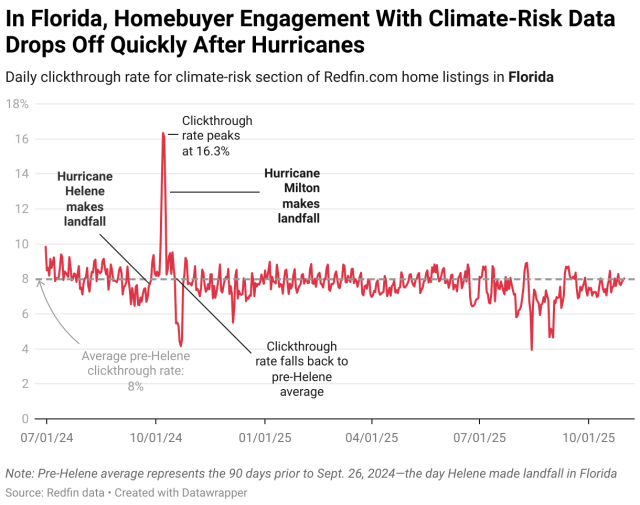
Engagement with climate-risk data also surged in Florida during the 2024 hurricane season. In the 90 days leading up to Hurricane Helene, Redfin users clicked into the climate-risk section of Florida home listings 8% of the time, on average. But three days after the storm made landfall, the click-through rate had increased to 9.4%.
The rate peaked at 16.3% on the same day a flood watch was issued for all of South Florida ahead of Hurricane Milton. But it fell back to pre-Helene levels in October and has hovered there ever since.
Humans often have short memories, at least when it comes to natural disasters, said Redfin Chief Economist Daryl Fairweather. “A major fire or storm can jolt homebuyers into paying attention to climate risk because the event feels fresh and likely to happen again, but this urgency is fleeting,” noted Fairweather.
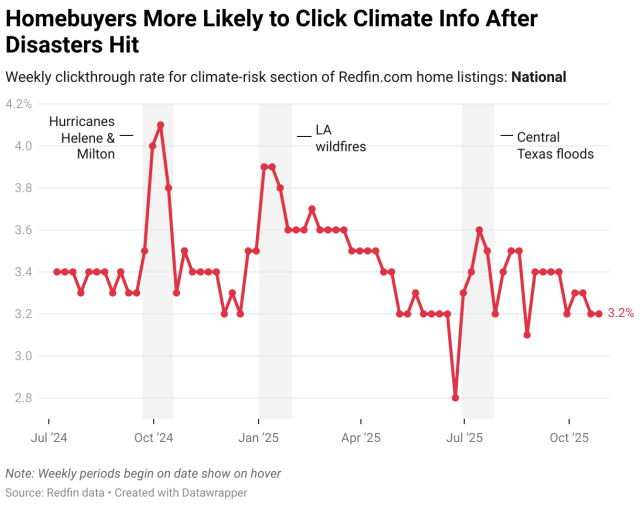
Nationally, Redfin put the click-through rate to its climate-risk section at 3.2% as of the end of October. Increases in the national percentage are “more muted” because the rate includes the behavior of house hunters in other states who aren’t affected by disasters, explained Redfin Senior Economist Yingqi Xu.
“This indicates that natural disasters primarily impact the behavior of people searching for homes near the disaster zone — not those searching in other areas,” Xu said.
Zillow, the nation’s largest listing site, and arguably its most popular, removed its climate risk section only a year after it introduced the tool, which showed the individual risk of a wildfire, flood, extreme heat and wind, and poor air quality for the properties listed on the site. At the time it was added, the company said “climate risks are now a critical factor in home-buying decisions” for many people.
It dismissed the tab at the behest of real estate agents and brokers as well as some home sellers who argued that the data harmed sales, could not be challenged, and seemed arbitrary.
But the company which provided the information to Zillow, First Street, said it was a poor decision.
It means buyers are now “flying blind,” said Matthew Eby, First Streets’s founder and CEO.
“The risk doesn’t go away; it just moves from a pre-purchase decision into a post-purchase liability,” Eby said. “Families discover after a flood that they should have purchased flood insurance, or discover after the sale that wildfire insurance is unaffordable or unavailable in their area.”