The number of loans in forbearance remained about the same in December from a month earlier and may have bottomed out, the Mortgage Bankers Association’s (MBA) said Tuesday.
According to the MBA’s monthly Loan Monitoring Survey, the estimated number of homeowners in forbearance plans remained around 350,000, or about 0.7% of all loans, as of Dec. 31, 2022.
The share of Fannie Mae and Freddie Mac loans in forbearance decreased 1 basis point to 0.31%, while Ginnie Mae loans in forbearance decreased 1 basis point to 1.45%, the MBA said.
The forbearance share for portfolio loans and private-label securities (PLS), meanwhile, increased 3 basis points to 1%.
“For three consecutive months, the forbearance rate has remained flat, an indicator that we may have reached a floor on further improvements,” said Marina Walsh, CMB, MBA’s vice president of industry analysis. “New forbearance requests and re-entries continue to trickle in at about the same pace as forbearance exits. The overall performance of servicing portfolios was also flat compared to the previous month, but there was some deterioration in the performance of Ginnie Mae loans.”
Walsh added, “Forbearance remains an option for struggling homeowners and its usage may continue, especially if unemployment increases as expected.”
The MBA forecasts that the unemployment rate will reach 5.2% in the second half of 2023, up from the current 3.5%, she said.
Other Key Findings:
Loans in forbearance as a share of servicing portfolio volume as of Dec. 31, 2022:
- Total: 0.7% (previous month: 0.7%)
- Independent Mortgage Banks (IMBs): 0.97% (previous month: 0.95%)
- Depositories: 0.44% (previous month: 0.46%)
- By stage, 37.9% of total loans in forbearance are in the initial forbearance plan stage, while 49.3% are in a forbearance extension. The remaining 12.8% are forbearance re-entries, including re-entries with extensions.
Of the cumulative forbearance exits for the period from June 1, 2020, through Dec. 31, 2022, at the time of forbearance exit:
- 29.6% resulted in a loan deferral/partial claim.
- 18.1% represented borrowers who continued to make their monthly payments during their forbearance period.
- 17.4% represented borrowers who did not make all of their monthly payments and exited forbearance without a loss mitigation plan in place yet.
- 16% resulted in a loan modification or trial loan modification.
- 10.9% resulted in reinstatements, in which past-due amounts are paid back when exiting forbearance.
- 6.6% resulted in loans paid off through either a refinance or by selling the home.
- The remaining 1.3% resulted in repayment plans, short sales, deed-in-lieus or other reasons.
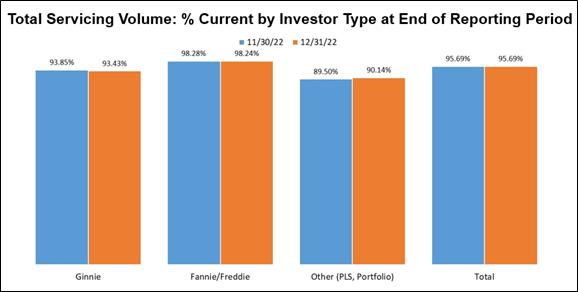
Total loans serviced that were current (not delinquent or in foreclosure) as a percent of servicing portfolio volume remained flat in December 2022 compared to November 2022 at 95.69% (on a non-seasonally adjusted basis).
- The five states with the highest share of loans that were current as a percent of servicing portfolio: Washington, Idaho, Colorado, Utah, and Oregon.
- The five states with the lowest share of loans that were current as a percent of servicing portfolio: Louisiana, Mississippi, West Virginia, Indiana, and New York.
- The share of loans that were current declined in 31 states compared to the previous month.
- Total completed loan workouts from 2020 and onward (repayment plans, loan deferrals/partial claims, loan modifications) that were current as a percent of total completed workouts decreased to 75.92% in December from 76.89% in November.
MBA’s monthly Loan Monitoring Survey covers the period from De. 1 through Dec. 31, 2022, and represents 66% of the first-mortgage servicing market (33.1 million loans).