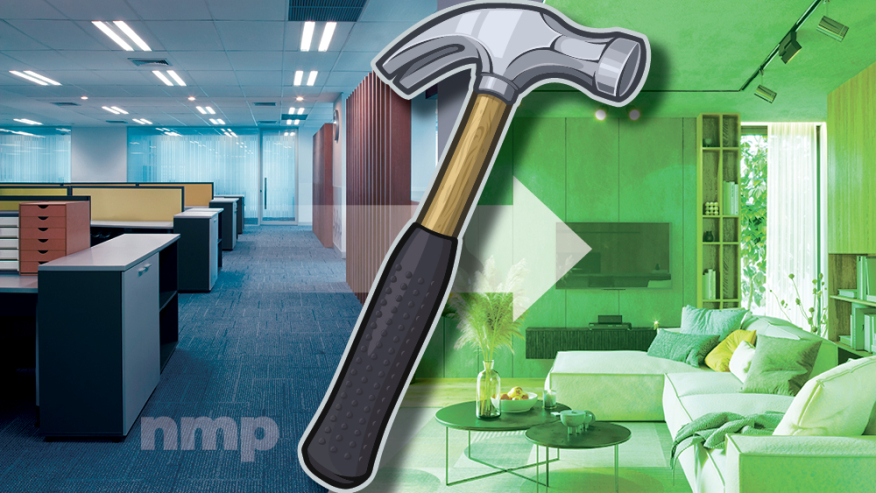
Spaces originally built for desks and conference rooms are being recast as apartments with kitchens and baths at a record pace, according to a new report. As of early 2024, 90,300 converted apartments were under construction, an increase of 70,600 from 2023. This marks another record year for office-to-apartment conversions, representing four times the number of converted apartments in 2022, according to RentCafe’s annual count. The national office vacancy rate was close to 20% in early 2024, with some buildings experiencing vacancy rates of 50% or higher.
“That gap has left millions of square feet underused, opening the door for large-scale residential conversions,” the RentCafe report states. Peter Kolaczynski, director of Yardi Research, said, “There is simply too much office space in the market right now.” RentCafe is an apartment search engine; Yardi is its sister company.
Financial Pressures Accelerate Conversions
Financial pressure is accelerating this trend. Approximately one-third of all office loans are set to mature by 2027, compelling many owners to address underperforming properties. Doug Ressler, senior analyst and manager of business intelligence at Yardi Matrix, noted that a “massive amount of office building loans” will mature, many on properties that have lost significant value due to decreased demand for office space.
A significant portion of current conversion activity began prior to 2024. Nearly 66,500 units are still moving through the pipeline, as the conversion process can take several years or more to complete. This process is often slowed by structural constraints, high construction costs, financing hurdles, and local regulatory requirements.
Office buildings now represent the largest segment of adaptive reuse activity nationwide, accounting for 47% of all future adaptive reuse units. In many metropolitan areas, office conversions drive most adaptive reuse activity. In 12 of the top 20 markets, office conversions comprise more than half of all projects. Hotels make up about 18% of future adaptive reuse projects, followed by industrial properties at 16%. Other building types, including healthcare facilities, schools, retail, and government buildings, account for roughly 19%.
Suitability And Feasibility For Conversion
While office-to-apartment conversions are common in many markets, the types of structures being converted are shifting, with more newer buildings undergoing the process. Nationally, over 1.9 billion square feet of office space — approximately 24% of total inventory — is considered suitable for conversion, according to the Conversion Feasibility Index from CommercialEdge.
However, Kolaczynski cautioned that “eligibility doesn’t guarantee feasibility.” He added that age, footprint, and structural layout are crucial factors. Proximity to mass transit and walkability are also key, and access to natural light presents one of the biggest challenges in conversions, often requiring multiple exposures.
New York leads the nation in conversions with 16,358 units under construction. Washington, D.C., is second with 8,479 units underway, followed by Chicago with 4,360 units, Los Angeles with 4,340 units, and Dallas with 3,966 units. Philadelphia’s conversion total increased by 119% year-over-year, Denver’s rose by 114%, and St. Louis’s increased by 110%, indicating a rapid scaling of conversions in these three metropolitan areas.
Impact On The Mortgage Industry
The surge in office-to-apartment conversions presents opportunities and challenges for mortgage professionals. Increased housing supply, particularly in urban centers, can alleviate housing shortages and potentially stabilize or reduce housing costs, influencing mortgage demand and affordability for borrowers. Mortgage loan originators and brokers should monitor these developments for new lending opportunities in multifamily financing and construction loans. Additionally, these conversions can impact property valuations in surrounding areas, requiring mortgage banks and lending operations to adjust underwriting practices and risk assessments for both commercial and residential portfolios.