The fight over Two Harbors just picked up a potentially decisive new voice.
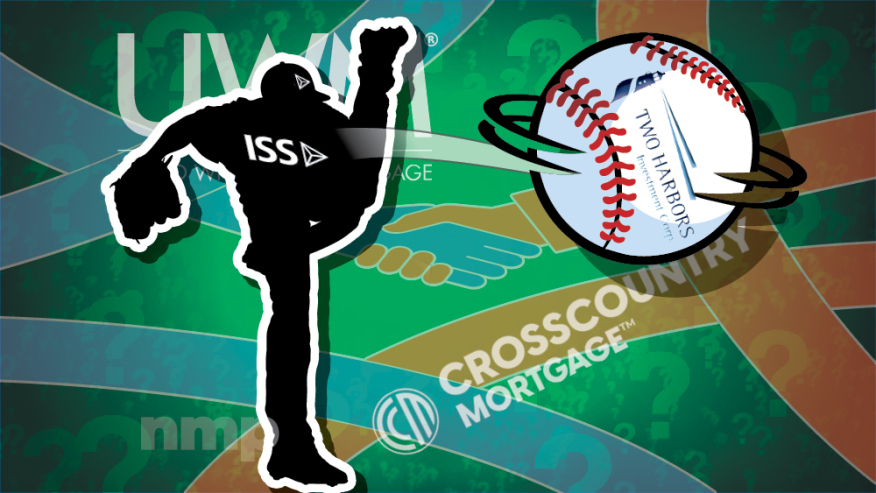
Proxy advisory firm Institutional Shareholder Services (ISS) is recommending that Two Harbors shareholders vote against the company’s proposed merger with CrossCountry Mortgage, adding fresh pressure ahead of the scheduled May 19 shareholder vote.
ISS raised concerns about the valuation offered in the CrossCountry deal and questioned whether the sales process maximized shareholder value, echoing arguments made in recent weeks by United Wholesale Mortgage (UWM).
ISS was particularly pointed in its critique of the board’s handling of the process.
“Ultimately, a review of the process does not provide shareholders with reason to be fully comfortable with the [TWO] board’s approach,” the firm wrote, noting that Two Harbors entered into multiple agreements with CrossCountry in recent weeks that were subsequently overtaken by higher bids.
ISS also questioned whether the company fully leveraged competing offers from UWM Holdings Corporation to maximize value.
“The board has not capitalized on the competing bids … in a way that provides shareholders with assurance the best terms have been extracted,” ISS said, adding that “it is difficult to identify convincing evidence” that the current deal reflects full value.
For industry watchers, that critique goes to the heart of the current dispute. Two Harbors Investment Corp.’s board has consistently framed the CrossCountry transaction around certainty of closing, while UWM has leaned into headline value and structural flexibility, including a higher cash election and a stock alternative.
ISS’s recommendation suggests at least some skepticism around whether that tradeoff — certainty versus potential upside — was fully tested through the sale process. In particular, questions around how competing bids were evaluated, and whether shareholders are being adequately compensated relative to those alternatives, are now front and center heading into the vote — especially as the spread between the competing bids has widened in recent days.
A Late-Stage Curveball Ahead Of The Vote
The ISS stance lands just days before shareholders are set to decide the fate of the CrossCountry transaction at the scheduled May 19 vote.
As previously reported by NMP, Two Harbors’ board has repeatedly reaffirmed its support for CrossCountry Mortgage’s all-cash offer of $12 per share, citing execution certainty and lower perceived risk relative to competing proposals.
UWM Holdings Corporation, meanwhile, has continued to escalate its bid, most recently increasing its cash election to $12.50 per share for shareholders who choose cash, while maintaining the option to receive 2.3328 shares of UWMC stock per share or a mix of cash and stock. The company has also emphasized the strength of its financing, including a previously disclosed $1.3 billion unsecured bridge facility from Mizuho, which it says removes key execution risks.
ISS now appears to be validating at least part of that argument — particularly around valuation and the sale process — even as Two Harbors’ board continues to stand behind the CrossCountry transaction.
Why This Matters For The Vote
While ISS recommendations are not binding, they carry significant weight, particularly among institutional investors who often rely on proxy advisors when voting on contested transactions.
In close or controversial deals, ISS guidance can influence a meaningful portion of the shareholder base, especially passive funds and institutions that may not independently evaluate every competing proposal in detail. That dynamic makes the firm’s stance especially relevant here, given the narrow and highly public nature of the bidding war between UWM and CrossCountry.
For mortgage professionals watching the outcome, the question isn’t just whether ISS is “right” — it’s whether its recommendation is enough to disrupt what had been framed as a certainty-driven outcome.
The timing is critical. With the May 19 vote approaching, there is limited runway for either side to materially reshape the narrative, unless another revision or response emerges in the final days.
The Bigger Industry Undercurrent
At this point, the Two Harbors saga has moved well beyond a straightforward M&A story.
For the wholesale and broker channel, the fight is increasingly being viewed through a broader strategic lens — including how servicing assets are valued, how aggressively lenders are competing on price, and how balance sheets are being deployed to win market share in a constrained volume environment.
And the backdrop to all of this is getting harder to ignore.
Banking analyst Christopher Whalen, whose recent “Who is the Next Countrywide Financial?” commentary in The Institutional Risk Analyst, drew explicit comparisons between today’s nonbank mortgage competition and the pre-2008 environment that produced firms like Countrywide Financial, pointing to aggressive pricing, elevated MSR valuations, and compressing margins as familiar warning signs.
The Two Harbors fight isn’t what he was writing about specifically. But it is unfolding inside that same pressure cooker, where “certainty” is being marketed as the safer path, even as the broader market dynamics start to look a lot less certain.