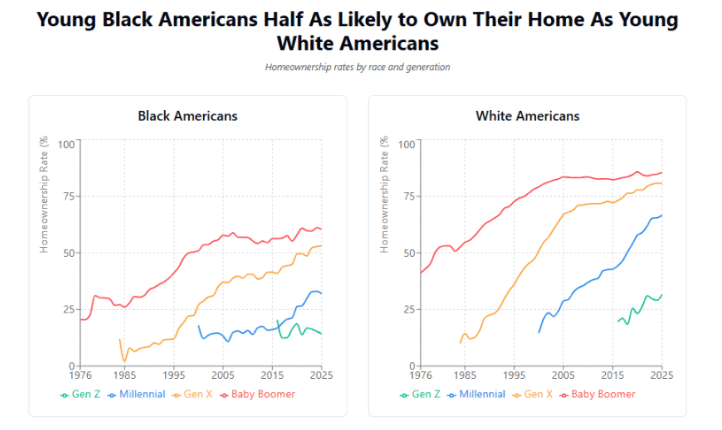
What’s Black and White and wholly disproportional? The homeownership rate among young people.
According to a new Redfin report, Black Gen Zers and millennials are half as likely to own their homes as their white counterparts. Indeed, the homeownership rate has declined for Blacks in those age cohorts while it has risen for whites.
One in seven Black Gen Zers (born between 1997 and 2012) are homeowners compared to nearly one in three white Gen Zers.
And the gap is similar for millennials (born between 1981 and 1996): a third of Blacks own compared to two-thirds of whites, the report says.
The ownership rate among Black Gen Zers was 16.3% in 2023, compared to 14.2% today. Black millennials’ rate was roughly 33% in 2023, compared to 32% now. The rate declined because many in those categories who formed new households ended up renting rather than buying, Redfin says.
For white Gen Zers, the rate has risen from 29.7% in 2023 to 31.6% today while white millennials saw their rate increase from 65.3% to 66.6%.
It’s tough to buy a house, and even tougher for Black people.
One reason is the racial wage and wealth gap. The typical Black worker earns 79 cents for every dollar earned by a white worker.
For every $100 in wealth held by white households, Black households have just $15.
“That makes it harder to save money for a downpayment and to afford monthly mortgage payments,” the report noted.
Then there’s the employment gap. The unemployment rate is 7.1% for Black men, roughly double the 3.7% rate for white men.
And It’s a similar story for women; the unemployment rate for Black women is 6.7%, compared to 3.2% for white women.
Discriminatory policies also have played a role. Past policies like redlining and discriminatory housing covenants caused generations of Black families to miss out on gaining wealth through owning real property. Today, there are still systemic barriers to home ownership for Black families, the report maintains.
For example, Black buyers are twice as likely to have their mortgage applications rejected as white buyers.
Black families also are less likely than white families to have generational, inherited wealth. A recent Redfin survey conducted by Ipsos found that 9% of recent Black buyers used a cash gift from family for their downpayment compared to 15% of recent white buyers.
Credit scores are another issue. The median score for Black Americans is lower than it is for white Americans, making it more challenging to obtain financing.
“Black millennials and Gen Zers are bearing the brunt of the racial homeownership gap because since they have reached homebuying age, the country has faced significant financial challenges and a major housing supply shortage,” said Redfin Chief Economist Daryl Fairweather. “Young Black Americans started out behind their white counterparts because they’re less likely to have property and money passed down from their families because of historical discrimination in housing and employment. Now they are coming of age during turbulent economic times that have impacted Black workers more than white workers. The Black unemployment rate rose to nearly 17% during both the Great Recession and the pandemic, compared to 9% and 14%, respectively, for white Americans.”