Realtor.com’s November Rental Report highlights both ongoing rent declines and the early impacts of rising minimum wages on housing affordability for the nation’s lowest-paid workers.
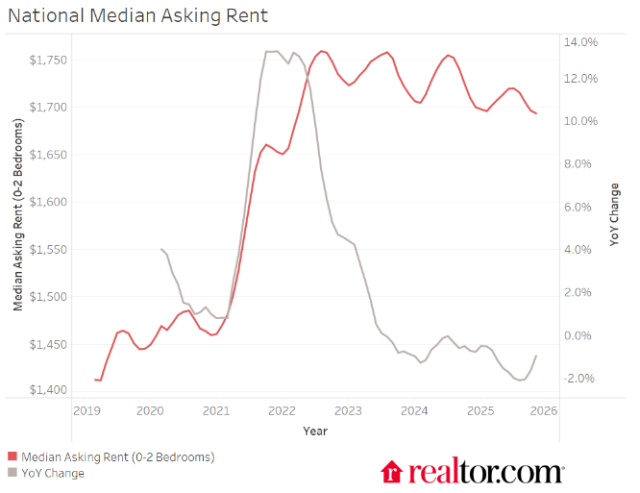
Across the 50 largest U.S. metropolitan areas, the median asking rent for 0–2 bedroom units was $1,693 in November 2025, representing a 1.0% year-over-year decrease from prior November 2024. This marks the 28th consecutive month in which rents have fallen compared to the same month in the previous year, continuing a sustained cooling trend in the rental market. Despite this relief, median rents remain 17.2% higher than in November 2019, underscoring persistent affordability challenges.
"Two years of sustained rent declines have offered modest financial relief to renters nationwide, and as we approach the new year, state-level minimum wage increases will help to improve affordability for the most burdened households," said Danielle Hale, chief economist at Realtor.com. "While the challenge remains immense, particularly in high-cost areas, the number of metros where two minimum wage earners can afford a typical rental without working overtime will grow in 2026, a positive sign. In other markets, especially in states with scheduled minimum wage hikes, the amount of overtime hours needed to afford a rental will decline, potentially freeing that income for other budget priorities."
The report uses a standard affordability metric in which renters spend no more than 30% of their income on rent and assumes a two-earner household with each partner working full time at the local minimum wage. Based on this framework, the report finds that only five of the top 50 metropolitan areas are currently affordable for such households without requiring overtime (defined as no more than 40 hours per week per renter). In these affordable metros, the combination of lower median rents and locally higher minimum wages makes this possible. In contrast, in the majority of large U.S. metros, even full-time minimum wage work does not generate sufficient income to afford the median rent within the 30% budget guideline.
"While our analysis is based on statutory minimum wages, the reality is that market forces often push starting pay higher, even in states defaulting to the $7.25 federal minimum," said Joel Berner, senior economist at Realtor.com. "In several high-cost-of-living areas, however, even a higher market-driven wage or a state-mandated increase, such as the one scheduled for San Jose, does not close the affordability gap. It's a clear signal that housing costs continue to pose a massive hurdle for those at the bottom of the pay scale."
Realtor.com emphasizes that while the observed trends represent a positive sign for minimum wage earners, meaningful improvements in rental affordability will depend on ongoing wage growth and broader changes in housing cost dynamics. The report’s findings reflect the interplay between rental market conditions and income policy at local and state levels, providing a nuanced view of emerging affordability patterns as the U.S. rental market adjusts.