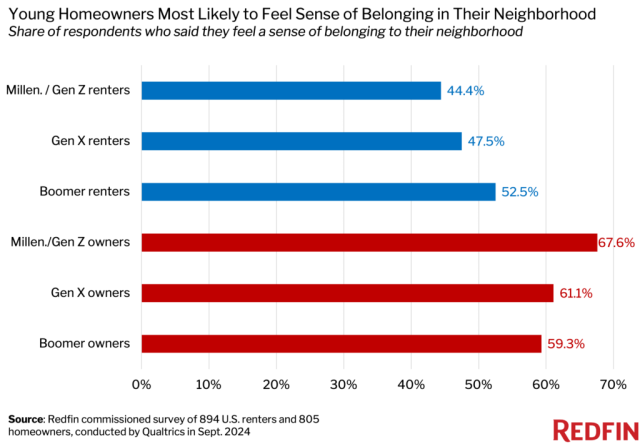
Here’s an arrow mortgage originators can put in their quiver: selling a sense of belonging. A new survey from digital real estate brokerage, Redfin, finds U.S. homeowners overall are nearly 17% more likely to feel a sense of belonging in their neighborhoods than are renters.
This may sound obvious, but may be overlooked as a reason for wanting to establish community roots with rentership rates rising fast amidst ongoing affordability challenges for mortgage borrowers.
Specifically in the Redfin survey, close to two-thirds (63.6%) of homeowners versus less than half (46.7%) of renters said they feel a sense of belonging in their neighborhoods. In an even larger gap, 38.9% overall of renters said they feel they have things in common with their neighbors, while 58.5% of homeowners said they feel they do.
Many renters – 41.6% – avoid their neighbors altogether, the survey found, while 33.1% of homeowner respondents said they try to avoid their neighbors. The survey was conducted in September and polled 894 U.S. renters and 805 U.S. homeowners aged 18-65.
“When someone buys a home, they’re making an investment in a property and a neighborhood, which means they’ll probably see their neighbors for years to come,” Redfin Chief Economist Daryl Fairweather stated. “Renters, on the other hand, tend to stay in their homes for a shorter amount of time, which means they’re often less inclined to get to know the neighbors.”
But there are generational differences, according to the survey. While more than two-thirds (67.6%) of millennial and Gen Z homeowners said they feel a sense of belonging in their neighborhoods, somewhat fewer (61.1%) of Gen X homeowners said they feel that way. The trend continues for older homeowners: 59.3% of Baby Boomer homeowners said they feel a sense of belonging in their neighborhoods.
Redfin speculated a bit as to why this was the case. “Young homeowners probably feel more connected to their communities because they recently chose to live there, whereas older homeowners may be unhappy with how the neighborhood has changed since they first bought decades ago,” Fairweather stated.
Sense of belonging aside, the renter-to-homeowner conversion still faces challenges. The number of renter households rose 2.7% on an annual basis in the third quarter to a record 45.6 million, three times faster than the 0.9% increase in homeowner households, which now total a record 86.9 million.
In a report released in early November, Redfin Senior Economist Sheharyar Bokhari noted that “affordable housing has been at the forefront of this election cycle because so many people are struggling to see how they will ever become homeowners – especially those from younger generations."