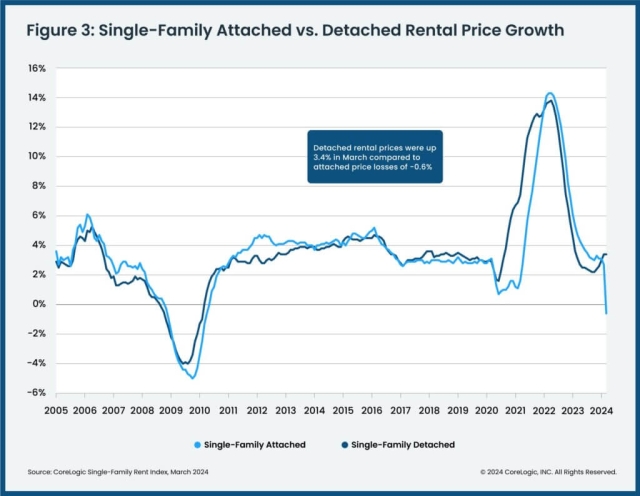
U.S. single-family rent growth continued to slowly increase year over year in March to 3.4%, according to the latest Single-Family Rent Index (SFRI) from CoreLogic. Attached single-family rentals, such as townhomes, duplexes, or rowhouses, experienced their first price decline in 14 years, dropping 0.6% in March.
“U.S. single-family rent growth strengthened overall in March," said Molly Boesel, principal economist for CoreLogic, "though some weaknesses are revealed in the latest numbers.” The median monthly cost for a U.S. three-bedroom home was $2,052 in February.
The index analyzes single-family rent price changes nationally and across major metropolitan areas. To offer a more nuanced view of the single-family rental market, CoreLogic also tracks rental price changes across price tiers and property types (attached or detached single-family rental homes).
Only six of the 20 metros CoreLogic tracks posted rental prices that were less expensive than the national average. Austin, Texas (-3.5%), Miami, Fla. (-3.2%), and New Orleans, La. (-1.4%) were the only three that experienced annual rental price declines, while Seattle, Wa. (+6.3%), New York, NY. (+5.3%), and Boston, Mass. (+5.2%), saw the largest annual increases.
CoreLogic's report attributes the strength of those expensive, coastal job hubs to workers' ability to shoulder the additional cost burden, the effect of higher wages in many job sectors and a U.S. unemployment rate that has remained below 4% for more than two years.
“Overbuilt areas, such as Austin, Texas continued to soften, decreasing by 3.5% annually in March," Boesel added. "And for the first time in 14 years, single-family, attached properties posted a year-over-year decline. The continued strength in single-family detached rents indicates that potential homebuyers who are priced out of the home-purchase market are choosing to rent similar alternatives.”
The most notable cooling off of rental prices occurred for lower-priced units (75% or less than the regional median), up only 2% annually compared to 6.7% in March 2023.