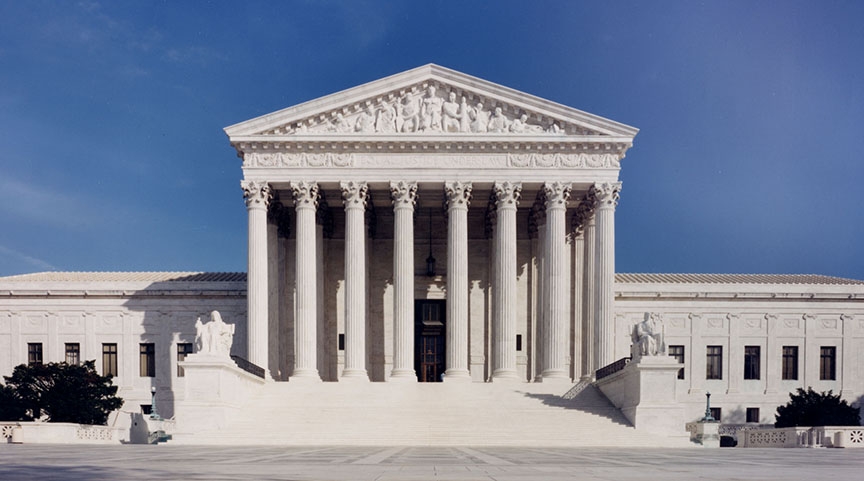
The Consumer Financial Protection Bureau (CFPB) will have its day in court — the U.S. Supreme Court, that is.
The nation’s highest court on Monday granted the CFPB’s petition seeking a review of a lower court’s ruling that the agency’s funding method is unconstitutional.
The CFPB filed its petition for a writ of certiorari in mid-November 2022, asking the Supreme Court to review the lower court ruling during its current session. The plaintiff in the case — the Community Financial Services Association of America, a payday lending trade group — also filed a petition seeking a review, but asked the court to hear it in its next term.
The Supreme Court granted writs of certiorari to both the CFPB and and the association, and listed it among the cases it will hear during its next term, which begins in October 2023.
According to www.law.cornell.edu, a writ of certiorari orders a lower court to deliver its record in a case so that the higher court may review it. The Supreme Court uses certiorari to select most of the cases it hears.
The CFPB’s appeal stems from a federal appeals court ruling issued Oct. 19, 2022. The decision by a three-judge panel of the 5th U.S. Circuit Court of Appeals in New Orleans was issued as part of a ruling on an appeal of a case brought by payday lending groups. The Community Financial Services Association of America and Consumer Service Alliance of Texas had sued the CFPB, challenging the validity of its 2017 payday lending rule, which regulates high-interest rate lenders.
The plaintiffs contended that in enforcing the rule, the CFPB “acted arbitrarily and capriciously and exceeded its statutory authority,” according to court documents. The groups also contended that the CFPB “is unconstitutionally structured, challenging the bureau director’s insulation from removal, Congress’s broad delegation of authority to the bureau, and the bureau’s unique, double-insulated funding mechanism.”
The U.S. District Court for the Western District of Texas rejected those arguments, but that decision was appealed to the 5th Circuit Court.
When the CFPB was created as part of the 2010 Dodd-Frank financial overhaul law, Congress chose to exempt the bureau from annual appropriations. Instead, CFPB is funded by transfers from the Federal Reserve. While the funding is capped at 12% of the Fed’s annual budget, it cannot reject requests that fall under the cap.
The 5th Circuit Court’s decision, written for the court by Judge Cory T. Wilson, states that, “Congress’ decision to abdicate its appropriations power under the Constitution, i.e., to cede its power of the purse to the bureau, violates the Constitution’s structural separation of powers. We thus reverse the judgment of the district court, render judgment in favor of the plaintiffs, and vacate the bureau’s 2017 Payday Lending Rule.”
Joining Wilson in the decision were Judge Don R. Willett and Judge Kurt D. Engelhardt. All three were appointed by former President Donald Trump.
In its petition to the Supreme Court, the CFPB says a review of the lower court’s decision is warranted “because the court of appeals’ decision declared an Act of Congress unconstitutional, because it squarely conflicts with a decision of the D.C. Circuit, and because it threatens to inflict immense legal and practical harms on the CFPB, consumers, and the Nation’s financial sector.”
The petition notes the appeals court recognized that every court to consider the CFPB’s funding structure, including the D.C. Circuit and at least six district courts, has deemed it constitutionally sound.
“But the (appeals) court ‘respectfully disagree[d] with’ those decisions. The court also acknowledged that Congress has established several other agencies that, like the CFPB, are funded through sources other than time-limited spending bills. But in the court’s view, the various features it had identified meant that CFPB’s ‘funding structure goes a significant step further than that enjoyed by the other agencies.’”
CFPB said it filed the petition less than a month after the lower court ruling to enable the Supreme Court to “hear and decide the case this term.”
Because the ruling was made by a three-judge panel of the 5th U.S. Circuit Court of Appeals, the CFPB could have asked all of the active judges on the appeals court to reconsider the decision. It sought the review by the U.S. Supreme Court instead.
Because the Supreme Court listed the case to be heard during its next term, oral arguments could be held in October, with a decision issued by the end of this year or in early 2024.