A short while ago, it would have been unfathomable to think that purchasing a car wouldn't necessitate a visit to a dealership. Today, Tesla has revolutionized this paradigm by offering consumers the ability to visit its website, meticulously select their desired car configurations, and subsequently have the vehicle prepared for them.
In a similar vein, Carvana has streamlined the acquisition of used cars, empowering consumers to select a vehicle online and have it delivered to their doorstep. Moreover, when procuring a car through a dealership, customers can promptly address their financing needs onsite and secure an auto loan without delay.
In stark contrast, the process of purchasing or refinancing a home and obtaining a mortgage is a considerably more protracted and less efficient undertaking.
Further, in the realm of buying and selling homes, aside from the property itself, a substantial expense arises from the commission fees for buyer and seller agents, typically amounting to about 6% of the property value. Likewise, for mortgages, a significant fee component is the loan officer’s compensation, which generally constitutes around 2% of the loan amount. These are considerable financial burdens that either the buyer or seller must bear.
To address the issue of high-cost agent commissions, a major tech conglomerate is endeavoring to streamline this process, allowing individuals to view homes from the comfort of their own residences. Additionally, virtual reality (VR) technology could potentially enhance this experience.
But what about mortgage processing? How can it be optimized? What changes are necessary, and what is required to facilitate these changes?
While auto loans can be finalized within an hour, securing a mortgage typically requires 30 to 60 days for the borrower. I am not suggesting that mortgage approval should be achievable within an hour, but it can undoubtedly be expedited to a day or two with the aid of technology, contingent upon regulatory adjustments.
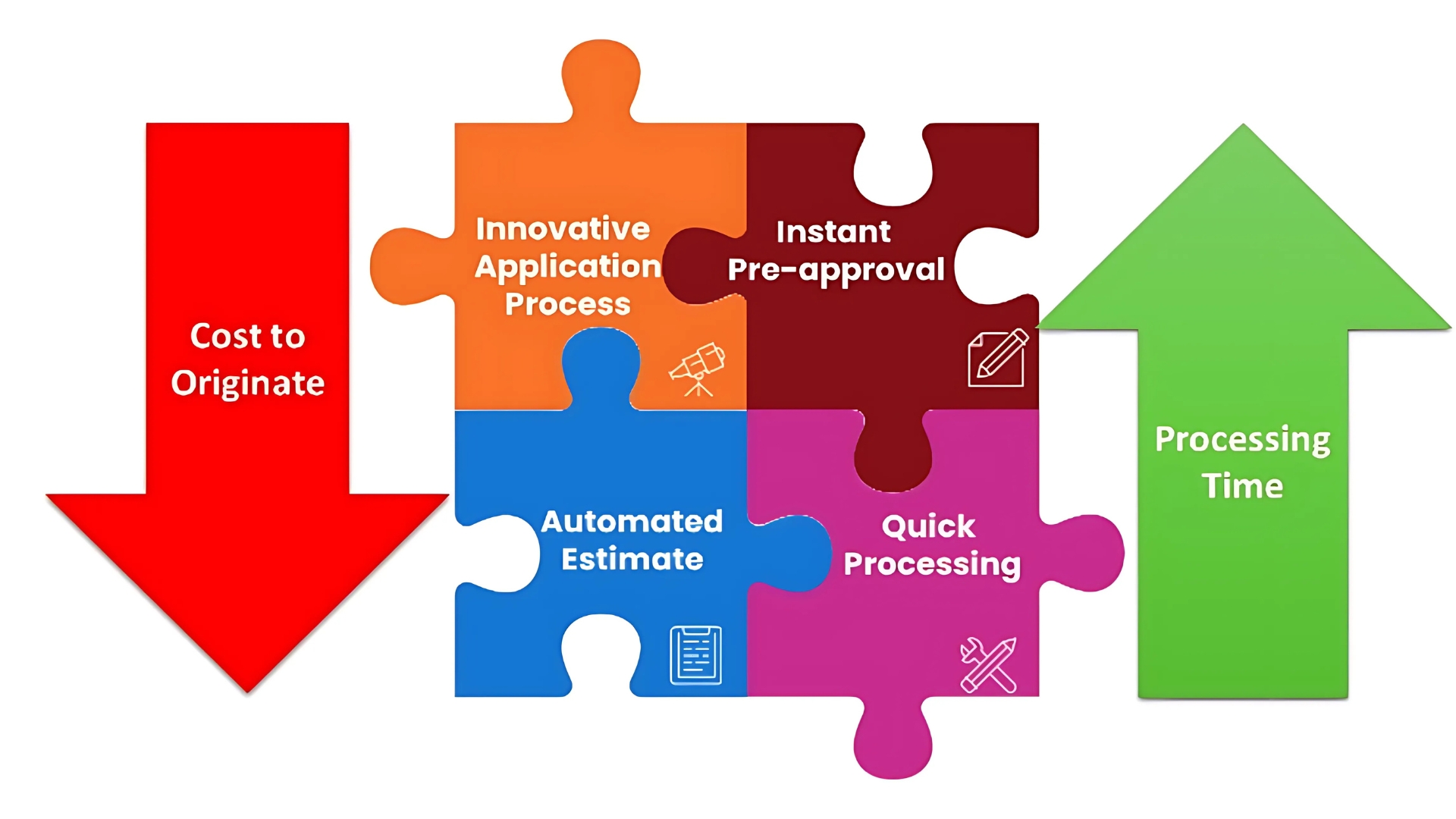
Here are four critical domains where advancements in artificial intelligence, automation, and machine learning can streamline the lending process, alleviate costs for lenders, and ultimately benefit borrowers:
- Innovative Application Process: To obtain a mortgage, borrowers must complete the Uniform Residential Loan Application (URLA), also known as the 1003 form, which contains over 200 data elements. Filling out this extensive form manually is both time-consuming and frustrating.
In today’s world, integrations have been introduced to help borrowers expedite this process. Tools such as credit pulls, asset verification, and income and employment verification through third-party services enable borrowers to complete more than 50% of the 1003 form with just a few clicks.
However, in more than three-fourths (75%) of cases, this automation is ineffective. For instance, even under optimal conditions, only 30% of borrowers successfully complete income and employment verification. Lenders need to leverage existing data extraction technologies to enhance this process further.
A few examples of how this can be achieved:
ID verification: Request that the borrower capture an image of their driver's license, allowing the fundamental borrower information such as name, date of birth, and current address to be obtained.
Upload income documents: Where third-party verification of employment records is unsuccessful or the borrower is self-employed, allow the borrower to upload relevant documents such as W-2 forms, pay stubs, and tax returns. Extract the necessary data from these documents to populate the 1003 mortgage application form, and enable the borrower to upload the documents directly by photographing them with their mobile device.
- Instant Pre-Approval: Typically, a lender requires 24 to 48 hours to provide a standard pre-approval, which usually does not undergo underwriter review. During this process, loan officers validate the borrowers’ assets, income, and credit to determine eligibility and issue a pre-approval letter. This entire process can be automated, allowing prospective homebuyers to instantly receive a pre-approval letter generated by the system.
Following the document upload process, the lender can request that the borrower upload their driver’s license, tax returns, and bank statements. Subsequently, the system can request the borrowers’ Social Security Number (SSN) to perform a soft credit pull. This information is sufficient to extract and derive the 60 data elements required for an initial assessment by Fannie Mae’s automated underwriting system (AUS). Based on this automated evaluation, a pre-approval letter can be issued to the borrower immediately, eliminating the need for loan officer involvement.
- Automated Estimate: From a compliance standpoint, a lender is prohibited from advancing a loan application until an Intent to Proceed (ITP) has been received from the borrower, which can only be acquired after the initial Loan Estimate (LE) has been provided to the borrower.
The generation of LEs in most organizations is currently handled either by loan officers or through a specialized disclosure desk, and can also be automated using existing technology and third-party integrations. The current gap lies in the absence of a technological solution that integrates these facets seamlessly, thereby enabling the automatic generation of the LE as soon as the borrower furnishes the six requisite data elements that trigger the TILA-RESPA Integrated Disclosures (TRID) rules.
By leveraging these advancements, the loan estimate issuance can be streamlined, ensuring compliance while enhancing efficiency.
- Quick Processing: In the current procedure, a mortgage application is forwarded to processors who scrutinize the loan file, request additional documentation as necessary, and prepare the file for the underwriter. This process should be automated to the greatest extent feasible.
Underwriting analysis tools are capable of AUS response analysis, asset analysis, credit analysis, appraisal analysis, and title analysis, among others, and can automatically generate conditions upon the borrower providing an ITP. The borrower can then submit the required documents to fulfill these conditions.
Advancements in document classification and data extraction technology can be leveraged to automatically satisfy these conditions. This automation will significantly reduce the effort and time required from underwriters, enabling them to make decisions on a greater number of loan applications within a single day.
Most of the technology needs exist in bits and pieces, but they are not stitched together to bring true benefit for borrowers. That would reduce turnaround time for lenders and would also help reduce cost significantly. If a lender’s cost is reduced, the lender can pass the benefit to borrowers, and this will be a noteworthy contribution to the American Dream of homeownership.
All these technological advancements are not entirely self-sufficient; they have the potential to reduce the mortgage loan processing time to two weeks. Technological enhancements, however, are subject to regulatory changes, meaning that technology alone cannot expedite this process beyond a certain point. Regulatory changes are also necessary.
For example, in the current mortgage industry, there is the 3/7/3 rule. According to this rule, once the initial disclosure (Loan Estimate or LE) is sent to the borrower, the lender must wait seven days before sending the Closing Disclosure (CD), and there must be a minimum gap of three days from when the Closing Disclosure is sent to the actual closing. That means no mortgage process can be completed in less than 10 days.
Another example is that e-closing with a remote online notary is not yet approved in all states, causing further delays in the closing process. Although most of those rules were established by regulators with the borrowers' interests in mind, regulators must reevaluate them, considering technological advancements.
Today, consumers can purchase a car from their living room and have it delivered directly to them — a notion that was inconceivable just a decade ago. In coming years, with advancements in technology, coupled with regulatory flexibility, prospective homebuyers or borrowers similarly will be empowered to select their next residence and secure a mortgage for it — or refinance their existing home with unprecedented swiftness — with only a few taps on their mobile devices.