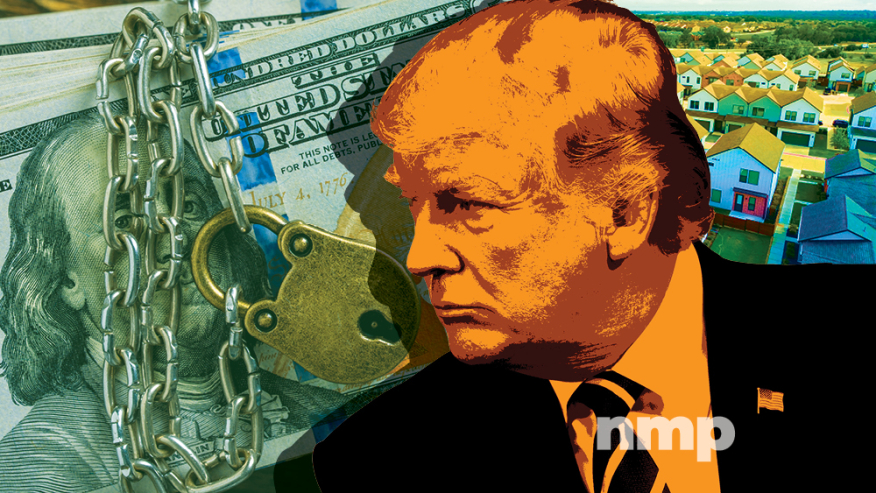
President Donald Trump has taken to his Truth Social account to announce an initiative aimed at restricting large institutional investors from purchasing single-family homes in the U.S., a policy he says is critical to addressing the ongoing housing affordability crisis.
In the post, Trump stated that he is “immediately taking steps to ban large institutional investors from buying more single-family homes” and will urge Congress to codify the measure into law.
The White House framing of the proposal stresses that single-family housing should serve individuals and families, not corporations.
“People live in homes, not corporations,” Trump wrote, linking the policy to broader concerns about housing costs and the “American Dream” of homeownership, which he says has become increasingly unattainable for many Americans. He plans to discuss the topic further, along with other housing and affordability proposals, during his scheduled speech at the World Economic Forum in Davos, Switzerland later this month.
The announcement immediately reverberated through financial markets, with shares of major homeowning and investment firms posting sharp declines. Shares of Blackstone were down 5.58%, and Invitation Homes was down 6.01% Wednesday afternoon, after President Trump's post. Some of the nation's homebuilders, including PulteGroup, DR Horton, and Lennar also saw their stock stumble slightly amid the news.
Trump’s proposal touches on a longstanding political debate over the role of Wall Street and private-equity firms in the single-family housing market. Critics argue that large investor purchases reduce available inventory, making it harder for first-time buyers to compete and contributing to rising rents and home prices. Supporters of restrictions have included both Democratic and Republican lawmakers, though past legislative efforts have failed to result in binding limits.
Housing economists caution that large institutional investors currently own a relatively small share of the nation’s single-family rental stock, and experts say that a ban alone may have limited impact on broader affordability challenges without accompanying measures to increase housing supply.
“A ban could reduce home prices, but the effect would likely be modest, since most investors are small-scale buyers rather than large institutional players," said Thom Malone, principal economist at Cotality. "A decline in investor demand could also slow new construction, offsetting some of the downward pressure on prices. At the same time, rents could rise as reduced supply tightens the rental market, potentially pushing some buyers out of more affluent neighborhoods where homeownership is already out of reach. The impact would also vary significantly by location. Atlanta stands out as the only major market where institutional investors account for more than 10% of purchases, making it a place where the policy could have a more noticeable effect.
"Importantly, this proposal would stop future purchases, not require investors to sell existing homes — an action that would have a far greater impact on the market.”
Implementation of Trump’s proposal is expected to face legal and legislative hurdles, and it remains unclear whether it can proceed without congressional action. Congress would likely need to define the scope of “large institutional investors” and establish enforcement mechanisms for such a ban.
Cato Institute Vice President and Director of the Center for Monetary and Financial Alternatives Norbert Michel disagreed with Trump's intentions, noting that the federal government should not be able to ban select parties from buying homes.
“Research has consistently shown that large institutional investors play a relatively small role in the market for owning single-family homes," said Michel. "Regardless of how small that share might be, nationally or in specific local markets, the federal government should not be in the business of banning certain people or firms from buying homes or anything else. Infusing private capital into housing markets, as with other segments of the economy, should be welcomed because it has positive long-term effects.”