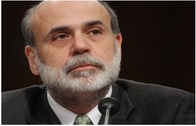
The United States Senate has confirmed Ben Bernanke for a second term as chairman of the Federal Reserve. The Senate voted 70-30 to reappoint Bernanke amid criticism of his judgment ahead of the financial crisis and his support for massive Wall Street bailouts. His supporters credited him for engineering a financial industry rescue in time to prevent a catastrophic collapse.
The vote was the closest ever for a nominee for Federal Reserve chairman. the vote came among public anger over the economy and high unemployment that fueled a backlash against Bernanke. A Fed chairman has never been rejected in the Senate. Bernanke's current term was set to expire this coming Sunday, Jan. 31.
Prior to Bernanke's 70-30 Senate victory, the closest margin of a Senate vote for Fed Reserve chair was the confirmation for Paul Volcker's second term in 1983 by a vote of 84-16.
"If you're the scorekeeper of our recovery, it looks like it can be summarized in the two-word phrase: Banks win," said Sen. Sheldon Whitehouse (D-RI).
"As Board Chairman, he ignored or downplayed serious emerging risks; failed to use regulatory authority available to the Fed to prevent housing speculation and unsound lending practices; often misjudged the nature of problems in markets; contributed to market turbulence by appearing to act inconsistently and in an ad hoc manner; failed to ensure transparency of actions; and took actions damaging to the political independence of the Federal Reserve and our Nation’s monetary policy," said Sen. Richard Shelby (R-AL), ranking Republican on the Committee on Banking, Housing, and Urban Affairs, who opposed the Bernanke nomination and commented on the Senate floor. "Ben Bernanke’s Federal Reserve also failed to detect and address the decline in lending standards and growing use of sub-prime loans. At the core of our financial crisis is the fact that far too many home loans were made that borrowers will be unable to repay. The failures of Bear Stearns, Lehman, Washington Mutual, and AIG largely stem from the sharp declines in mortgage values. Although Congress gave the Federal Reserve authority to address lending standards and sub-prime loans when it passed the Home Ownership and Equity Protection Act in 1994, the Fed failed to enact strong regulations until 2008, more than two years into Chairman Bernanke’s term. In other words, Bernanke fiddled while our markets burned."
"One must raise the question of where our country would be today if Chairman Bernanke was not leading the Federal Reserve, and who specifically could do a better job," said Sen. George Voinovich (R-OH). "I am pleased he will continue in his role as chairman as our country begins to right itself from the depths of the greatest financial calamity since the Great Depression."
Sen. Jon Kyl (R-AZ), also opposed the nomination: “When I think of what a Federal Reserve chairman is supposed to do, I think of two key responsibilities: Maintaining stable prices and keeping our dollar strong. Unfortunately, Chairman Bernanke’s Federal Reserve has not performed well on either count. Consumer inflation, as measured by the Bureau of Labor Statistics, increased 2.9 percent from June to December 2009."
For more information, visit www.federalreserve.gov.