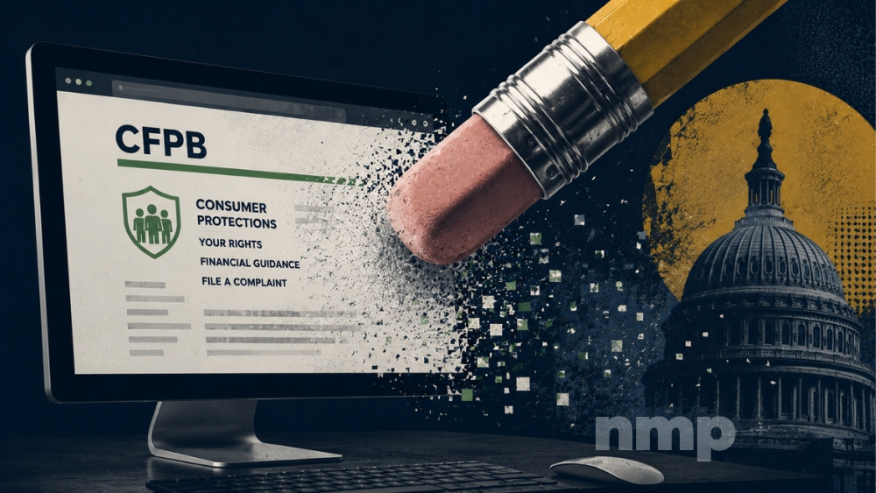
Acting CFPB director’s first congressional testimony comes as lawmakers scrutinize staffing cuts, suspended supervision, deleted agency records, and an unexpectedly active rulemaking agenda.
Acting CFPB Director Russell Vought is scheduled to appear before the Senate Banking Committee Thursday, July 16, in a hearing titled “The CFPB Semi-Annual Report: A New Day at the CFPB Through Reform” — a notable shift given attempts during the early days of the second Trump administration to effectively dismantle the CFPB.
The hearing will mark Vought’s first appearance before Congress as acting CFPB director since taking over the agency in February 2025 while continuing to lead the Office of Management and Budget.
Lawmakers are expected to question Vought about the bureau’s sharp reduction in enforcement and supervision, proposed staffing cuts, removal of historical material from its website, and plans to pursue a wide-ranging regulatory agenda with a substantially smaller workforce.
President Donald Trump has nominated Brian Johnson, a Capital One executive and former CFPB deputy director, to serve as the agency’s next permanent director. His nomination remains subject to Senate confirmation.
A Smaller Bureau With A Busy Agenda
The CFPB’s latest semiannual regulatory agenda identifies about 20 rulemaking actions focused on reconsidering, rescinding, or streamlining regulations adopted under previous administrations.
Several items could directly affect mortgage lenders, servicers, and originators, including potential changes involving:
- Ability-to-Repay and Qualified Mortgage requirements;
- loan originator compensation rules;
- mortgage servicing regulations under Regulations X and Z;
- pandemic-era mortgage servicing protections;
- calculations used to determine the Average Prime Offer Rate; and
- supervisory rules governing large nonbank financial companies.
The bureau also recently sought public input on the TILA-RESPA Integrated Disclosure rule, the Truth in Lending Act’s right of rescission, and reverse mortgages.
The agenda suggests the CFPB intends to rely heavily on formal rulemaking even as it scales back enforcement actions and supervisory examinations.
Democrats Question CFPB Enforcement Retreat
Vought is likely to face questions about the removal of nearly 15 years of material from the CFPB’s website and the bureau’s broader pullback from enforcement.
Sens. Elizabeth Warren, D-Mass.; Raphael Warnock, D-Ga.; Andy Kim, D-N.J.; and Lisa Blunt Rochester, D-Del., asked Vought in a June 22 letter to explain what they described as the deletion of thousands of pages of CFPB material.
The senators said the removed content included all press releases, testimony, and speeches published before President Donald Trump’s second term, as well as consumer advisories, settlement notices, original research, major reports, and all 35 editions of the CFPB’s Supervisory Highlights.
According to the letter, CFPB blog posts published before February 2025 were removed on May 14, followed by newsroom material on May 19. The senators said the Supervisory Highlights reports were removed on June 2.
The lawmakers asked who ordered or approved the removals, where the original records were preserved, whether additional material would be taken down, and whether the CFPB would restore the deleted pages and reports.
They also linked the website removals to what they described as the CFPB’s retreat from enforcement. The letter alleges that the bureau dismissed or terminated at least 42 public enforcement actions after Vought took over in February 2025. That figure is based on outside advocacy research cited by the senators.
The lawmakers further alleged that enforcement orders involving Toyota Motor Credit and Navy Federal Credit Union were terminated before all promised consumer compensation had been paid. They also questioned whether the removal of settlement notices, consumer advisories, and supervisory reports was intended to obscure the agency’s previous enforcement work and findings.
The letter requests a response by July 2, but Vought has reportedly not yet responded.
Poll Shows Bipartisan Support For CFPB
Vought’s testimony also comes as a new poll from Lake Research Partners and Chesapeake Beach Consulting suggests the CFPB retains broad support across party lines.
The survey found that 80% of likely 2026 voters favored the agency after hearing a description of its mission, including 86% of Democrats, 69% of independents, and 77% of Republicans.
Republican voters maintain their opposition to attacks on the CFPB by a sizable margin (+18 net oppose) even when these attacks are attributed to Republicans in Congress. They also oppose elimination of the CFPB when the effort is attributed to President Trump by a similar margin (+16 net oppose).
It also found that 67% of voters supported more regulation of financial companies, including mortgage lenders, s Wall Street banks, payday lenders, debt collectors, and credit card companies.
Bottom Line
For mortgage lenders, servicers, and originators, the hearing could offer the clearest indication yet of how the Trump administration intends to reshape federal oversight of the industry.
The central question is no longer simply whether the CFPB will survive, but what kind of agency will remain.