Gen Z mortgage shoppers are entering the purchase market with considerably less cash than older borrowers, creating a sizable opportunity for originators equipped to structure low-down-payment financing.
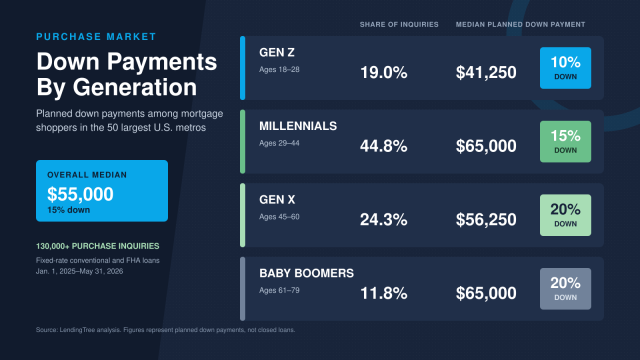
Americans ages 18 to 28 accounted for 19% of mortgage purchase inquiries across the nation’s 50 largest metros, according to a LendingTree analysis of more than 130,000 inquiries. Their median planned down payment was $41,250, or 10% of the estimated purchase price — the lowest amount and percentage among the four generations studied.
Millennials represented the largest share of prospective borrowers by a wide margin. Shoppers ages 29 to 44 generated 44.8% of inquiries and planned a median down payment of $65,000, tying baby boomers for the highest amount among the generations analyzed.
Gen X borrowers accounted for 24.3% of inquiries and planned to put down a median of $56,250. Baby boomers represented the smallest share of shoppers, at 11.8%, despite matching millennials’ $65,000 median.
The results provide a more segmented view of the purchase market confronting LOs. Millennials are supplying much of the active demand and have accumulated down payments comparable to those of the oldest borrowers. Gen Z shoppers are also present in meaningful numbers, but their smaller equity contributions may require different product and affordability conversations.
Gen Z Ranks Last In Every Metro
Gen Z reported the lowest median planned down payment in all 50 metros, including two markets where it tied another generation.
The generation’s lowest median was $23,750 in Virginia Beach, Va. At the opposite end, Gen Z shoppers in San Jose, Calif., planned to put down $115,000, followed by $105,000 in San Francisco.
Those six-figure amounts demonstrate the limits of comparing down payments solely in dollars. San Jose’s median planned down payment across all generations reached $190,000, more than five times the $33,750 median reported in San Antonio, Oklahoma City, and Memphis, Tenn.
California accounted for four of the five markets with the highest median planned down payments. San Jose led at $190,000, followed by San Francisco at $170,000, Los Angeles at $115,000, and San Diego at $101,250. Boston tied San Diego at $101,250 and was the only non-California metro in the top five.
Millennials recorded the two largest down payments for any generation in any metro: $250,000 in San Jose and $195,000 in San Francisco.
At the lower end, San Antonio, Oklahoma City, and Memphis each posted an overall median of $33,750. Louisville, Ky., and Virginia Beach followed at $36,250. No generation in those five markets reported a median above $45,000.
The 20% Divide
Down payment percentages also varied substantially by age.
Gen X and baby boomer shoppers planned to put down a median of 20%, compared with 15% among millennials and 10% among Gen Z. That divide has direct implications for loan selection, mortgage insurance, cash reserves, and the use of assistance programs.
Eleven metros had an overall median planned down payment of 20%, including New York, Los Angeles, Chicago, Washington, Philadelphia, Miami, Boston, San Francisco, Seattle, and San Diego. Eight metros had a median of 10%, while the remaining 31 were at 15%.
In Miami, for example, the overall median was 20%, but Gen Z shoppers planned a median contribution of only 10%. Seattle showed the same split. Those gaps suggest that even in markets where larger down payments are common, younger borrowers may require a substantially different financing strategy.
LendingTree’s generational breakdown shows where much of the low-down-payment opportunity may be concentrated. Gen Z’s 19% share of inquiries indicates that younger shoppers are not absent from the market, even if their available cash trails that of older borrowers.
That puts greater weight on an LO’s ability to compare conventional low-down-payment products, FHA financing, mortgage insurance structures, and down payment assistance.
LendingTree’s findings measure borrowers’ intentions rather than completed transactions. The analysis covers purchase inquiries submitted through its platform from Jan. 1, 2025, through May 31, 2026, and includes fixed-rate conventional and FHA loans.