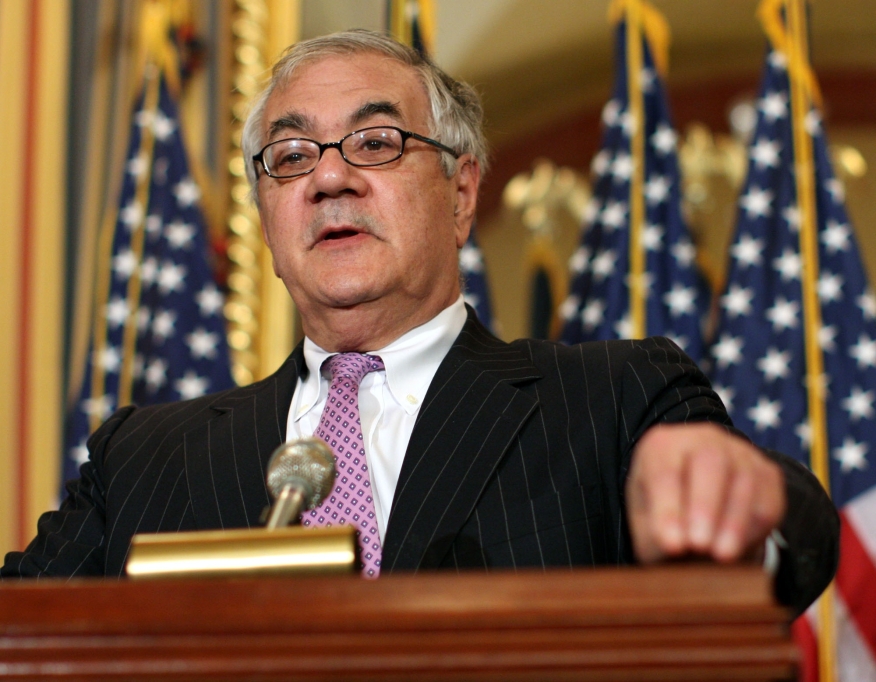
The co-author of the Dodd-Frank Act is insisting that there is no sin for a politician to accept campaign donations from financial services companies, nor is there a problem if a politician worked for such companies either before or after that person served in public office.
In a column published on Politico, former Rep. Barney Frank (D-MA) held himself and his Dodd-Frank co-author, former Sen. Chris Dodd (D-CT) as examples of elected officials that accepted donations from financial services companies. He added that he solicited fees from financial entities since his retirement in 2012, and is now serving as a director for Signature Bank.
Although Frank cited Barack Obama’s acceptance of campaign donations from financial entities in his 2008 presidential bid, he conspicuously avoided mentioning by name the current presidential campaigns of Hillary Clinton or Bernie Sanders. But Frank made it clear in his thinly veiled language that he supported Clinton’s candidacy (which has fielded charges from both liberals and conservatives that she is too close to Wall Street) and rejected Sanders’ argument against accepting Wall Street campaign funds.
“Given our unhappiness at the disproportionate amount of campaign money that heavily favors the right, why would we insist on making it worse?” Frank wrote. “By demonizing finance-industry contributions, we’re effectively insisting that instead of 80 percent of the industry’s contributions going to opponents of regulation, it should be 95 percent or more. Is this money corrupting? In my own experience, it’s more reasonable to see it as a form of political self-defense unlikely to dilute their support for reform. For liberals to demonize those who do so is a needless self-inflicted wound for their cause.”
For her part, Clinton used an op-ed column in yesterday’s New York Times to promise that she would be tough on the Wall Street companies that lavished her with millions of dollars in speaker fees and campaign donations. In a piece titled “How I’d Reign In Wall Street,” she acknowledged Frank’s support of her efforts and insisted that she “would also fight for tough new rules, stronger enforcement and more accountability that go well beyond Dodd-Frank.” But unlike Frank, Clinton made no mention of her own profitable friendship with the financial services world.