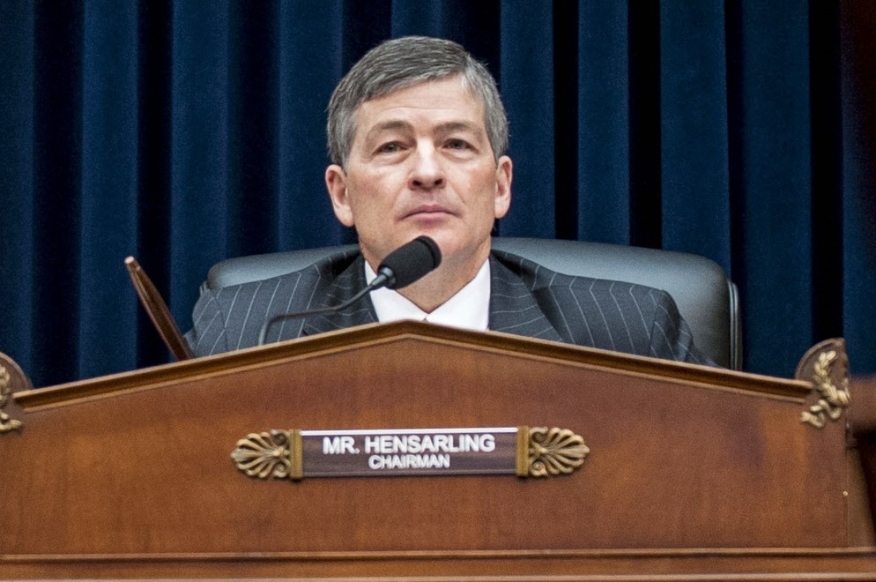
Rep. Jeb Hensarling (R-TX), chairman of the House Financial Services Committee, reacted angrily to yesterday’s announcement by Federal Housing Finance Agency (FHFA) Director Mel Watt that the government-sponsored enterprises (GSEs) will soon launch a principal reduction program aimed at helping struggling homeowners.
In a statement issued by the committee’s office, Rep. Hensarling argued that the “best foreclosure prevention program ever conceived by the mind of man is a good-paying job created by a healthy, growing economy, not more Washington housing schemes.” He warned that the FHFA’s actions would repeat the problems that led to the 2008 crash.
“Contrary to the fable told by the Left, the root cause of the financial crisis was not deregulation but dumb regulation,” Rep. Hensarling stated. “Regulations and statutes that ultimately put people in homes they could not afford to keep and led to the bailout of Fannie Mae and Freddie Mac, the biggest taxpayer-funded bailout in history. We need to build a sustainable housing finance system that protects both homeowners and taxpayers. But instead, the FHFA is helping Washington roll the dice again with another scheme founded on perverse incentives. Principal reductions exacerbate the same moral hazard problems that left taxpayers holding the bag for the government’s failures. Further, the FHFA itself previously warned us that principal reduction would be very costly for taxpayers, who already have spent hundreds of billions to bail out Fannie and Freddie.”
Rep. Hensarling’s unhappiness was echoed by Dan Berger, president and CEO of the National Association of Federal Credit Unions (NAFCU).
“We fail to see how principal reduction will do anything to strengthen the housing market,” he said. “NAFCU has always supported protecting consumers, but we believe principal reduction sets a dangerous precedent. Credit unions have a strong history of doing everything they can to keep members in their homes.”
On the flip side, the principal reduction announcement was greeted warmly by Mike Calhoun, president of the Center for Responsible Lending (CRL).
“The new program recognizes the value of principal reduction as an important tool that helps to keep families in their homes and reduces the cost of foreclosures,” Calhoun said. “Up until now, this effective loan modification tool was not available to homeowners whose mortgages are owned by Fannie Mae and Freddie Mac. However, private lenders have long used principal reduction as one of the best tools to help homeowners remain in their homes and become current on their mortgages.”
Also praising the FHFA, albeit with more caution than Calhoun, was John Taylor, president and CEO of the National Community Reinvestment Coalition (NCRC).
“We applaud FHFA and Director Watt for taking this important step in the right direction,” he said. “The new principal reduction modification program will help certain underwater borrowers avoid foreclosure and stay in their homes. That’s a very positive thing. That said, with the scope announced today, this program will have limited impact—this represents the first bite at the apple. Hopefully this program will serve as a model for what can be done with the larger portfolio of delinquent loans that could be modified at Fannie Mae and Freddie Mac.”