Economist’s analysis finds the pendulum has swung toward renting, making local expertise more important than ever for mortgage pros
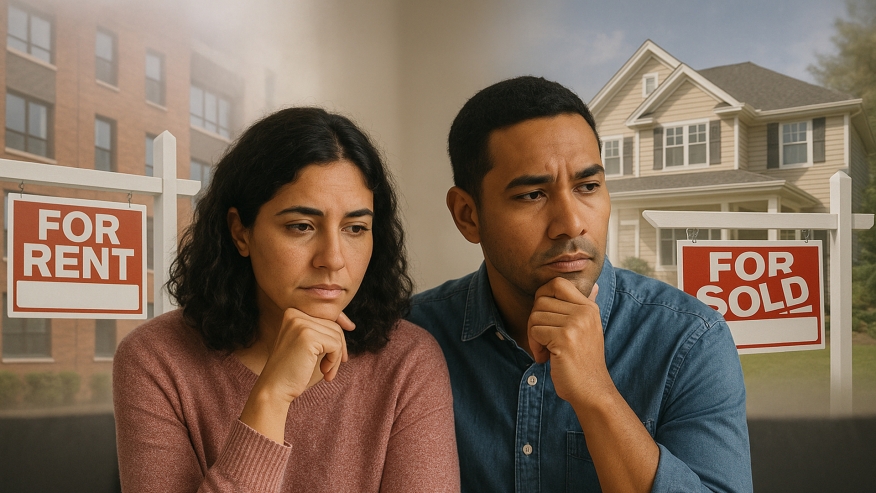
For Americans weighing the classic “rent or buy” dilemma, new research from First American Financial Corporation suggests the scales have tipped decisively in favor of renting — at least for now, and at least nationally.
“Renting is currently more affordable than owning in most major markets, even after adjusting for equity gains,” writes Odeta Kushi, deputy chief economist at First American. “But that’s not true everywhere.”
In her latest analysis, Kushi notes the national difference between renting and owning — even after factoring in potential equity from home price appreciation — is now the widest it’s been since 2011.
First American Deputy Chief
Economist Odeta Kushi
Driving the shift? A cooling housing market with annual home price growth slowing to a 13-year low — even turning negative in some areas — and rent growth moderating below pre-pandemic norms.
Between 2012 and 2022, homeownership offered a clear financial edge, with strong appreciation delivering nearly $225,000 in cumulative wealth for the average homeowner over 10 years. In contrast, the typical renter lost about $148,000 in potential gains. But that has changed in 2025.
Get the NMP Daily
Essential stories, every weekday.
After evaluating the monthly cost of renting versus owning — including mortgage payments, taxes, insurance, repairs, and appreciation — First American finds that renting made more financial sense in all of the top 50 U.S. markets in Q2 2025.
However, after adjusting for home price appreciation, owning edged ahead in 14 of those markets, including Louisville, Ky. ($503 monthly ownership premium), Hartford, Conn. ($473), Buffalo, N.Y. ($465), and Pittsburgh ($435).
Kushi illustrates the contrast by comparing markets like Baltimore and San Francisco. In Baltimore, buying a home costs around $2,355 a month — but with a 4.1% annual appreciation rate, equity gains lower the net cost to $1,440, below the median rent of $1,660.
Meanwhile, in San Francisco, home prices fell 6% year-over-year, pushing the net monthly cost of owning to $10,000 — far above the $2,500 median rent.
“Real estate is intensely local,” Kushi writes. “Whether it’s smarter to rent or buy depends heavily on the market.”
Still, she cautions that financials aren’t the only factor. Flexibility versus stability, mobility versus putting down roots, and long-term equity versus short-term savings all play into the decision.
“At the end of the day, the choice comes down to lifestyle,” according to Kushi. It’s up to individuals to determine which is the right path for them.
Kushi’s analysis underscores a critical challenge for mortgage professionals — and opportunity. With the financial advantage shifting toward renting in most markets, the traditional homeownership pitch may need to be reframed.
Emphasizing long-term equity gains, lifestyle stability, and the wealth-building potential of even modest appreciation in select markets will be key. Local expertise matters more than ever, as personalized, market-specific guidance could make the difference in converting would-be renters into confident buyers.
The dispute over publicly marketed homes comes amid a Compass–Rocket alliance linking home search, buyer inquiries, and financing offers
Six multiple listing services have sued Compass over its demands that they stop penalizing agents who publicly market homes without sharing the listings through the MLS, escalating a dispute over who gets access to for-sale inventory and when.The lawsuit, filed Oct. 21 in th...
Veterans United’s survey finds less willingness to hold out for lower rates, but little change in purchase timelines
Prospective homebuyers are growing more pessimistic about interest rates, and less inclined to wait for relief.In Veterans United Home Loans’ latest survey, 57% expect interest rates to rise over the next year, up from 45% a year earlier. Yet the share who would consider wai...
September’s decline leaves originators competing for fewer purchases, while rising borrowing costs and limited new listings keep affordability under pressure
Realtor.com finds 66 of 99 metros favor buyers or are moving that way, while rising financing costs have cut borrowing capacity 7.2% since late August for a fixed monthly payment