
Image



COVER STORY
Appraisers face stagnant pay and rising costs as AMCs defend their fees and new technology reshapes the industry
By Czarinna Andres, vice president of content, National Mortgage Professional
and Katie Jensen, special to National Mortgage Professional
Stacie Damkohler built her appraisal business by filling her pipeline and emptying her gas tank.
Chasing more than a dozen assignments a week across Queens and Long Island, New York, from Montauk to the Hamptons, she covered territory like a New York cab driver, earning her way toward the next call.
In a male-dominated profession, Damkohler says her arrival often surprises the person answering the door. Homeowners greet her with, “Oh, you're a lady!”
She smiles, holding up her digital tablet: “Yep, I'm the lady with the stylus!”
As a child, Damkohler spent afternoons filing paperwork at her mother's mortgage office. What began as a chore eventually sparked an interest in researching properties and uncovering the details that determine their value.
“I call myself a ‘find-out-ologist,’” she said.
Now a 23-year veteran, Damkohler says people often mistake an appraisal for a quick property visit, a few photographs, and a number on a report.
“I think people don't realize the amount of schooling that it took or takes us to do what we do,” she said.
She spent two years training under an appraiser and failed her certification exam twice before earning her credentials in 2008, just as the financial crisis was reshaping the mortgage industry.
The reforms that followed strengthened appraisal independence requirements and helped cement appraisal management companies, or AMCs, as major intermediaries between lenders and appraisers.
Newly certified, Damkohler joined multiple AMC panels, hoping to build her business. But being accepted onto a panel didn't guarantee assignments.
Despite working in one of the nation's busiest housing markets, she said she went six months without receiving a single order.
“A lot of the AMCs want you to have five years’ experience,” she said.
> Stacie Damkohler, owner of LEX Appraisals
Eventually, she called a coordinator at an AMC serving a major national bank. When the coordinator told her business was slow, Damkohler challenged the explanation.
“’That's a lie,’ I said. ‘Because you have your people, and I want to be one of your people. So, what do I need to do to be that?’”
The coordinator gave her a chance.
Assignments followed across Suffolk County, Brooklyn, and the Bronx. Damkohler estimates it took about five years before she began receiving regular business from AMCs.
“And I tell people I worked my way out of Suffolk; I worked my way out of Brooklyn; I work my way out of the Bronx. I'm where I need to be right now. But it’s a hustle,” she said. “I've fallen down attic stairs. I’ve hit my head on pipes in basements — you name it. I literally climbed myself up that ladder to get where I am.”
Today, Damkohler operates LEX Appraisals, completing 10 to 12 appraisals weekly across Nassau and Queens counties.
She has built a career around work that can be physically demanding, technically complex, and legally consequential.
“I raised two children, and when they’d come into the house after school, they’d know where to find me — Mommy's in her office,” she said. “And it's sad because I've devoted a lot of my life to this. I try to … balance motherhood and career. It's not easy.”
Yet after more than two decades, she says one part of the business has barely changed.
“The fees that we're getting have been the same, pretty much, for 20 years.”
Her frustration is shared by appraisers who argue that while the cost of obtaining an appraisal has increased, too little of the money reaches the professional responsible for producing the valuation.
At the center of that dispute are AMCs, which coordinate assignments, manage appraiser panels, oversee compliance, and perform administrative and quality-control functions.
The question is not whether those services have value.
It is how much they should cost, how transparently those costs are disclosed, and whether the current system fairly compensates the people doing the work.
For most homebuyers, an appraisal is another expense in an already costly mortgage transaction.
The borrower pays a fee, the lender obtains a valuation, and the loan moves toward closing.
But the amount listed as an appraisal charge does not necessarily represent what the appraiser receives.
When an AMC is involved, the total charge may include both the appraiser's compensation and the company's administrative fee. Depending on the billing arrangement, those amounts may appear together rather than as separately itemized charges on the borrower's closing disclosure.
That distinction has become a central issue for appraisal industry advocates who argue that borrowers should know how their money is distributed.
The Consumer Financial Protection Bureau (CFPB) considered whether to require separate disclosure of appraisal management fees during the development of its integrated mortgage disclosure rules. It ultimately did not require the breakdown, citing concerns that additional detail could overwhelm consumers.
More than a decade later, appraisal organizations continue to challenge the lack of visibility into the fee split.
A 2025 industry survey cited by The Appraisal Foundation found that 73% of responding appraisers reported no fee increase over the preceding 15 years.
In materials prepared for federal appraisal regulators, the foundation also compared a typical residential appraisal fee of approximately $400 in 2011 with about $425 in 2025.
That represents a $25 increase over 14 years, far below the increase in general consumer prices over the same period.
The foundation's analysis estimated that keeping pace with inflation would have required a fee of approximately $575.
Those figures illustrate the compensation pressures that appraisers say have persisted even as mortgage-related expenses have risen.
The dispute becomes sharper when examining how much AMCs retain.
A 2011 Government Accountability Office report described arrangements in which appraisal management companies retained roughly 30% to 50% of the overall appraisal charge, although fees and business models varied.
More recently, the Appraisal Regulation Compliance Council, or ARCC, has sought to document the difference between what consumers are charged and what appraisers receive.
Joshua Tucker, a regional bank chief appraiser and ARCC co-founder, has spent the past two years collecting transaction records and examining appraisal fee practices.
The organization says it has gathered more than 2,000 itemized records and identified transactions in which AMCs retained a majority of the gross appraisal charge.
Among the examples identified in ARCC's research:
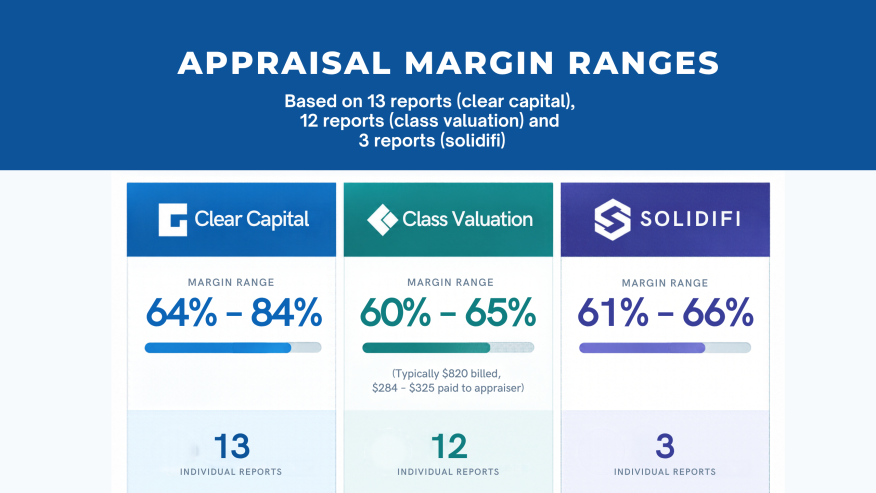
The records raise questions about the relationship between the services provided and the amounts retained.
In its response to the CFPB's 2024 request for information on mortgage closing costs, ARCC estimated that approximately $12 billion in borrower-paid appraisal-related charges had been retained as undisclosed or allegedly mischaracterized AMC fees between 2013 and 2023.
For Tucker, the larger issue is that appraisers have limited leverage over a fee structure largely controlled by intermediaries.
“Appraisers are just getting nickeled and dimed, and we have no way to fight back,” he said.
Damkohler takes a firm position on the compensation she will accept.
“I personally won't take on work for less than a certain amount of money, and any appraiser that would do so is hurting their own industry,” she said.
She also points to the economics of running an appraisal business. After the AMC takes its portion, there may not be enough left to compensate another appraiser or employee while covering overhead.
“It's just not feasible,” she said.
The rise of appraisal management companies is closely tied to the mortgage industry's response to the financial crisis.
Before the crisis, concerns about pressure on appraisers had become a significant issue in mortgage lending. Investigations into inflated valuations and lender influence prompted regulators and the government-sponsored enterprises to strengthen appraisal independence standards.
In 2008, then-New York Attorney General Andrew Cuomo reached an agreement with Fannie Mae and Freddie Mac that led to the Home Valuation Code of Conduct, or HVCC.
The code took effect in 2009 and imposed restrictions intended to separate appraisal decisions from loan production personnel.
Although the HVCC was later replaced by other appraisal independence requirements, the changes helped expand the use of third-party appraisal management companies.
Marc Savitt, a former president of the National Association of Mortgage Brokers and president of the National Association of Independent Housing Professionals, was among those who challenged the original framework.
He argued that the restrictions disadvantaged independent mortgage brokers while allowing large lenders to maintain substantial control over appraisal management operations.
Savitt was president of NAMB during the financial crisis and recalls the difficulty of confronting a rapidly changing regulatory environment.
“Everybody went, ‘good luck, sucker!’” he said.
> Marc Savitt, president of NAIHP and former NAMB president
He met with Cuomo's office and later challenged the rules before lawmakers, arguing that the system could preserve the influence of large lenders while limiting the ability of independent brokers to compete.
Savitt also questioned whether AMCs would improve appraisal quality enough to justify their costs.
“It is important to understand consumer costs have not been reduced along with appraiser compensation," he said. “In fact, the cost of an appraisal has increased on average $150. The increase, along with the ‘haircut’ taken by appraisers, has gone into the pockets of AMCs and their partners, the big banks.”
His assessment reflects a longstanding criticism of the AMC model, but it is not the only interpretation of the industry's evolution.
Appraisal independence requirements were intended to address a genuine problem: pressure on appraisers to produce valuations that supported loan approvals.
AMCs can provide a separation between production staff and the professionals determining property values.
And importantly, lenders are not legally required to use them.
Fannie Mae emphasized that distinction in a December 2025 Appraiser Update, noting that neither the HVCC nor subsequent appraisal independence rules mandate the use of AMCs.
The GSE said a significant portion of the appraisals delivered to it are obtained directly by lenders without AMC involvement.
That means the industry's reliance on AMCs is a business and operational choice, not an unavoidable regulatory requirement.
For appraisers, one of the most contentious aspects of the AMC model is how assignments are awarded.
Many AMCs manage large panels of independent appraisers, selecting professionals based on factors such as location, qualifications, availability, price, and turnaround time.
Federal law requires customary and reasonable compensation for fee appraisers in covered transactions, subject to applicable rules and exceptions.
But determining what is customary and reasonable can be contentious, particularly when appraisers are competing for assignments.
Tucker argues that some AMCs use their position between lenders and appraisers to push compensation lower.
He cited internal communications he obtained from Accurate Group that, according to his account, encouraged employees to negotiate down appraiser fee quotes and improve margins on individual orders.
Such records, if authenticated and considered in their full context, could help illuminate how appraisal fees are negotiated. They do not, by themselves, establish a violation of compensation rules.
The broader concern is that pressure to complete assignments quickly and inexpensively may influence which appraisers receive work.
Savitt points to geographic competency as one potential casualty.
In testimony before lawmakers, he described a historic property in Harpers Ferry, West Virginia, that was appraised by a professional from Maryland. Savitt said he challenged the valuation and paid for a second review, which identified concerns about comparable sales and adjustments.
The AMC ultimately reimbursed the cost of the review after Savitt threatened legal action, according to his account.
For Savitt, the case illustrated the risk of selecting appraisers without sufficient knowledge of local market conditions.
The same issue can arise when lenders impose additional restrictions on who may perform appraisal work.
Frank Gregoire, chairman of The Appraisal Foundation and owner of Gregoire & Gregoire Inc., argues that some lender and AMC requirements unnecessarily narrow the available pool of qualified appraisers.
“Some of the people complaining the loudest about a possible shortage of appraisers are inadvertently contributing to that by overlays that they are imposing on the actual reporting of an appraisal,” he said.
The conflict extends to new appraisers trying to enter the profession.
Tucker said some lenders and AMCs restrict the use of supervised trainees even while accepting property data collected by individuals who are not licensed appraisers.
That can make it harder for new professionals to gain the experience needed for certification.
The Appraisal Foundation has supported alternative training pathways, including the Practical Applications of Real Estate Appraisal program, known as PAREA, which allows qualifying participants to complete approved experience requirements through simulated appraisal assignments.
Such initiatives may help expand the profession, but they do not resolve the underlying dispute over compensation and assignment practices.
> Frank Gregoire, chairman for The Appraisal Foundation
and owner of Gregoire & Gregoire, Inc.
The appraisal industry's longstanding compensation dispute is now colliding with one of its largest technology transitions in years.
Beginning November 2, Fannie Mae and Freddie Mac will require new appraisal reports submitted through the Uniform Collateral Data Portal to use Uniform Appraisal Dataset 3.6, unless a lender has obtained an approved exception.
The redesigned reporting format replaces familiar appraisal forms with a dynamic, standardized dataset that changes how lenders collect, document, and review property information.
For lenders, it means new systems and workflows.
For appraisers, it means learning a different reporting process, adapting software, and potentially collecting and documenting additional information.
And for AMCs, it means managing the transition while lenders remain sensitive to appraisal costs.
A survey published in August by Corporate Settlement Solutions, an appraisal management and settlement services provider, illustrates the tension.
Of 831 appraisers who answered a question about fees, 66.7% anticipated charging more for UAD 3.6 assignments.
Among 214 respondents who had already completed UAD 3.6 reports, that figure rose to 82.2%.
Turnaround times were another concern. Of 816 appraisers who answered that question, 78.3% expected assignments to take longer.
The survey reflects appraisers' expectations, not measured nationwide changes in fees or production times. Nevertheless, the responses indicate that the transition has intensified existing concerns about compensation.
Early production data is beginning to show what those expectations may mean in practice.
In October, Clear Capital reported that appraisal fees were averaging approximately $65 more in comparable markets where it had sufficient UAD 3.6 production data.
The company also reported that appraisers were completing the new reports 28% faster as they gained experience with the format, although overall turnaround times remained somewhat longer.
Corporate Settlement Solutions has reported a different early experience, with some live UAD 3.6 orders costing $100 to $200 more than comparable legacy assignments and taking two to three additional days.
Those findings come from different company samples and should not be interpreted as competing national averages.
Together, however, they demonstrate that the transition's impact on costs and turnaround times is not uniform.
Appraisers are also encountering resistance to fee increases, which exposes a fundamental question.
If the new reporting requirements demand more work from appraisers, should they receive more compensation? And if technology eventually reduces the time needed to complete those reports, who should benefit from the savings?
For an industry already debating whether appraisers receive a fair share of the borrower's fee, UAD 3.6 sharpens those questions.
Despite her frustrations with fees and assignments, Damkohler does not dismiss the value of appraisal management companies.
She credits the system with protecting her independence.
Before the AMC model became widespread, she recalls mortgage companies pressuring appraisers to produce the valuations they wanted.
“Whereas the mortgage companies, before the AMCs, used to tell me what they wanted, now I tell them,” she said.
Appraiser independence is intended to protect the credibility of property valuations and reduce the risk that loan production pressures influence the outcome.
AMCs can support that separation while coordinating assignments, managing appraiser panels, reviewing reports, and overseeing compliance and quality control.
Those services carry operating costs, including staffing, technology, licensing, and insurance. As a result, the difference between what an AMC charges and what it pays an appraiser does not necessarily represent profit.
But that distinction leaves a central question unresolved: How much of the fee reflects the actual cost of managing an appraisal, and how much does the AMC retain after those expenses?
The question is whether the amount retained reasonably reflects those services and whether lenders and borrowers receive sufficient value.
Damkohler's experience also illustrates a tension within the system.
While AMCs may help protect appraisers from pressure by loan production staff, they do not necessarily shield appraisers from professional liability.
“We all have to carry our own insurance,” she said. “The liability will always fall on us, not the AMC. If I had a homeowner that made a complaint to the state for argument's sake and didn't like my value, I don't think an AMC is protecting me. I'm protecting me.”
Appraisers remain responsible for their professional opinions and compliance with applicable standards.
But lenders also have responsibilities that cannot simply be transferred to an intermediary.
Fannie Mae made that point explicit in its December 2025 guidance to appraisers and lenders.
Although lenders may use third-party vendors to manage appraiser selection and other functions, they remain accountable for the quality of the work performed.
The GSE also disclosed that it had begun sending educational letters to AMCs in July 2025 identifying appraisal quality problems discovered during reviews of loans completed in 2024.
Those problems included inadequate adjustments for differences between properties, inappropriate comparable selections, and inaccurate reporting of property condition or quality.
The letters were intended to help AMCs improve training and quality-control procedures. Fannie Mae emphasized that they were not rankings or comparative scorecards.
The initiative offers an important perspective on the value of appraisal management.
AMCs may help lenders administer appraisal programs and identify deficiencies. But their involvement does not eliminate appraisal quality problems, nor does it relieve lenders of responsibility for their vendors.
Fannie Mae also noted that UAD 3.6 makes AMC involvement easier to identify in appraisal reports, improving visibility into which organizations participate in the process.
That added transparency could eventually support more detailed analysis of appraisal quality and vendor performance.
The assumption that AMCs necessarily produce better appraisals has also been examined by federal researchers.
A 2018 Federal Housing Finance Agency working paper analyzed approximately 5.3 million appraisal records associated with mortgages purchased by Fannie Mae and Freddie Mac.
The researchers found differences in valuation behavior between AMC and non-AMC appraisals but did not establish that AMC involvement consistently produced more accurate valuations.
Among the findings, AMC appraisals were more likely to match the contract price exactly: 26.41% compared with 22.67% for non-AMC appraisals.
The study also identified a slightly higher incidence of appraisals exceeding contract prices by more than 6% among AMC reports, 1.05% compared with 0.81% for non-AMC reports.
That complicates the argument that adding an intermediary automatically improves valuation quality.
Tucker believes lenders should consider whether maintaining more appraisal expertise internally would provide better oversight.
His regional bank operates an in-house appraisal department within its risk and analysis function, separate from loan production.
He estimates that the department costs approximately $400,000 annually to operate.
“Ensuring that you're getting good quality reports is more important than trying to save money on personnel costs,” he said.
He argues that the cost of maintaining an appraisal department should be weighed against the financial exposure created by flawed valuations.
“Let's just say that you have one or two foreclosures on a house that's half a million dollars. Well, your appraisal department, having been there, could have just saved you that.”
An in-house department is not necessarily practical for every lender. Volume, staffing costs, compliance requirements, and operational capacity all influence whether direct appraisal management is feasible.
But Fannie Mae's confirmation that AMC use is optional makes the comparison relevant.
The question is not simply whether lenders can outsource appraisal management. It is whether outsourcing provides the best combination of quality, cost, and independence.
> Joshua Tucker, chairman and co-founder of the
Appraisal Regulation Compliance Council
The industry's move toward UAD 3.6 is also accelerating the adoption of automated appraisal review.
As appraisal reports become more structured, technology providers can apply rules and automated checks to larger portions of the information.
In September, Clear Capital introduced its AURA Risk Navigator, designed to help lenders identify and resolve appraisal findings through an automated review workflow.
On October 27, Friday Harbor announced that it had expanded its AI appraisal review platform to support UAD 3.6, with more than 350 automated checks intended to distinguish validated information from issues requiring additional attention.
These products address appraisal review rather than replacing the licensed appraiser's professional valuation.
Their significance lies in the potential to reduce manual processing, identify errors earlier, and help lenders manage collateral risk.
But they also introduce another economic question into the appraisal fee debate.
If technology makes review and quality-control work more efficient, will those savings eventually reduce borrower charges, improve appraiser compensation, or remain with the organizations managing the process?
The answer is not yet clear.
Vendors have reported improvements in particular workflows, but there is insufficient independent evidence to establish how automation is affecting AMC operating margins or the division of appraisal fees across the industry.
There is also a distinction between faster processing and lower costs.
Technology systems require investment, integration, maintenance, oversight, and staff training. Automation may reduce some expenses while creating others.
Still, the transition is changing how lenders and AMCs perform work that has traditionally helped justify appraisal management fees.
That makes transparency over both costs and outcomes increasingly important.
As the industry standardizes appraisal data, it may become easier to evaluate turnaround times, error rates, review activity, and other measures of performance.
Those measures could help lenders determine what they are receiving for the fees paid to appraisal management providers.
The dispute over appraisal charges has also reached the courts.
In December 2025, plaintiffs filed a lawsuit in Florida against Appraisal Nation, AMC Links, and United Wholesale Mortgage, alleging that appraisal fees charged in certain transactions were unlawful, unfair, or deceptive under Florida law.
The plaintiffs sought class certification and monetary and injunctive relief.
The allegations were contested claims, not judicial findings.
UWM subsequently filed motions to dismiss and sever the claims against it.
According to UWM's filing with the Securities and Exchange Commission, a joint stipulation filed May 8, 2026, dismissed UWM from the case with prejudice.
That dismissal means UWM is no longer a defendant in the action and cannot be sued again on the same claims by those plaintiffs. It does not, by itself, establish the merits or disposition of claims involving the other named defendants.
The case illustrates how disputes over appraisal charges can extend beyond disagreements between appraisers and AMCs to questions about consumer disclosures and fee practices.
For Damkohler, the debate over appraisal fees has become more than a question of how much an AMC retains.
It has influenced the kind of work she wants to do.
After years of relying on lender and AMC assignments, she has expanded into private appraisal work involving estate matters, court proceedings, attorneys, financial planners, and accountants.
Those assignments generally allow her to work directly with the client rather than through an appraisal management company.
They also give her greater control over pricing and the types of properties she evaluates.
In estate and legal matters, an appraiser's expertise may be needed to resolve disputes, establish values for administration purposes, or provide testimony in court.
Damkohler says she finds that work more personally rewarding than completing a steady stream of lender assignments.
She still credits her years of mortgage appraisal work with developing the skills she now uses in those settings.
“I still work as hard. It's just a different avenue to make a different amount of money,” she said.
Her decision illustrates a challenge facing the mortgage valuation business.
Experienced appraisers have opportunities outside lender-controlled assignment channels. If those alternatives offer better compensation or working conditions, some professionals may choose to reduce their dependence on AMC work.
That could have consequences for lenders that rely on experienced local appraisers to support loan production.
At the same time, the industry is entering a new era of standardized reporting, automated review, and more detailed appraisal data.
Those changes may improve efficiency and quality. They may also reshape how appraisal management services are delivered and priced.
But none of them resolves the fundamental issue that has frustrated appraisers like Damkohler for years.
Borrowers pay for a professional valuation. Appraisers perform the work and assume professional responsibility for their conclusions. Lenders and AMCs manage the process, enforce requirements, and oversee risk.
The industry's next challenge is demonstrating how the cost of that process is divided — and whether the value delivered justifies what everyone pays.
For lenders and brokers, that is more than a dispute between appraisers and intermediaries. It is a question of what the borrower receives for one of the most consequential third-party charges in a mortgage transaction.