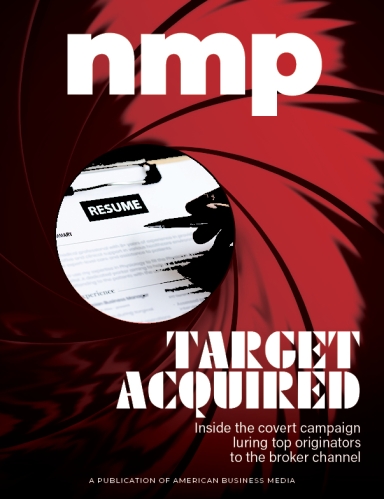
Meet the Mega Broker recruiters who are dismantling retail strongholds
By Katie Jensen, associate editor, National Mortgage Professional
COVER STORY
Assassin Recruiters
Meet the Mega Broker recruiters who are dismantling retail strongholds
By Katie Jensen, associate editor, National Mortgage Professional
The scene of the crime is quiet. No shattered glass. No smoking gun. But one thing is inescapably clear: someone has issued a kill shot on the retail lending channel. Its declining market share wasn’t sudden enough to raise alarms, but that’s because this is the work of professionals. Make no mistake, someone is bleeding the retail channel dry of its talented originators and siphoning them into wholesale.
The leading evidence for this trend comes from Inside Mortgage Finance (IMF), whose quarterly reports have tracked the steady decline. As recently as 2022, the retail channel accounted for 60.4% of total originations before trickling down to 54.8% in 2023, and 51% in 2024. Meanwhile, the broker share of originations has nearly doubled over the past seven years, from 9.8% in 2017 to 19.1% in 2024. Even the correspondent lending channel has gained ground, inching up from 27.9% in the third quarter of 2022 to 29.9% in the fourth quarter of 2024.
Market fluctuations have played into this effect with inflated pricing in the housing market, causing borrowers to focus more so on mortgage rates and other fees associated with getting a loan. A study from Polygon Research, supported by the nation’s leading wholesale lender, United Wholesale Mortgage, used 2023 HMDA data to find that consumers, on average, save more than $10,000 by working with a mortgage broker compared to a nonbank retail lender.
The numbers make a convincing case that the grass is greener in the third-party lending channel. But flipping from one lending channel to another can be a drastic career change for originators, especially those who decide to go broker. To make that final leap, it takes strategy, finesse — and sometimes, an inside job.
That’s where the assassin recruiters come in — the elite few who are reshaping the mortgage landscape by recruiting talented originators and branch managers from the retail channel and pulling them into the faster, leaner world of brokering.
There’s “Wild Card” Jason DuPont, the provocateur who uses shock value and swagger to cut through the noise.
“The Sleeper” Matthew Blackmer, who plays the long game — embedding himself in LOs’ networks, earning their trust, and flipping them only when the timing is perfect.
And then there’s Major Singleton, “The Sniper,” a former Navy commander who recruits with military-grade precision, identifying weak points in a retail LO’s business and striking with hard numbers.
There’s “Wild Card” Jason DuPont, the provocateur who uses shock value and swagger to cut through the noise.
“The Sleeper” Matthew Blackmer, who plays the long game — embedding himself in LOs’ networks, earning their trust, and flipping them only when the timing is perfect.
And then there’s Major Singleton, “The Sniper,” a former Navy commander who recruits with military-grade precision, identifying weak points in a retail LO’s business and striking with hard numbers.
Together, they represent the new vanguard of mortgage recruitment — each with their own style, but all with the same mission: re-establish mortgage brokers as the dominant players of the mortgage industry.
Jason duPont: The Wild Card
For originators considering a change — especially those coming from declining retail environments where autonomy may be limited — NEXA Mortgage Managing Partner and Branch Manager Jason duPont’s approach can feel like a jolt. But that’s the point. In a crowded industry, sometimes the clearest message comes from the loudest person in the room.
Hit ’Em Where It Hurts
DuPont’s approach doesn’t start with flattery or flashy promises. He’d rather hit them where it hurts. “If a company or individual can solve people’s pain points, they’re going to create revenue,” he said.
For small broker-owners, duPont sees two common bottlenecks: compliance and capacity. “They’re caught up running a business they don’t want to run, or originating so much they can’t scale,” he said. However, the nation’s largest brokerage, NEXA Mortgage, addresses both, offering back-end support like call reports and compliance infrastructure, while allowing originators to focus on production or growth.
For retail LOs, it’s about control and compensation. “They’ve been indoctrinated. [They’re] told brokers are slow, brokers can’t talk to underwriters, brokers don’t have support. None of that is true anymore,” he said.
Like the other leading assassins, duPont said that many retail originators have been inundated with fear-mongering myths about the broker channel that require careful dismantling. Although some of those misconceptions are due to outdated perceptions on broker capabilities, he claimed that some of it is driven by competitors who want to keep originators from leaving the retail channel.
“Retail people still believe they can’t talk to an underwriter. That’s just indoctrination,” duPont said. “You have underwriters that call you when a loan comes out after initial underwrite, to go over conditions with either you or your processor or whomever.”
“I’ll stab you with everything that benefits you — and I’ll do it to your face, not your back.”
> Jason duPont, top recruiter at NEXA Mortgage, calling himself a “kind assassin.”
“I’ll stab you with everything that benefits you — and I’ll do it to your face, not your back.”
> Jason duPont, top recruiter at NEXA Mortgage, calling himself a “kind assassin.”
Contrary to what some retail originators may believe, duPont says that many brokerages, including NEXA, have the ability to offer greater access to underwriters as well as stronger earnings potential through more transparent compensation models. NEXA also offers a loan officer support department with over 30 full-time loan officer coaches who are prepared to help price, place, and structure loans.
“The main thing that I focus on is transparency. What are you really getting right now? Do you have access to your purchase advice? Do you have access to your coupon? Let’s try to get raw pricing,” duPont said. “Let’s compare comp and rates apples to apples, both at a company branch and loan officer level. And what do those look like? Let’s break it down so you can see, what are we really talking about here.”
Looking For The NEXA Big Thing
Rather than focusing exclusively on high-producing loan officers, duPont says he’s open to recruiting individuals at all stages of their careers if they show enough potential.
“I will bring over someone that did two loans last year,” he said. “As long as I think that they’re willing to work hard and be successful.”
“They’ve been indoctrinated. [They’re] told brokers are slow, brokers can’t talk to underwriters, brokers don’t have support. None of that is true anymore.”
> Jason duPont, claiming retail originators have been fed myths and lies about the wholesale channel.
“They’ve been indoctrinated. [They’re] told brokers are slow, brokers can’t talk to underwriters, brokers don’t have support. None of that is true anymore.”
> Jason duPont, claiming retail originators have been fed myths and lies about the wholesale channel.
Mega brokerages like NEXA often target fledgling broker owners, who feel weighed down by all the administrative tasks that come with running a business. While it may benefit NEXA to recruit smaller broker owners, it doesn’t add to overall market share in the broker channel. Instead, duPont also likes to attract retail branch and team leaders. As someone who prefers scaling through branches, he sees NEXA’s hybrid model as a perfect fit for leaders looking to grow without building a company from scratch.
“I was able to talk Mike Kortas into going non-delegated,” duPont said. “We determined that showing the purchase advice, showing the coupon, showing where every penny in the loan goes on non-delegated works. And because of that, we have the option of going broker, going non-delegated, and everything in between. Well, that allows for branches to come over.”
Although duPont said he’s willing to offer signing bonuses occasionally to those who request it, he actively avoids those who are looking for short-term perks without long-term vision. However, it may not be in the originator’s best interest to request a signing bonus in the first place.
“Every single place you get a signing bonus from, you’ll have higher rates,” duPont explained. “They’re artificially increasing the rates until the bonus is paid back … But yeah, I’ll give signing bonuses. I will do those things if they need it. It’s got to make sense. I’m not gonna give a signing bonus to a guy that did 2 million last year in total [dollar] volume. But we have those kinds of flexibilities, and we explore them every now and then.”
Matthew Blackmer: The Sleeper
Unlike recruiters who rely on aggressive outreach, flash, or viral gimmicks, Matthew Blackmer, Vice President of Business Development at West Capital Lending, takes a subtle yet strategic approach: he earns attention by listening first, then building custom solutions around each originator’s goals.
Blackmer lives up to his name with a “black ops” style of recruitment. Instead of pressuring originators to take the leap from retail to wholesale, he educates, consults, and lets the numbers speak for themselves.
APR: Actual Pain Realized
One of the most common pain points he encounters is from retail loan officers frustrated by rigid product menus, shrinking compensation, and limited autonomy.
“I’m selling the same freaking Fannie, Freddie, FHA product all day, every day, and I’m hating having to say no,” he said, echoing what he hears from incoming recruits.
So, Blackmer offers them access to a broader product suite, increased income potential, and the freedom to structure their business their way. “Now you get to decide, how am I going to write a loan today? How am I going to find business today? You are now in charge of that,” he said.
He’s upfront about the tradeoff: more freedom also means more responsibility.
“On the broker side, there’s going to be a lot of corporate platforms. We’re one of them that will give you a lot of tools and resources to be successful. But you don’t have someone managing your dials … you don’t have someone looking at your full conversion and strategy report on what your day should or shouldn’t look like. You don’t have a lot of [what] Rocket has — it’s no secret — the best technology in the business.” he asserted. “The larger brokers, [like] us, you get a lot of those tools and resources, but I can still tell you that our tools and resources are not nearly as strong as Rocket’s.”
For broker-owners, the pain comes from the weight of operational and compliance demands that distract from actually doing business. “You only can do so much when you’re having to manage your call reports, look at all of your audits, pay all of your costs,” Blackmer explained.
His message to them is direct: “Let someone do that for you … Let us open more doors for you and give you more opportunity to build your brand.” By absorbing the back-end infrastructure, West Capital lets these originators return their focus to clients and community impact.
Another common frustration Blackmer tackles is the lack of transparency in LO compensation among not only retail lenders but also some non-delegated correspondent lenders. Even in the wholesale realm, he claims that some broker owners who employ non-delegated correspondent bankers operate with hidden margins.
A company that utilizes hidden margins can potentially increase the interest rate on loans beyond what a borrower is actually qualified for in order to achieve a higher profit margin — an unethical practice known as “padding.”
“You see a lot of people trying to mimic other retailers out there,” he said, referring to a group of non-delegated brokerages. “We do know that there are platforms out there, frankly, where we’re watching these broker owners take a lot of money out of someone’s paycheck when realistically it should be in the broker’s hands.”
Additionally, Blackmer has heard that some owners will pad loan officer expenses to increase the company’s margin revenue, such as increasing the cost of credit reports. “We believe that there shouldn’t be a broker charging $400 for a credit report when realistically, the cost of it was $80 bucks,” he said.
“We don’t sling mud,” he continued. “But we know there are brokers and broker owners out there that are holding LOs hostage … We believe that message should be shared — that there is a better way.”
To prove it, he said West Capital offers radical transparency.
“Everyone knows what everyone makes,” Blackmer said. “There are no secrets. There is no favorite … We share our numbers with all of them because transparency for us is key.”
Underwriting The Ideal LO
At West Capital Lending, Blackmer said he isn’t recruiting originators based on cookie-cutter production metrics or narrow quotas. Instead, he seeks out mortgage professionals who want to take ownership of their business and thrive within a flexible but well-supported platform.
“We don’t take part time. We don’t take, ‘I have my license, and I hang it,’” Blackmer said. “That’s not for us. You’re coming in — we want to know you’re going to be able to engage in our ecosystem right away.”
While previous production is taken into account, it’s not the deciding factor. What matters most to West Capital is the originator’s mindset: “I want to know that you’re going to have a vision, and you’re going to be able to run with it,” Blackmer said. “If you don’t, and I think you’ve got that intangible entrepreneurial risk-taker hustler, we’re going to come up with a plan together.”
“We know there are brokers and broker owners out there that are holding LOs hostage. We believe that message should be shared — that there is a better way.”
> West Capital Lending Vice President of Business Development Matthew Blackmer, revealing how some brokerages operate with hidden margins.
“We know there are brokers and broker owners out there that are holding LOs hostage. We believe that message should be shared — that there is a better way.”
> West Capital Lending Vice President of Business Development Matthew Blackmer, revealing how some brokerages operate with hidden margins.
Blackmer attracts a wide range of originators, including seasoned brokers overwhelmed by the back-end demands of running a shop, and retail loan officers tired of saying “no” because of limited product options. The common thread among the originators he recruits is they often want more control, more upside, and a platform that won’t restrict their growth.
“You are the brand,” he explained. “You are the entity that’s moving forward and supporting your clients every single day.”
He’s especially interested in originators who bring a clear strength to the table — whether that’s digital marketing savvy, a strong community presence, or a disciplined retail sales background.
“Some people are like, ‘Hey, I’m a pro at social media.’ Or, ‘I golf at this country club, and every single person is an investor.’ Okay, cool — let’s go,” he said.
Blackmer’s approach is to meet originators where they are and build custom pathways to help them scale. His team will work with anyone who has a clear plan — or even the desire to make one — and who is ready to treat this as a full-time career, not a side gig.
“I need to know that if you’re coming into our ecosystem … you’re going to be able to pick up that wrench, and we’re going to be able to put something together.”
Major Singleton: The Sniper
Major Singleton of Edge Home Finance is a precision operator who doesn’t spray the market with mass messaging or gimmicks. As a retired Navy Commander who spent 23 years in the military, he knows how to pick his targets carefully, study their patterns, and reach out with intentional, high-impact timing. His recruitment isn’t built on volume; it’s built on accuracy.
Since joining Edge in 2021, Singleton says he’s recruited around 50 loan officers from the retail lending channel to join his team or start their own business on the Edge platform. Overall, he estimates that he recruits between 15 and 20 loan officers per year, using a strategy he calls “social proofing.”
Major Pains
Singleton’s recruiting message is laser-focused on solving originators’ frustrations by giving them more control, better compensation, and the freedom to build their own brand and business.
One of the most common pain points Singleton tackles is lack of transparency in retail pricing and compensation. Many retail loan officers, he notes, don’t fully understand how much money they’re leaving on the table.
“When I talk to loan officers, I ask, ‘How much money did your branch make off of you last year?’” he said. “Most people don’t know how to answer that question.”
In his experience, that disconnect often leads to resentment, especially when originators realize they’re doing most of the work while layers of management benefit from overrides and back-end profits.
Singleton bluntly stated he isn’t a fan of the correspondent model, because “the leadership can easily hide pricing in those models,” he said, “an additional, you know, 20, 30, 40 basis points into your pricing, which is why I left retail in the first place.”
“The leadership can easily hide pricing in those models.”
> Major Singleton, mortgage broker at Edge Home Finance, bluntly stating that he isn’t a fan of the correspondent model.
“The leadership can easily hide pricing in those models.”
> Major Singleton, mortgage broker at Edge Home Finance, bluntly stating that he isn’t a fan of the correspondent model.
Although Singleton admits to receiving overrides for the originators he recruits to Edge, he’s still required to originate at least 2 loans per month to receive those benefits. While the majority of his income comes from originating loans, he also enjoys having a secondary stream of residual income.
To address any concerns about transparency, Singleton provides clarity to originators by comparing how much they’re getting paid and how much their company is making as a retail LO, versus how much they would get paid as a broker.
He also speaks directly to the frustration retail LOs feel when they lose deals because of pricing and don’t understand why.
“If you’re a retail loan officer and you lost a deal to me, and you’re trying to figure out why, I’m probably calling you up in a month or two,” Singleton said. “And 99% of the time, the reason you lost the deal is because you have so much pork stuffed into your pricing.”
To be fair, Singleton admits that working with retail lenders has some advantages: they are known to offer loan officers more support due to their in-house structure and resources, often have experienced marketing departments, and utilize other tools to help loan officers generate leads and streamline their workflow.
Singleton also acknowledges that some originators feel intimidated by the broker model. Oftentimes, he hears concerns about it being more complex or riskier than originating in the retail channel.
To ease that anxiety, he offers one-on-one support. “I explain how it works. I show them pricing. I’ll even show them my own loans in the system,” he said. “I try to help them see that it’s not as scary as they think it is.”
In the end, Singleton is addressing originators’ most pressing pain points: being underpaid, undervalued, and over-managed. His solution is simple — give them back ownership of their business, their income, and their brand.
“We’re for the entrepreneur that happens to be a loan officer,” he said. “You’re not going to get a Rolex here, but you’re going to get paid like the business owner you are.”
High Value Targets
With steady precision, Singleton aims to recruit entrepreneurial, brand-minded professionals who want to take ownership of their business and income. He prioritizes mindset and long-term vision over titles or flashy résumés.
“I like to look at people’s social media, and I can’t tell exactly what company they work for,” Singleton said. “Because they’ve figured out that people come for them, not the company. My clients do not care what platform I’m on. What matters is [that] they believe in me.”
His ideal recruit is someone who recognizes themselves as the value, not the retail brand or branch they work for. Singleton favors originators who are actively building their personal brand, educating borrowers online, and showing up on video as thought leaders. They need to have the “heart of a teacher” whose business model centers on client education and clarity.
“I don’t really want the branch manager. I want the person who’s directly originating … the person doing 10 to 15 loans a month while the branch is doing 100.”
> Sharp shooter Major Singleton, explaining that he only aims for high-value targets.
“I don’t really want the branch manager. I want the person who’s directly originating … the person doing 10 to 15 loans a month while the branch is doing 100.”
> Sharp shooter Major Singleton, explaining that he only aims for high-value targets.
While Singleton occasionally recruits originators from smaller brokerages, he emphasizes that his mission is to grow the broker channel overall, not just shift people from one brokerage to another.
“I believe that we’re going to grow the broker channel by getting loan officers from the retail side over to the broker side,” he said. “I don’t really like to change people between brokerages because that’s not really growing the broker channel.”
One of his strongest recruiting tactics is targeting mid-level retail producers — those who are originating solid volume but may be unaware of how much of their revenue is being siphoned off by management layers.
“I don’t really want the branch manager,” Singleton said. “I want the person who’s directly originating … the person doing 10 to 15 loans a month while the branch is doing 100. That’s the person I get excited about.”
Overall, Singleton said he tries to avoid ego-driven originators chasing perks or signing bonuses. Instead, he attracts those who want control over their CRM, their brand, their pricing, and their future.
“We are for the entrepreneur that happens to be a loan officer,” he said. “If I wasn’t doing loans, I’d probably be an entrepreneur doing something else.”
Building Broker Dominance
What unites Jason duPont, Matthew Blackmer, and Major Singleton beyond their distinct recruiting styles is a shared, deeply rooted mission to grow the broker channel.
According to the recruiting assassins, the retail channel is failing because it’s burdened by bloated pricing structures, hidden compensation layers, and limited product offerings that restrict originators’ ability to compete. Loan officers are frustrated by rigid corporate hierarchies, and an illusion of support that comes at the cost of lower earnings and higher rates.
Meanwhile, modern originators crave autonomy, transparency, and entrepreneurial freedom — traits they claim that are often suppressed in the retail lending channel. As mega brokerages scale with better tools, compliance infrastructure, and expansive product menus, they offer a more agile and financially rewarding alternative that’s pulling talent away from retail in growing numbers.
Moreover, the assassin recruiters would likely agree with NEXA’s duPont who doesn’t see broker dominance as aspirational — he sees it as inevitable. “I really feel like we could just be getting started here,” he said. “That sounds weird, but … I think we could just really be getting started, and time will tell.”
Armed And Dangerous
The crime-scene tape may have been whisked away, but the hit is still fresh: a clean incision that drained talent from retail and left nothing but an outline where its market share used to stand. duPont’s flash, Blackmer’s stealth, and Singleton’s sniper fire have already melted back into the night, polishing their weapons for tomorrow’s raid. All that remains are originators counting wider margins and the faint echo of a single ultimatum — adapt, defect, or bleed out. In this quiet war, the assassins aren’t finished; they’re just reloading.
platforms consolidate and vendors gain leverage, the lenders who stay disciplined about data, adoption, and exit terms will be the ones who keep control of their own tech stack































 Built with Shorthand