Non-Agency originations could reach $500 billion this year. Are you ready to tap in?
AI makes human loan officers more essential, not less
Meet your your colleagues, both national and local, by attending an event in your area.
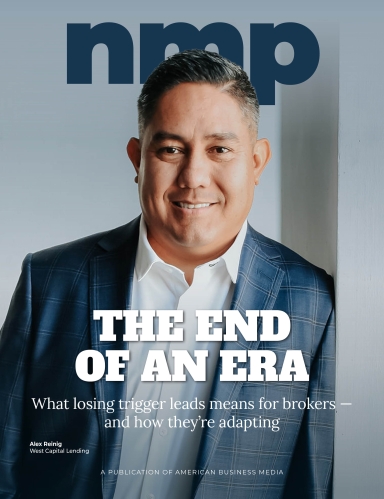
When the locally-focused, Pennsylvania-based brokerage Red Tree Mortgage was acquired by West Capital Lending in 2024, Alex Reinig traded his CEO title for Vice President. But a more seismic shift was already underway: Reinig’s brokerage was built on trigger leads and lightning-fast closings, but the strategy that had once fueled his rise was now imploding under its own success.
Once a staunch believer in trigger leads, Reinig built a thriving operation around quick-turn transactions, at one point closing 200 loans per month. But by 2023, he was watching the strategy crumble under the weight of industry oversaturation and predatory practices.
He wasn’t alone. Industry leaders within the broker community, like AIME Chairman and President of Next Door Lending Jonathan Haddad, were pivoting from trigger leads to become trusted sales advisors. Meanwhile, major advocacy groups like the Mortgage Bankers Association (MBA), National Association of Mortgage Brokers (NAMB), Brokers Action Coalition (BAC), and Community Home Lenders of America (CHLA) were rallying support for legislation to curtail trigger leads altogether.
“No other industry in America has a practice like this,” said Steven Grossman, SVP of Retail Lending at Luminate Bank and CHLA member, who describes how credit bureaus sell consumer data after a mortgage credit pull. “Your phone blows up … thirty, forty, fifty, sixty, seventy calls.”
At first, Reinig believed trigger leads encouraged competition and gave consumers access to better deals.
“But after so many players got in the game, I ended up seeing and hearing about so many bad companies out there,” Reinig said. “Friends who had burners who would call [or] text customers after their phone numbers were added to the Do Not Call list.”
Today, Reinig said he’s grateful he weaned off of trigger leads before Congress passed a bill that is expected to severely limit their distribution and completely cut off access to mortgage brokers.
Red Tree Mortgage started in 2019 by self-generating leads. But by late 2020, Reining began experimenting with trigger leads — a practice where lenders buy lists of consumers who recently had their credit pulled for a mortgage inquiry.
“Obviously, [as] mortgage brokers … we want to get paid quickly,” Reinig said. “So we looked at trigger leads, the quick transaction. Why? Because the customer has already applied somewhere. Whether it be a bank, a credit union, another broker, or what have you.”
He then realized that trigger leads produced quicker transactions, on average, compared to self-generated or internet-purchased leads.
It was an irresistible pitch: “Can I ask you, what rate were you quoted? Well Tom, my local lender just pulled my credit, and he offered me 6.5. Well, that sounds great, Tom, but guess what? What if I told you I could offer you 6%? Well, hell, I'd rather go with you instead,” Reinig recounted.
> Alex Reinig, Vice President at West Capital Lending and former President and CEO of Red Tree Mortgage
Over the next four years, Red Tree Mortgage began to flourish, closing 200 loans per month solely on trigger leads. It didn’t take long for the company’s wholesale partner, Rocket Pro (then called Rocket Pro TPO), to recognize Reinig’s growing volume of business — which was impressive even during the peak years of the refinance boom.
That’s what Reinig calls “quick sale, quick blood.” But, what started out as a somewhat niche tactic among mortgage brokers became a bloodbath after sharing his algorithm and tech stack with his peers at one of Rocket’s fireside chats.
“I'm talking to all the owners, trying to help them to flourish,” he said. “It was like throwing tuna into a tank full of sharks. Boom! Exploded. So now, fast forward three years later, it's like you pull a trigger, you pull credit [and] that person's getting 150 phone calls within the first two hours.”
On August 2nd, the U.S. Senate gave unanimous consent to pass H.R. 2808, the Homebuyers Privacy Protection Act, to restrict how consumer reporting agencies (CRAs) can furnish consumer reports — specifically limiting the use of trigger leads.
The bill, put forth by the Mortgage Bankers Association and supported by major trade associations including the Brokers Action Coalition (BAC), prohibits CRAs from selling consumer reports to third parties in connection with a mortgage credit inquiry unless certain strict conditions are met.
Under the bill, a CRA is barred from providing a consumer report based on a mortgage credit inquiry unless the recipient is making a firm offer of credit (FOC) or insurance, and one of the following applies:
Most mortgage brokers meet none of these conditions since they do not service loans, nor do they hold consumer accounts like banks or credit unions. Trigger lead transactions also rarely involve prior consumer authorization. Because of these stipulations, brokers would be effectively cut off from purchasing trigger leads, as they cannot certify a firm offer of credit without a direct consumer relationship or prior consent.
> Steven Grossman, Senior Vice President of retail lending at Luminate Bank, speaking candidly on the impact of trigger lead restrictions and emphasizing that mortgage brokers may be shut out altogether since they cannot issue firm offers of credit independently.
While retail shops, banks, and credit unions face limited access to trigger leads, Steve Grossman points out that mortgage brokers are likely to be shut out altogether, since they typically can’t issue firm offers of credit independently.
“A mortgage broker cannot make a firm offer of credit. And you know what, I’m not a broker. So f*** the brokers,” Grossman said bluntly. “They weren’t the lenders. They’re not the servicers. I lent the money.”
However, the “firm offer of credit” (FOC) requirement to access trigger leads was already in effect due to the Fair Credit Reporting Act (FCRA). Technically, if the FOC rule is what eliminates mortgage brokers from qualifying for trigger leads, they should have never been able to access them in the first place.
Still, Grossman acknowledged that brokers could potentially regain access to trigger leads indirectly. When asked whether mortgage brokers could make a firm offer of credit by getting some form of approval from their wholesale lender that is servicing the borrower’s current loan, he admitted that it’s a possibility.
"The thing is, that could become another cottage industry,” he responded, “where a wholesale lender might say, ‘Hey, you know what? We’re gonna protect you. If we get the trigger, we’ll give the lead back.’ And I’m sure the ones with very good technology may give it back at a discounted commission."
After going cold turkey on trigger leads, Reinig pivoted to purchasing long-form leads from LowerMyBills.com, LendingTree, Free Rate Update, and Facebook. Unlike trigger leads, these prospects were still in the early stages of their buying journey, requiring longer nurturing cycles and making ROI much harder to track.
“As an owner, oh my gosh, I'm going to spend $20,000 a month on LendingTree leads, which there's no way for me to measure an ROI because they may not buy or refinance,” he said. “So I really don't know when I'm going to get my money back. And no owner wants to do that, whereas [with] trigger leads, you're probably going to close within 30 to 60 days.”
Today, a $20,000 monthly spend gets Reinig’s team only about 45 leads a day — down drastically from the 1,500 leads they’d receive in the heyday of trigger leads.
“The sale is different up front because instead of selling a rate, you're selling yourself,” Reinig said. “So you need to be prepared … Now I have to actually sell myself as a company and why I am the right person to do business with.”
Despite advocating for the Homebuyer Privacy Protection Act, Grossman acknowledged that trigger leads had operational advantages for his retail shop and, most likely, others. They weren’t used solely for pricing battles — they also acted as early alerts when prospective borrowers were “cheating,” i.e., applying with another lender. That insight, he said, was especially helpful in long sales cycles or refinance markets.
“If you're a good loan officer, you're gonna continue to follow up … but most people don’t do that,” Grossman said. “It’s like your partner tracking you on your phone … if your partner sees you at an old boyfriend or girlfriend’s house, they know you're cheating. That’s what we used the trigger leads for.”
But prospective borrowers are not existing customers. A Luminate originator might have spoken to them a few times but never originated or serviced their loan.
> Steven Grossman
> Steven Grossman
Under the proposed legislation, retail lenders and banks can no longer use trigger leads to monitor prospects. Unless they originated or service the consumer’s loan, or hold their bank account, they’ll need to obtain consent.
“These people didn’t close the loan with me. They’re just a prospect. So I’ll lose out on the prospects when I would catch them cheating on me,” Grossman said.
Once Reinig recognized the growing backlash against trigger leads, he redirected his focus on transforming his sales team into sales advisors — a shift that’s become even more critical as brokers face losing access to them altogether.
“The way I tell my staff is this: Hey guys, we are transitioning from a sales person to a sales advisor, okay? A sales person is going to sell you the lowest rate, lowest cost right on the phone right now. A sales advisor is going to point you into the right direction of where you should financially be,” he said.
The sales process involves walking clients through different loan scenarios such as comparing home equity line of credit payments, cash-out refinance rates, and amortization schedules.
“You become a loan advisor because now you have to do so much other work to prove which scenario is better for your client," Reinig continued. “And if you don't want anything, listen, I'm going to shake your hand and I'm gonna let you go your way. But I want to be able to provide you with the best option for your family.”
Matthew Blackmer, Vice President of Business Development at West Capital Lending, said the industry has reached a point where loan officers can no longer succeed by simply undercutting rates.
“The days of a singular professional on their own are long gone. The game is too complex now to not be in a collaborative environment,” Blackmer said. “If you’ve been working on business solely by undercutting the frontline competition, you haven’t been needing to sell your value and most likely are out of touch of what that unique value proposition is.”
For Reinig, the pivot is clear. “Right now, I sell the reputation of my company. Hi, I'm Alex Reinig. I'm a vice president here with West Capital Lending. We are the number one brokerage in the nation. We have partnered with 154 other lenders, where my job is to get you the lowest rate with the lowest cost.”
The use of trigger leads may have been accepted and even championed within Reinig’s circle of peers, but it was becoming more controversial among the broader community of originators. And, perhaps, no one remembers it better than Chairman of the Association of Independent Mortgage Experts (AIME) Jonathan Haddad.
Within the first few months of leading AIME, Haddad came under fire by AIME’s own members once they discovered that his brokerage, Next Door Lending, was using trigger leads — a practice the association said it was against.
Haddad responded to the backlash within the Brokers Are Better Facebook groups, stating, "In the event, if you as a broker, get any kind of issue with a credit trigger because of Next Door Lending, all you have to do is reach out to me directly and it will get handled right away. Only if you are an AIME approved member.”
> AIME Chairman and President of Next Door Lending, Jonathon Haddad, shares advice on how mortgage brokers can refine their lead-generating skills after losing access to trigger leads
Now, as some broker owners and originators may be faced with the same challenge, Haddad advises them to think about three basic fundamentals.
Step 1: Stop Complaining and Get Focused
Haddad’s first piece of advice is blunt but necessary: Don’t waste time complaining.
“Yes, you can ask questions and try to figure out what’s going on — that’s fine,” Haddad said. “But don’t spend longer than a day or two on that. Don’t go complaining, don’t go talking to your neighbor. It’s not going to help anything.”
Haddad cautions that regulatory changes surrounding trigger leads will play out soon enough, and lingering in frustration will only distract loan officers from preparing for what comes next. “Once this goes through, all the other cards will come into play and you’ll see,” he added.
Step 2: Master the Funnel — Get Back To Sales Basics
The next step, Haddad says, is to relearn the art of converting cold leads. That skill will become even more essential as regulatory changes and the decline of trigger leads reshape how originators fill their pipelines.
“Master the funnel. Get back to the basics,” he said. “Understand what makes a cold lead convert — not just because they’re shopping and racing to the bottom — but because you know they have a problem and you can solve it.”
Haddad urges loan officers to audit their sales process:
“If I were to ask you, ‘How do the first three minutes of your phone call go?’ and you don’t have the same answer every single time, you’re not set up for success,” Haddad said.
Step 3: Track Everything — Know Your Numbers
Haddad emphasizes the importance of tracking every metric in your funnel. He expects this process to become even more critical when lead costs rise and sales cycles stretch out, as Reinig experienced after moving away from trigger leads.
“If you don’t know your lead-to-credit pull ratio or your credit pull-to-closing ratio, that’s going to be a problem for you long-term,” Haddad said. “It’s gotten a lot easier to track this stuff, especially with AI, so don’t make excuses.”
For loan officers in direct-to-consumer shops, where data isn’t always shared, Haddad advises tracking everything manually:
In addition to tracking metrics, Haddad says LOs need to shift from a transactional mindset to a relationship-based model.
Haddad’s recommendations reflect a broader reality that consumer-direct brokers stand to feel the sharpest impact if credit trigger leads are curtailed. With high-intent leads that once fueled their sales engines suddenly gone, Haddad and Reinig both suggest that those originators rebuild their pipelines from the ground up by mastering cold lead conversion and implementing robust tracking to maximize efficiency. The shift also demands a deeper focus on relationship-building, which can help offset higher acquisition costs and longer sales cycles.
In a market where consumer-direct strategies face structural changes, early adoption of these tactics may determine which firms can sustain volume and which are left scrambling for business.
The “Homebuyers Privacy Protection Act” (HR 2808) is intended to help consumers by protecting their credit information, preventing fraud, and reducing the amount of solicitations they receive from competing lenders. It remains to be seen whether solicitations will actually decrease as a result. In the meantime, John Comiskey, author of the Reverse Engineering Finance newsletter, hypothesizes how it will impact various mortgage industry players.
Comiskey warns that the “Homebuyers Privacy Protection Act” will significantly alter how brokers compete for borrowers. By curbing the sale of mortgage trigger leads, the law consolidates power in the hands of large servicer-originators while leaving brokers with fewer tools to retain clients.
Large servicer-originators like Rocket Mortgage will enjoy less competition when recapturing borrowers for rate-and-term refinances. With a clearer path to reach their existing clients, they can act swiftly and aggressively.
If that happens, wholesale lenders will likely feel the squeeze. Brokers' reduced ability to fend off competitor offers can, by extension, impact wholesale lenders that rely heavily on broker-sourced business.
Comiskey optimistically included a number of actionable items to help brokers stay competitive.
Non-Agency originations could reach $500 billion this year. Are you ready to tap in?
AI makes human loan officers more essential, not less
Meet your your colleagues, both national and local, by attending an event in your area.