Image



COVER STORY
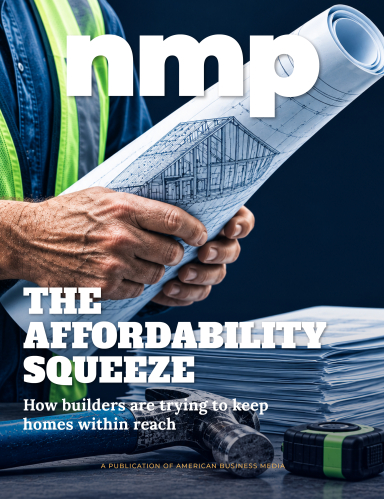
With buyers struggling to afford homes and construction costs squeezing margins, builders are turning to private capital, aggressive incentives, and new technology to keep projects moving. But how long can those strategies hold?
By Czarinna Andres, VP of Content, National Mortgage Professional
America's homebuilders are caught in an increasingly difficult financial equation. It costs more to build a home, buyers are struggling to afford one, and the incentives needed to close the gap are eating into the profits that make new construction possible.
To keep homes selling, builders are cutting prices, subsidizing mortgage rates, and shifting toward smaller, less expensive properties. Behind the scenes, developers are exploring alternative financing and looking for efficiencies in everything from construction scheduling to the paperwork exchanged between builders and subcontractors.
The adjustments are helping sustain sales. Whether they can sustain the pace of future construction is another matter.
"Builders are already feeling the margin squeeze. They're using incentives to keep homes moving, but every dollar spent buying down a mortgage rate or cutting a price comes out of the economics of that sale," said Odeta Kushi, deputy chief economist at First American.
The pressure is widespread. In October, 65% of builders reported offering sales incentives, while 43% cut prices, according to the National Association of Home Builders (NAHB). The average reported price reduction was 6%.
And the concessions are coming at a time when builders face higher construction costs, skilled-labor shortages, and financing pressures that make it increasingly expensive to carry unsold homes.
"There isn't one point when every builder has to pull back; some have more room than others," Kushi said.
"But, if buyers continue to need this level of help, builders will respond by being more careful about what they build and how quickly they bring it to market. We're already seeing them manage their construction pace closely."
For mortgage lenders, the implications extend beyond the new-home sales figures. Builders' financing decisions affect the types of homes reaching the market, the incentives available to borrowers, and ultimately the volume of purchase loans available to originate.
The industry is finding ways to make the numbers work. The question is how much longer it can keep doing so.
Photos provided by Convergence Communities Founder and CEO Colby Cox.
With mortgage rates straining buyers' budgets, homebuilders are relying on price cuts, rate buydowns, and other incentives to keep sales moving. But some developers are taking a different approach, targeting the additional expenses that can make homeownership financially daunting even after a buyer qualifies for a mortgage.
At The Granary, a 451-acre master-planned community in Milton, Delaware, developer Convergence Communities introduced a 10,000 incentive called "10K Your Way," offering eligible buyers a payment after closing that could be used for home improvements, HOA fees, or other expenses.
The incentive, funded entirely by Convergence, emerged from conversations with residents and builder partners, according to Colby Cox, the company's founder and CEO.
"In conversation with our builder partners, they described seeing hesitation in the market. People were interested in buying, but between economic uncertainty and rising costs, many were putting off their decision by a year or two," Cox said.
One particular concern was The Granary's Special Development District (SDD), which helps finance infrastructure and amenities through an annual special tax paid by homeowners for up to 30 years. While the arrangement allows certain development costs to be spread over time, the additional expense can complicate affordability for prospective buyers.
The $10,000 payment could be applied toward those taxes or expenses such as fencing, landscaping, and furniture.
Convergence reported eight home sales during the incentive period, which Cox described as a strong month for the development. The company did not provide comparative sales figures or establish how many purchases were directly attributable to the offer.
For Cox, the appeal was that the incentive addressed buyers' concerns without permanently reducing home prices.
"Each approach has different financial implications, but one advantage of the $10K Your Way incentive is that it's a defined, one-time investment rather than a permanent reduction in a home's asking price," he said.
"Price reductions can have a ripple effect on comparable home values and the pricing of future inventory. Mortgage-rate buydowns can be helpful for buyers focused on monthly payments, but they don't necessarily address other upfront expenses."
The strategy illustrates the competing financial priorities developers face: maintaining sales, protecting future home values, and managing the cost of infrastructure and construction. Cox said Convergence has not yet had to alter its development timelines or plans because of financing costs, construction expenses, or slower demand, although flexibility remains important for a community being developed over 12 to 15 years.
The broader market is under greater strain.
"Builder incentives are manufacturing affordability," said Kushi. "A rate buydown can bring some buyers back into the market by making the monthly payment work, while helping builders compete for a smaller, more cautious pool of active shoppers as mortgage rates remain above 7 percent."
New homes now account for roughly 14% of combined new- and existing-home sales, compared with a pre-pandemic five-year average of approximately 10%, according to Kushi. Much of that increase reflects the contraction in existing-home sales rather than a significant recovery in demand.
"Incentives are helping some buyers move forward and helping builders win sales in a smaller market," she said. "However, they haven't sparked a broad rebound in demand, as buyer traffic is weak and sales sit below their level from a year ago."
For builders and developers, the pressure is increasingly two-sided: Buyers need more financial assistance to purchase homes, while the concessions required to attract them leave less room for profit and future investment.
> Colby Cox
Builders aren't relying on incentives alone. They're also changing what they bring to market.
In September, 51% of newly sold homes were priced below $400,000, compared with 46% a year earlier, according to figures cited by First American.
For the seventh consecutive month, the median price of a new home was below that of an existing home, reversing the historical pattern in which new construction typically commanded a premium.
The September median new-home price was $400,400, down 3.9% from a year earlier.
But the numbers require some interpretation.
"Builders are reaching buyers with lower-priced homes," Kushi said. "Part of the lower median reflects a change in the mix of homes sold, including a greater share of lower-priced homes, but builders are also adjusting prices to meet buyers' budgets."
Newly completed homes have also become somewhat smaller, she noted, while changes in the geographic distribution of sales can influence the national median.
In other words, a lower median sales price doesn't necessarily mean the same house has become less expensive. It can also mean builders are selling different houses.
That shift has consequences for the broader housing market. Smaller homes and lower price points may expand the pool of potential buyers, but they also require builders to reconsider land use, construction costs, floor plans, and the margins available on each sale.
For originators, the changes could alter the opportunities available in new construction. More lower-priced inventory may bring some buyers within qualifying range, while builder-funded financing programs can further reduce monthly payments.
But the underlying affordability problem remains. Builders are adjusting their products to what buyers can afford, rather than benefiting from a broad recovery in purchasing power.
> Odeta Kushi
Before a builder can offer a mortgage-rate buydown or negotiate with a prospective buyer, the project itself must be financed.
And construction financing presents its own challenges.
Unlike a traditional residential mortgage, acquisition, development, and construction lending requires financing a project before the finished homes can be sold. Developers must account for land costs, construction expenses, carrying costs, and the possibility that market conditions will change before the project is completed.
Those risks have become more consequential as affordability pressures slow buyer demand.
The environment is creating opportunities for private lenders that offer alternatives to conventional bank construction financing.
One example is Ascent Developer Solutions, a Los Angeles-based private lender that provides financing for residential developers and investors.
In October, Ascent announced that it had originated $1 billion in loans during the third quarter of 2026, including $450 million in September alone. The company reported more than $4.1 billion in cumulative originations at the time.
Its lending business includes acquisition, renovation, construction, and post-completion bridge financing across several residential property categories.
Ascent has also expanded into manufactured housing communities and infill development, reflecting its interest in a broader range of residential projects.
The company's growth suggests substantial demand for its financing products, although its total originations encompass multiple asset classes and cannot be treated as a measure of new housing construction alone.
It also raises an important question about the changing structure of the homebuilding industry: As builders seek greater flexibility, how much of the financing traditionally provided by banks is moving toward private lenders?
The answer matters because the cost, structure, and availability of construction financing influence which projects move forward and how much financial risk developers can carry.
Those costs do not disappear when construction is completed. They become part of the economics that determine whether a builder can sell a home profitably.
And when homes take longer to sell, carrying costs can place additional pressure on the next development.
Financing is only one part of the equation. Once construction begins, builders must coordinate a network of subcontractors, suppliers, and schedules that can introduce additional costs long before a home reaches the market.
Some of those expenses are easy to see, including labor, materials, and equipment.
Others are buried in the administrative work required to keep construction moving.
Ben Johnson, co-founder and CEO of Scaffold, a software company that helps residential builders and trade contractors exchange project information, believes those less-visible costs deserve greater attention.
"I don't think builders are close enough to their trades. I don't think they understand their trades' real pain points, and a lot of these inefficiencies are out of sight, out of mind," Johnson said.
His company works to address a common problem in residential construction: Builders and subcontractors often operate on different software systems, requiring contractors to manually enter, translate, and reconcile information before work can proceed.
That can mean employees spending hours processing purchase orders, checking schedules, and correcting mistakes that originate in incompatible systems.
Johnson believes the financial consequences are substantial.
"We estimate roughly 15% of a trade's revenue is eaten up by unnecessary back-office expense, and another 5% by mistakes and rework. That's about 20% of revenue, which is massive, and it's built into the price of every home."
Those figures are Scaffold's estimates, not independently audited industry statistics. But Johnson points to measurable improvements among companies using the platform.
Hollywood Crawford Door Co., a trade contractor that processes approximately 500 builder purchase orders each week, previously had three full-time employees handling related administrative work, including two focused on purchase-order entry and scheduling.
According to Johnson, processing individual orders manually took between three and 10 minutes. About 5% contained errors requiring revision requests.
After adopting Scaffold, purchase-order entry reportedly fell to less than 30 seconds per order, while overall processing time declined by more than 90%.
Johnson said the company estimates it has eliminated between 10,000 and 20,000 manual steps annually.
The financial benefits, he argues, begin with contractors, which can handle additional work without proportionately increasing administrative staffing.
"The savings show up first at the trade contractor, but they get passed along to the builder quickly: in more competitive bids, fewer mistakes and shorter lead times," Johnson said.
However, he draws an important distinction between reducing administrative work and proving that homes are becoming cheaper to build.
"We have not yet documented reductions in construction cycle time or per-home construction cost attributable to Scaffold, and I'd rather say that plainly than stretch the data," he said. "Cycle time is probably where the next big number lives, but too many factors drive it for us to claim credit today."
That distinction is particularly important in an industry searching for ways to offset the cost of buyer incentives.
Johnson doesn't believe technology savings can simply be redirected into mortgage-rate subsidies.
"Anyone who says operational savings at the trade level will fund a rate buydown is overselling."
Instead, he sees a potentially more direct connection to mortgage financing through construction schedules.
"Where efficiency does connect to financing is schedule reliability. A builder's mortgage offer depends on knowing when the house will close. The less certain that date, the longer the rate lock has to be, and longer locks cost more."
For lenders financing newly constructed homes, uncertainty around completion dates can complicate rate-lock management and closing schedules.
Johnson argues that improving the flow of information between builders and contractors could make those schedules more predictable, even if the resulting financial savings are difficult to isolate.
"The closing date is only as reliable as the dozens of trades building the house, so better data flow between builders and trades makes schedules more predictable, and predictability has real value in a financing program."
> Ben Johnson
The pressure to reduce costs also highlights the advantages enjoyed by the nation's largest homebuilders.
National builders typically have greater purchasing power, broader access to capital, and, in some cases, affiliated mortgage operations that allow them to coordinate financing incentives with home sales.
Smaller builders may have fewer options when construction financing becomes expensive or buyers demand larger concessions.
Johnson sees a similar divide in construction operations.
"The largest builders have invested in their own systems and portals, so they send trades more structured data," he said.
But he cautions against assuming that size automatically translates into operational efficiency.
"As a builder, the thing that matters most is being easy to work with: a builder that sends complete, accurate orders tends to get crews first when labor is tight."
Technology can help smaller builders reduce some of the disadvantages associated with less sophisticated administrative systems, he said, but it cannot eliminate the larger financial differences.
"On purchasing power and cost of capital, the nationals' advantage is structural, and software will not close it."
That distinction could become increasingly important if construction financing remains expensive and builders must continue absorbing the cost of buyer incentives.
A large builder may have the financial flexibility to reduce prices, offer financing assistance, and continue purchasing land for future development.
A smaller builder facing the same market conditions may have to make a different calculation about whether to begin another project.
The industry's efforts to sustain sales are taking place against a backdrop of elevated new-home inventory.
According to Kushi, months' supply has averaged approximately nine months during 2026, compared with 5.5 months during the five years before the pandemic.
That inventory gives buyers more negotiating power while increasing the pressure on builders to avoid adding homes faster than the market can absorb them.
"Builders are facing pressure on both sides: higher construction costs, regulatory burdens and skilled-labor shortages are making homes more expensive to build, while affordability challenges mean they're offering incentives to keep sales moving," Kushi said.
Builders have responded by managing their construction pipelines more cautiously, with permitting activity slowing.
That may help protect profitability in the near term, but it creates a potential longer-term problem for housing supply.
"If demand remains weak, financing and carrying costs could lead to further pullbacks in starts in 2027, especially in markets where homes are taking longer to sell and among builders with less financial flexibility or substantial unsold inventory," Kushi said.
The industry also faces another risk if buyer demand improves: whether the labor needed to increase construction will still be available.
Johnson said builders are concerned about the capacity of trade contractors that have reduced staffing as construction volumes declined.
"Volumes are down over the last 12 to 24 months, and trades have sized their crews to match. If demand comes back, builders are worried there won't be enough labor to support it."
That could leave builders facing a difficult transition. They may need to slow construction to protect margins during periods of weak demand, then struggle to increase production when conditions improve.
Kushi sees a potential path toward recovery if economic conditions stabilize and mortgage rates level off or decline. Improved affordability could support an increase in housing starts.
But that outcome is far from guaranteed.
For now, the homebuilding industry is managing the pressures it can control: financing structures, construction schedules, home sizes, and the incentives offered to buyers.
The harder problem is that each adjustment comes with its own cost.
And decisions made today about which projects to finance, which homes to build, and how quickly to bring them to market will help determine how much housing is available when the next generation of buyers is ready.
As Johnson put it, "Every poor software product, every bad user interface, every scanned document instead of clean data: it's all a tax, and somebody has to pay the tax. Today the trades pay it first, and ultimately it shows up in the cost of the home."