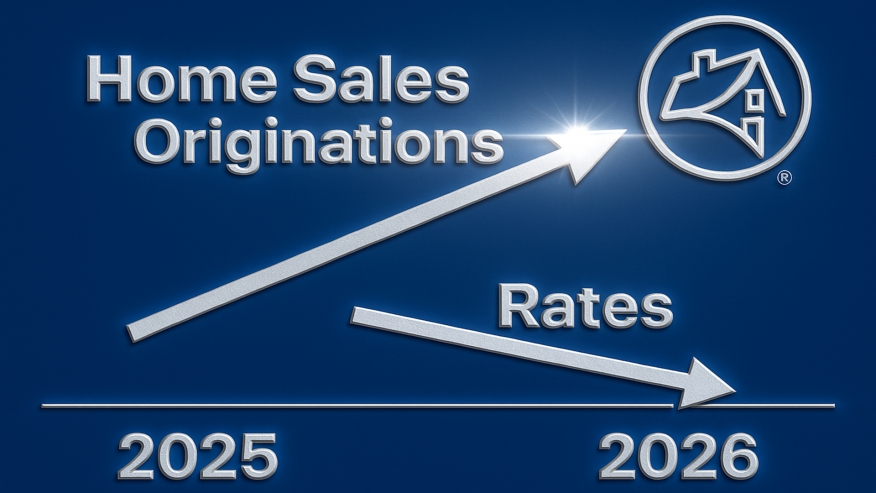
Fannie Mae has revised its projections upward for home sales this year, and now expects an additional 60,000 homes will be sold nationally — and 2026, meanwhile, could be markedly better.
The GSE is predicting single-family home sales will close out the year at 4.92 million units, with existing home sales accounting for 4.24 million of those, according to the May 2025 Economic and Housing Outlook from Fannie Mae’s Economic and Strategic Research Group. That total is up from 4.86 million units noted in the company’s April 2025 outlook.
Fannie Mae expects 2026 will see a significant boost. The company currently forecasts total home sales of 5.25 million for the year, with existing home sales making up 4.54 million of that figure.
That would mean 2025 will see a 3.6% increase in total homes sold and a 4.4% increase in existing home sales compared to last year, while 2026 would have another 6.8% increase over 2025 in total home sales and a 7.0% increase in existing home sales.
Lower Rates Are Primary Driver
The upward revisions come partly because Fannie Mae expects mortgage rates will be lower. The company forecasts rates will end 2025 at 6.1% and 2026 at 5.8%, which is down slightly from 6.2% and 6.0%, respectively, in the company’s April forecast.
Fannie Mae expects the 30-year fixed-rate mortgage rate will average 6.4% this year, and 5.9% in 2026. According to the May outlook projections, the GSE is now expecting higher mortgage origination totals.
Those will be $1.99 trillion for 2025 and $2.38 trillion for 2026, Fannie Mae predicts, which is up from the company’s April forecast of $1.98 trillion for 2025 and $2.33 trillion for 2026 — notably indicating a larger bump up for next year.
Home Price Appreciation To Ease
According to the Fannie Mae Home Price Index (HPI) which measures the average price change of single-family homes in the United States, this year will see home price growth of 4.1%, compared to growth last year of 5.3%.
For 2026, the company predicts house prices will rise an average of 2.0%.
In its latest economic outlook, Fannie Mae also forecasts:
- Gross domestic product (GDP) growth will be 0.7% for 2025 and 2.0% for 2026 on a fourth-quarter-to-fourth-quarter basis, which is up from 0.5% and 1.9%, respectively, in the prior forecast.
- The Consumer Price Index (CPI) will rise by 3.5% Q4/Q4 in 2025; that's unchanged from Fannie Mae’s April forecast. Core CPI is expected to rise 3.8% Q4/Q4 in 2025, down slightly from a 3.9% projection in April. Fannie Mae expects core CPI will increase by 2.6% in 2026, unchanged from its April forecast.