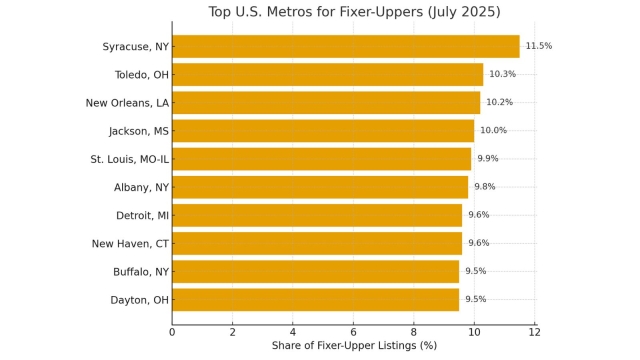
With housing affordability stretched to the breaking point, Americans are increasingly turning to an old-fashioned workaround: the fixer-upper.
A new analysis from Realtor.com shows homes marketed as “fixer-uppers” now draw 52% more page views per listing than comparable affordable homes, and searches for the term have tripled since 2021. The attraction is clear. The median price of a fixer-upper stands at $200,000 — a 54% discount from the $436,250 median for all single-family homes.
“Fixer-uppers give buyers a way to break into the housing market at a time when affordability is still stretched thin,” said Danielle Hale, chief economist at Realtor.com. “For those with the vision and a toolbox, fixer-uppers provide both a starting point in the market and the chance to create a home that’s truly their own.”
While these homes tend to be older, smaller, and slower to sell, the affordability gap has made them more appealing. In July 2025, there were just over 79,000 fixer-uppers on the market, up from 2021 but representing a smaller share of total listings than four years ago.
Five cities stood out for both abundance and price breaks — St. Louis, Detroit, Jackson, Miss., Toledo, Ohio, and Dayton, Ohio — where buyers can often pay less than half of what a move-in-ready property would cost. In Jackson, the median fixer-upper listing was $66,750, nearly 78% below the citywide average.
“Compared to four years ago, when rates were lower and homes were slightly more affordable, buyers today are showing more interest in fixer-uppers,” said Realtor.com economist Joel Berner. “For those willing to roll up their sleeves, sweat equity can be just as valuable as cash in hand.”
Home Flipping ROI Still Lags
Despite the surge in popularity, yesterday’s ATTOM report saw profit margins for professional flippers slipping, with ROI narrowing to levels not seen since before the housing crash. The two reports are about different slices of the “fixer-upper” universe, and reconciling them reveals an important nuance: demand for lower-cost, project-ready homes is strong, but the economics of flipping those same properties has grown far more precarious.
The affordability crunch has buyers looking for sweat-equity opportunities, yet high acquisition costs, labor shortages, and pricier materials are eroding the resale profits that once drew investors into the space.
The regional overlap is striking. Realtor.com identifies the Midwest and South as hotbeds of fixer-upper demand; ATTOM finds those same regions are where flippers still manage to eke out stronger returns. In the West, however, where prices are steepest, fixer-uppers are less forgiving — leaving investors squeezed and buyers with fewer bargains.
ATTOM CEO Rob Barber put it, “The latest numbers show that home flipping is still a money-maker, but the windfall gains investors were reaping a few years ago are just not there anymore.”
That tension underscores the split: fixer-uppers remain an entry point for stretched buyers, even as they lose luster as an easy profit play for seasoned investors.